How to Hide or Unhide Copilot Button on Windows 11

- 3 ways to do it
- Needs administrator rights
- Group Policy needs Windows 11 Pro, Enterprise or Education
- Includes a restart or sign-out
The Copilot button in Windows 11 version 23H2 and newer updates puts Microsoft’s AI helper right on your taskbar. Hiding this shortcut cleans up your screen and makes room for apps you use more often.
Turning off the button only removes the icon from your taskbar. It does not delete the AI tool from your PC. You can turn the shortcut back on at any time, and the simplest way is the Windows Settings app. This guide covers three methods: Settings, Local Group Policy Editor and Registry Editor. It also explains what happens with the dedicated Copilot key on newer laptops.
Open Settings, go to Personalization, then Taskbar, and toggle the Copilot (preview) switch to Off to hide or On to show it. Alternatively, use the Group Policy Editor or Registry Editor for more advanced control.
Why hide or show the Copilot button?
Removing the icon gives you a cleaner taskbar when you don’t use the AI features. Restoring the button brings back one-click access to Copilot whenever you need it.
If the Copilot button isn’t on your taskbar at all, check your version first. Go to Settings System About and look under Windows specifications. The button needs version 23H2 or newer, or a PC with the latest updates installed. On older builds there is nothing to hide.
What happens when done?
Once you finish the steps in any method below, the Copilot icon appears on or disappears from your taskbar, depending on what you chose. With the Settings method the change is immediate. The Group Policy and Registry methods may need a restart or a fresh sign-in before you see the result.
Pick the method that fits your PC. Settings works on every edition, including Home. Group Policy needs Windows 11 Pro, Enterprise or Education. The Registry method works on every edition, but it is the one where a typo costs you the most, so follow it carefully.
Method 1Using Windows Settings
You can hide the Copilot button through the built-in Settings app without touching any advanced system tools. In short: open Settings, go to Personalization, click Taskbar, and turn off the toggle next to Copilot. The icon leaves your taskbar right away. This method only affects your own account and needs no administrator rights.
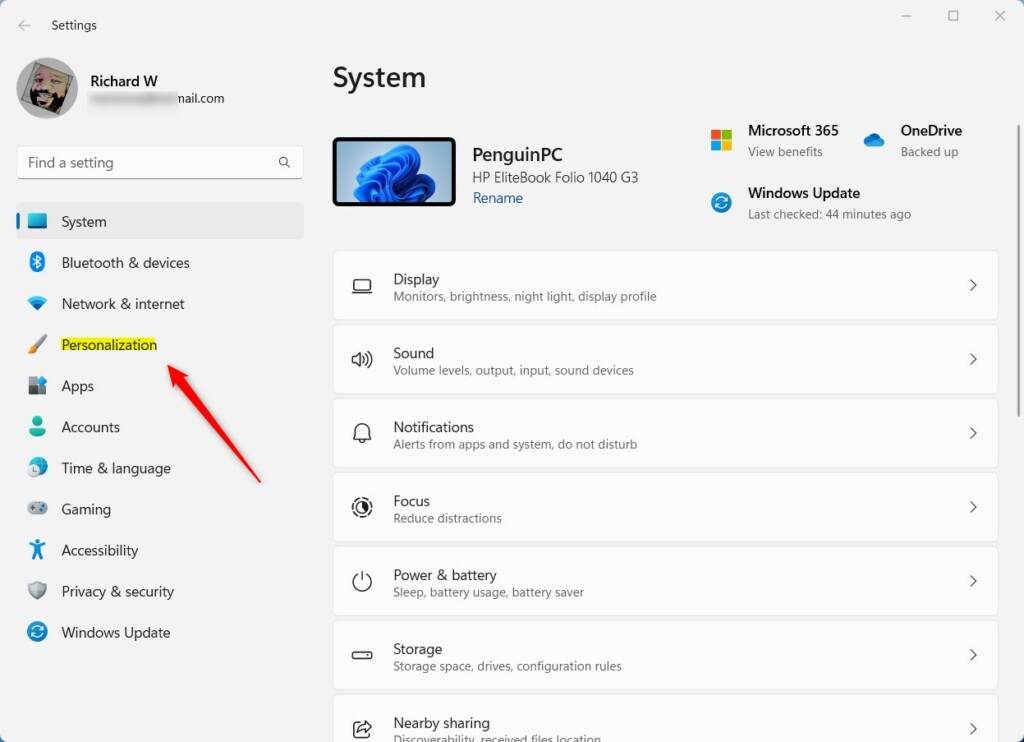
- Open the Windows Settings app. Click the Start menu and select Settings, or press the Win+I. The Settings window opens with a list of categories on the left.
- Click Personalization in the left menu. The personalization options for backgrounds, colors and themes appear on the right.
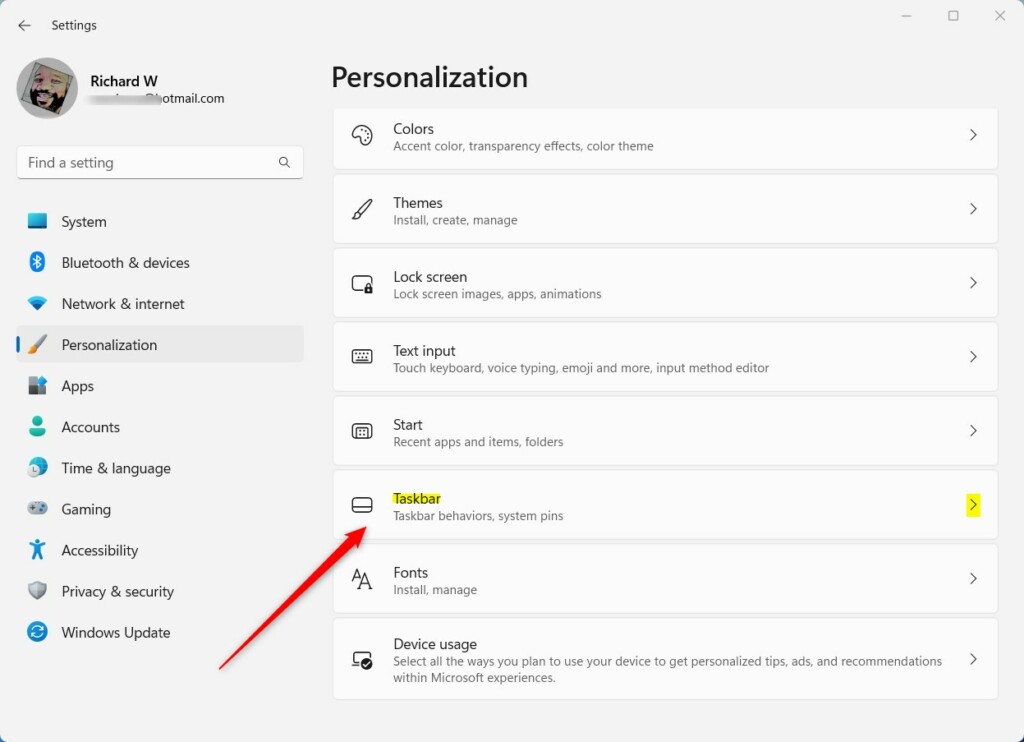
- Click the Taskbar tile on the right side. You may need to scroll down to find it. The taskbar page opens and starts with a list called Taskbar items.
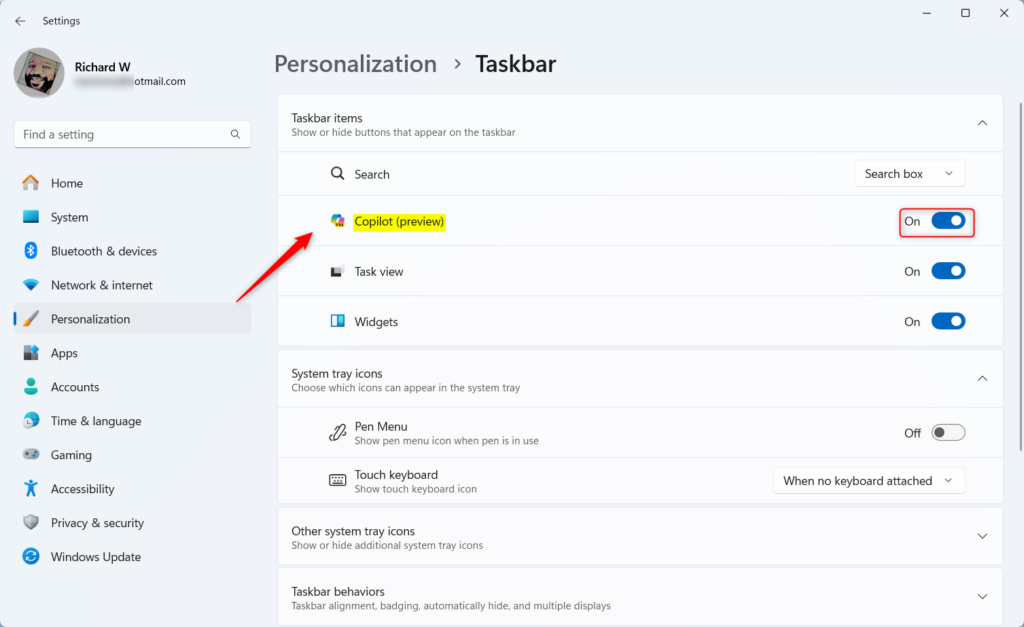
- Look for Copilot (preview) in the taskbar items list. Set the switch to On to show the button, or Off to hide it. The icon appears or disappears from the taskbar straight away. On some newer builds the label may read just Copilot without “(preview)”.
Method 2Using Local Group Policy Editor
You can hide the Copilot button for every user account on your computer at once using the Local Group Policy Editor, a built-in tool for managing system configuration. This method works best if you manage several accounts on the same Windows 11 PC and want to turn off the AI assistant for everyone.
This method does not work on Windows 11 Home. Home does not include the Local Group Policy Editor, so use the Settings method or the Registry method instead. You also need to be signed in with an administrator account.
The Local Group Policy Editor handles this configuration control. Search for “Edit group policy” in your Start menu and open the Local Group Policy Editor. The editor opens with a folder tree on the left and the settings for the selected folder on the right. This tool lets you change advanced settings, so only change the one setting described here.

- On the left side, go to Computer Configuration Administrative Templates Start Menu and Taskbar. Click the folder name and its settings are listed in the right pane.
- Find Hide the Copilot button in the right pane and double-click it. A window for that policy opens with three options: Not Configured, Enabled and Disabled. If you can’t find the policy, your Windows build may not include it or may word it differently, so use the Settings method instead.
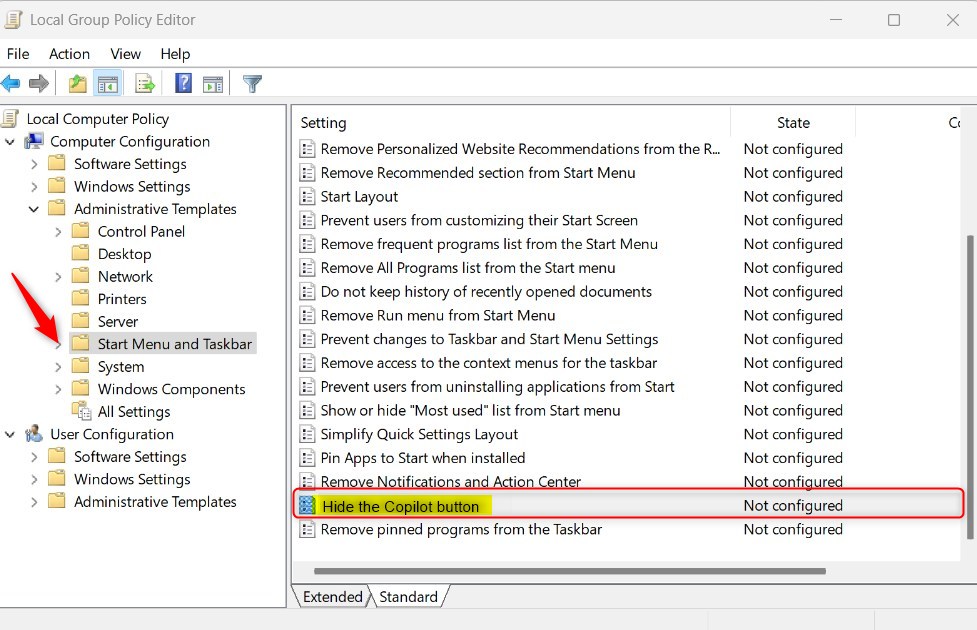
- Choose Enabled to hide the button, or Disabled to show it. To go back to the default behavior and let each user decide, choose Not Configured.
- Click OK and close the editor. The change may not show until you restart the PC or sign out and back in.
Method 3Using the Registry Editor
You can hide the Copilot button by editing the Windows Registry, a database for low-level system settings, if the Settings app does not work for you. It also works on Windows 11 Home. This approach creates a specific registry value that forces the button off for your Windows 11 user profile.
A wrong change in the registry can cause problems. Before you start, consider making a restore point or exporting the key you are about to edit (File Export in the Registry Editor). Only follow the steps below.
The Windows Registry editor allows you to change settings for your computer. Open it by searching for “regedit” in the Start menu and selecting the result. Click Yes if Windows asks whether you want to allow the app to make changes. Then navigate to the 🗝️HKEY_CURRENT_USER\
To hide the Copilot button, you first create the Explorer key if it is missing. Right-click the Win (the folder in the left pane), select New, then Key, and name the new key Explorer. This step makes sure the location exists for the value you add next. If an Explorer key is already there, skip this step and click it instead.
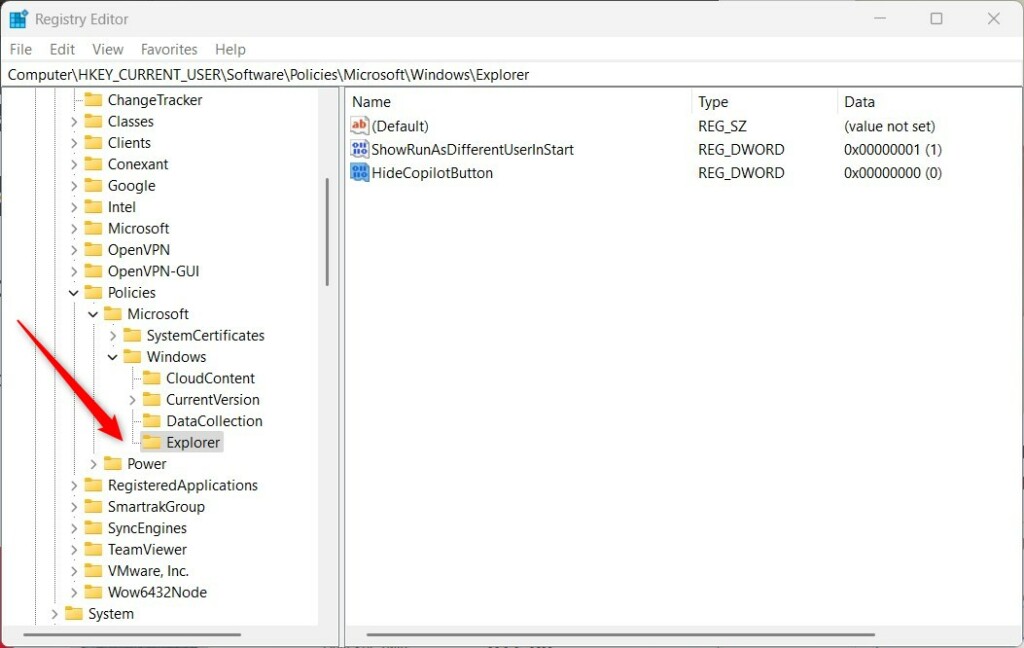
- With the correct key selected, right-click in the empty space on the right side and select New String Value. A new item appears in the right pane with its name ready to edit.
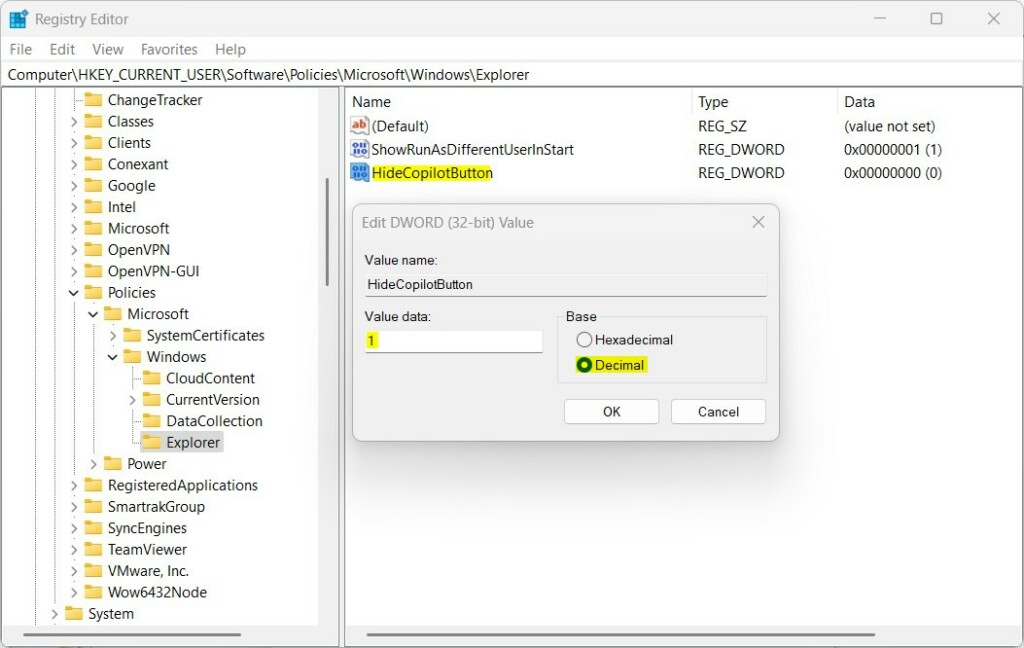
- Name the new item
ShowCopilotButton. Press Enter to confirm the name. - Double-click
ShowCopilotButtonand set the “Value data” to 1 to hide the button. Click OK to save it. - To show the button again, delete the
ShowCopilotButtonitem. Right-click it, select Delete, and confirm.
Restart your computer to apply the changes. This applies mainly to the Registry and Group Policy methods. After the restart, check the taskbar. The Copilot icon should be gone if you hid it, or back if you restored it. The Settings toggle does not need a restart.
Understanding the Physical Copilot Keyboard Key
Newer laptops have a dedicated Copilot hardware key. This key launches the AI assistant instantly. Hiding the taskbar button does not change what the key does, so disabling the software component may still leave the key opening the app or showing a notification. Third-party software is required to remap the physical key.
Summary
Several methods exist for managing the Copilot button on your Windows 11 taskbar. The Settings app is the quickest and works on every edition. The Group Policy Editor suits Pro, Enterprise and Education PCs where you want to apply the change to all users. The Registry Editor works on any edition for fine-tuning. Each method lets you hide or show the icon depending on your needs, and each one can be reversed with the same steps.
Have a question about this guide?
Answered by AI from this guide. Good questions may be added to this page — please don't include personal details.
Did this guide fix your problem?

About the Author
Richard
Tech Writer, IT Professional
Richard is a writer at Geek Rewind who turns complex IT tasks into clear, step-by-step guides. He draws on years of hands-on experience in system administration and enterprise IT operations, focusing on Windows, Linux and WordPress: the problems people actually run into, and the fixes that work. His server and WordPress guides come from systems he runs himself. Richard builds and maintains the platform behind Geek Rewind, from its Ubuntu servers and Nginx configuration to its custom WordPress plugins. Many new tutorials start with readers' questions, and he's always glad to answer them in the comments.
[…] computers that have Copilot added, a new Copilot button will appear on the Taskbar. It will appear as a flyout interface when you press the button or use the keyboard shortcut […]
[…] computers that have Copilot added, a new Copilot button will appear on the Taskbar. It will appear as a flyout interface when you press the button or use the keyboard shortcut […]
[…] computers that have Copilot added, a new Copilot button will appear on the Taskbar. Clicking the button or using the keyboard shortcut (Windows key + C) will appear as a flyout […]
[…] computers that have Copilot added, a new Copilot button will appear on the Taskbar. Clicking the button or using the keyboard shortcut (Windows key + C) will appear as a flyout […]
[…] computers that have Copilot added, a new Copilot button will appear on the Taskbar. Pressing the button or using the keyboard shortcut (Windows key + C) will appear as a flyout […]
[…] can use a passkey to sign in to Microsoft apps and websites, including Microsoft 365 and Copilot on desktop and mobile browsers. On your Microsoft account sign-in screen, use your passkey by […]
[…] computers that have Copilot added, a new Copilot button will appear on the Taskbar. Clicking the button or using the keyboard shortcut (Windows key + C) will appear as a flyout […]
[…] computers that have Copilot added, a new Copilot button will appear on the Taskbar. Clicking the button or using the keyboard shortcut (Windows key + C) will appear as a flyout […]
[…] computers that have Copilot added, a new Copilot button will appear on the Taskbar. Clicking the button or using the keyboard shortcut (Windows key + C) will appear as a flyout […]
[…] computers that have Copilot added, a new Copilot button will appear on the Taskbar. Clicking the button or using the keyboard shortcut (Windows key + C) will appear as a flyout […]
[…] computers that have Copilot added, a new Copilot button will appear on the Taskbar. Clicking the button or using the keyboard shortcut (Windows key + C) will appear as a flyout […]
[…] computers that have Copilot added, a new Copilot button will appear on the Taskbar. Clicking the button or using the keyboard shortcut (Windows key + C) will appear as a flyout […]
[…] computers that have Copilot added, a new Copilot button will appear on the Taskbar. Clicking the button or using the keyboard shortcut (Windows key + C) will appear as a flyout […]
[…] computers that have Copilot added, a new Copilot button will appear on the Taskbar. Clicking the button or using the keyboard shortcut (Windows key + C) will appear as a flyout […]
[…] computers that have Copilot added, a new Copilot button will appear on the Taskbar. Clicking the button or using the keyboard shortcut (Windows key + C) will appear as a flyout […]
[…] computers that have Copilot added, a new Copilot button will appear on the Taskbar. It will appear as a flyout interface when you press the button or use the keyboard shortcut […]
[…] is launching the new Copilot experience that works with Bing Chat AI. It lets you use plain language to change settings or complete tasks. […]