How to Customize Windows 11 Taskbar Settings


Taskbar customization in Windows 11 changes how the bar at the bottom of your screen looks and behaves. You can move your app icons back to the left side, hide the bar automatically when you do not need it, and turn off system tray items you never use. All of these options live in one place, Settings Personalization Taskbar, and they work the same on Windows 11 Home and Pro. Changes apply right away, so you can switch any of them back if you do not like the result.
Adjust taskbar alignment by going to Settings Personalization Taskbar Taskbar behaviors, then select Left or Center for Taskbar alignment. You can also hide or show taskbar items like Search and Widgets from this same menu.
Taskbar Alignment: Left vs. Center
By default, Windows 11 centers your taskbar icons. If you prefer the classic layout from Windows 10 and earlier, with the Start button in the bottom-left corner, you can move the icons back to the left. The change only affects the layout. Your pinned apps and their order stay the same.
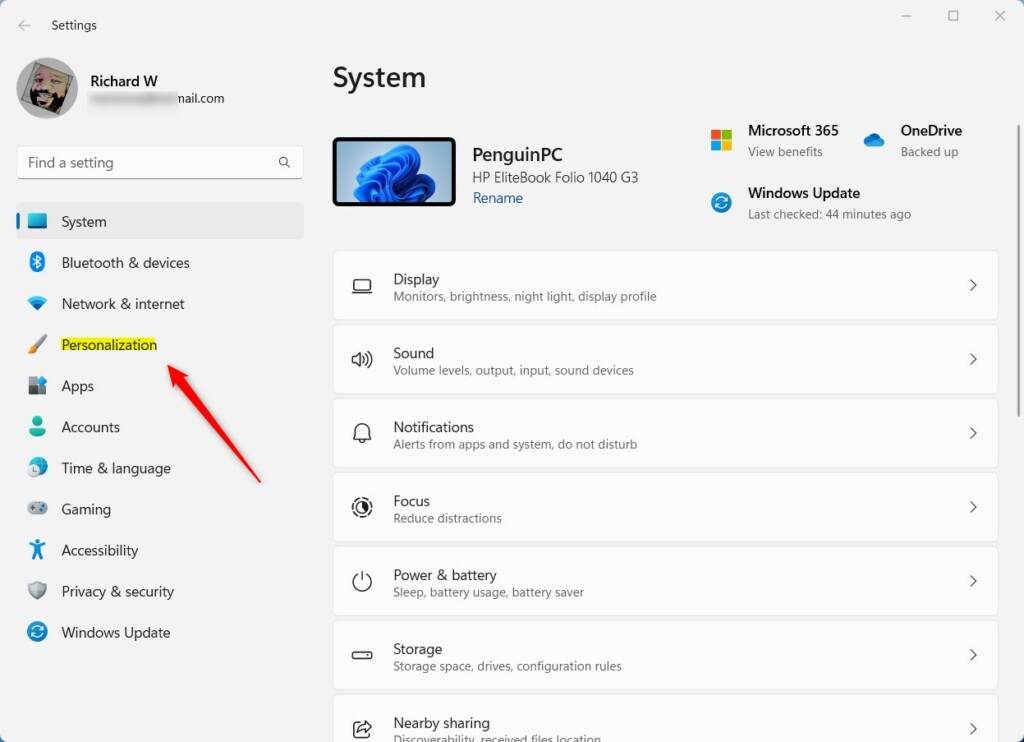
- Open Settings. The quickest way is to press the Win+I. You can also right-click the Start button and pick Settings.
- Go to Settings Personalization Taskbar You should see the taskbar options, with several sections you can expand or collapse.
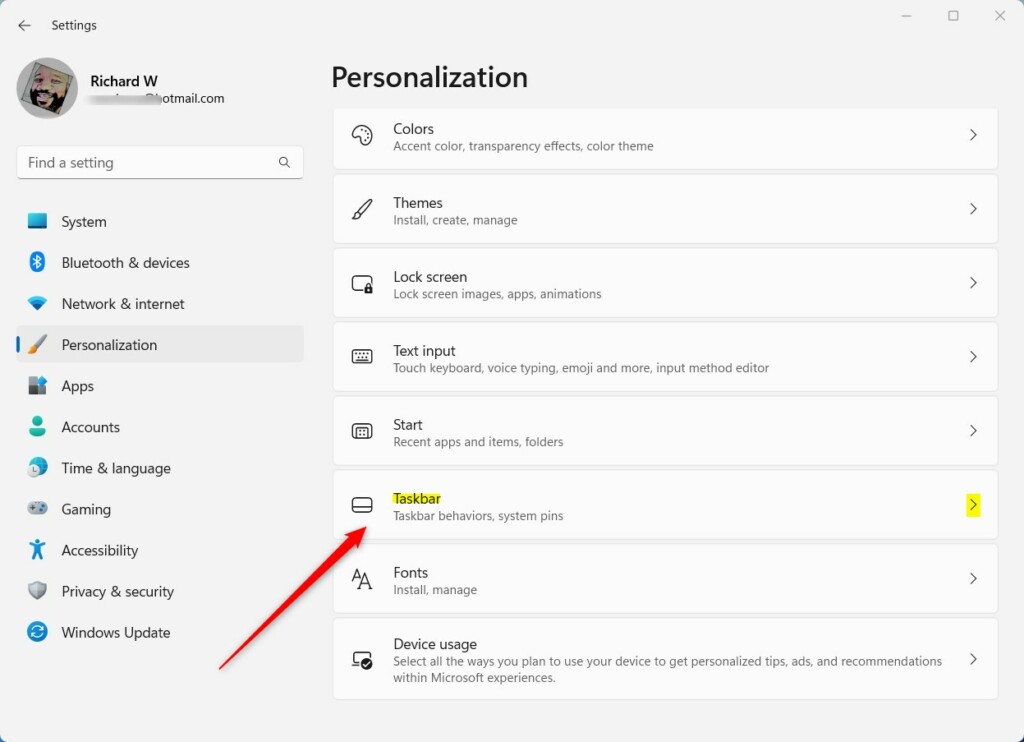
- Click Taskbar behaviors. The section expands and shows a list of options below it.
- Find Taskbar alignment and choose Left or Center from the drop-down. The icons and the Start button move as soon as you pick one.
To undo the change, return to the same drop-down and choose Center. While you are in Taskbar behaviors, you can also turn on Automatically hide the taskbar . The bar then slides out of view and comes back when you move the pointer to the bottom edge of the screen.
Managing Taskbar Behaviors and Buttons
Windows 11 taskbar settings let you change how your app buttons behave, including whether icons combine into a single button or show text labels. This matters most if you keep many windows of the same app open, because grouped icons make it harder to tell windows apart. You adjust these options under Settings Personalization Taskbar, in the Taskbar behaviors section. There you can also control notification badges to fit how you work.
The Combine taskbar buttons and hide labels setting was added in later Windows 11 updates. On an early build of Windows 11 (the original 21H2 release, for example) you will not find it, and buttons are always combined. Run Windows Update and check again. If the option is greyed out or missing on a work PC, an administrator may be managing the taskbar through policy.
- Go to Settings Personalization Taskbar
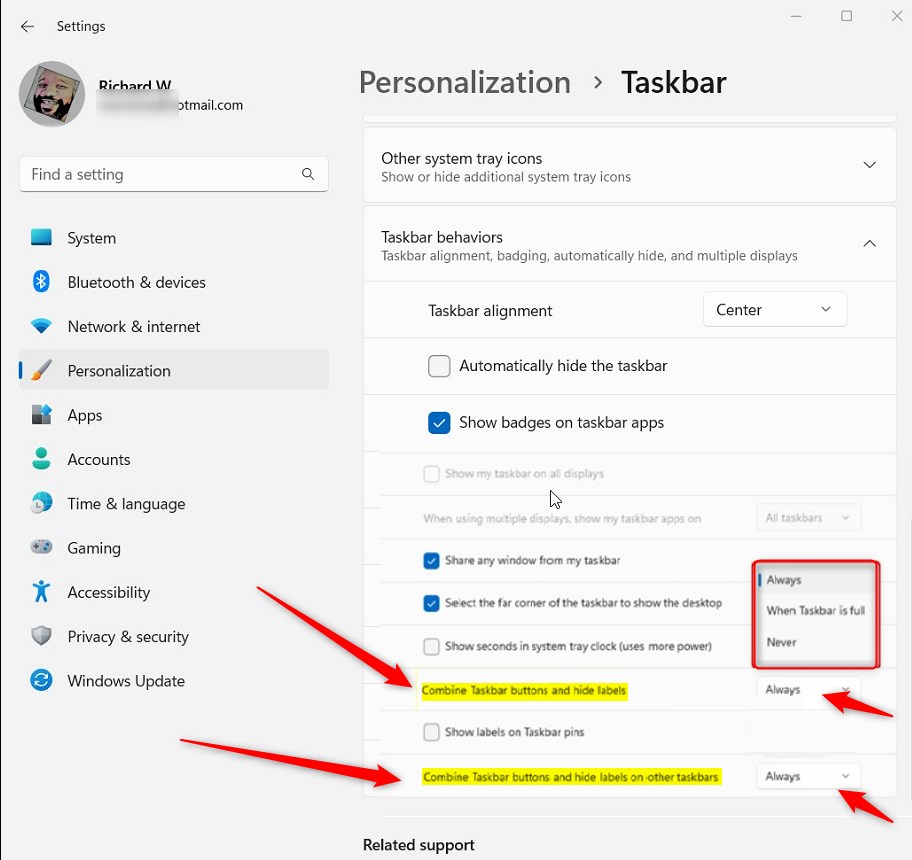
- Select Taskbar behaviors to expand the list of options.
- Open the drop-down next to Combine taskbar buttons and hide labels and pick one of the three choices. The taskbar updates as soon as you select one, so you can try each and compare.
Here is what each choice does:
- Always: Icons are grouped together to save space. Each app gets one button, however many windows it has open.
- When taskbar is full: Icons group only when you have many apps open. Until then, each window keeps its own button.
- Never: Each window shows its own label, making it easy to see every open app. On a small screen with many windows, the taskbar can fill up and start scrolling.
To go back to the default, set the drop-down to Always.
System Tray and Notification Area
The Windows 11 system tray sits at the bottom right of your screen to show the clock, battery, volume, and background app icons. Over time, installed software adds icons here that you rarely need. You can manage which ones appear under Settings Personalization Taskbar From there, you can toggle specific app icons on or off so your taskbar stays clean and uncluttered. Turning an icon off here does not close the app. It only stops showing the icon in the tray area.
- Go to Settings Personalization Taskbar
- Click Other system tray icons to expand the list. You should see each app that can place an icon in the tray, with a toggle beside it. Switch an app on or off to show or hide its icon.
- Use the System tray icons menu to hide or show the volume, network, or input indicators. Which items appear in this menu depends on your Windows 11 version and your hardware. Some builds list only items such as the pen menu, touch keyboard, or virtual touchpad.
If an app's icon is not in the list, the app may not have started yet or may not support a tray icon. You can also click the small arrow in the tray to see hidden icons. To undo a change, switch the toggle back on.
Widgets and Search Customization
If you never use the Search, Widgets, or Chat buttons, you can hide them and clear the clutter from the interface. Hiding a button only removes it from the taskbar. The feature itself stays installed, and you can bring the button back at any time.
- Open Settings Personalization Taskbar
- Under Taskbar items, toggle the switches for Search, Widgets, and Chat to Off. Each button disappears from the taskbar as soon as you flip its switch.
The exact list depends on your build. On newer versions of Windows 11, Search is a drop-down rather than a switch, so pick the option that hides it. The Chat button has been removed from recent builds, so you may not see it at all. Other items, such as Task View, may appear in this list instead. To restore a button, turn its switch back on.
Advanced Registry Tweaks
Advanced Windows 11 taskbar settings can be changed using the Registry Editor (a hierarchical database for storing system settings) when standard menus do not offer the options you need. You can open this tool by pressing the Windows key plus R, typing regedit, and pressing Enter. If Windows asks for permission, click Yes. This lets you target specific database values to force custom layouts that are normally hidden.
Be careful here. A wrong edit can cause problems, and some registry tweaks stop working after a Windows update. Before you change anything, back up the key you plan to edit. In Registry Editor, select it and choose File Export
Target specific values within the database to force custom layouts.
In the left pane of Registry Editor, navigate to: HKEY_CURRENT_USER\Software\Microsoft\Windows\CurrentVersion\Explorer\Advanced
Create a new DWORD (32-bit) value named `TaskbarSi`. To do this, right-click an empty area in the right pane, choose New DWORD (32-bit) Value, and type the name. Then double-click it and enter a value of 0, 1, or 2.
One correction to the original wording: TaskbarSi is generally documented as the setting for taskbar icon size (0 for small, 1 for medium, 2 for large), not for button grouping. For grouping, use the Combine taskbar buttons and hide labels setting described earlier. Its behavior can also vary between Windows 11 builds.
Changes to this value usually take effect after you restart Windows Explorer or sign out and back in. To undo the change, delete the value you created or restore the registry backup you exported.

Summary
Tweaking these preferences tailors the workspace to personal preference. Start with the options in Settings, since they are safe and easy to reverse, and use the Registry Editor only when Settings does not offer what you need.
Have a question about this guide?
Answered by AI from this guide. Good questions may be added to this page — please don't include personal details.
Did this guide fix your problem?

About the Author
Richard
Tech Writer, IT Professional
Richard is a writer at Geek Rewind who turns complex IT tasks into clear, step-by-step guides. He draws on years of hands-on experience in system administration and enterprise IT operations, focusing on Windows, Linux and WordPress: the problems people actually run into, and the fixes that work. His server and WordPress guides come from systems he runs himself. Richard builds and maintains the platform behind Geek Rewind, from its Ubuntu servers and Nginx configuration to its custom WordPress plugins. Many new tutorials start with readers' questions, and he's always glad to answer them in the comments.
[…] than one monitor, you can show the Taskbar on all your monitors. You can also turn on or off “never combined mode” so your taskbar items do not group […]