How to Change Foreground Flash Count for Windows 11 Taskbar Apps

Foreground flash count in Windows 11 controls how many times an app icon blinks on your taskbar when an application needs your attention. By default, Windows 11 makes the icon blink 7 times and then leaves it highlighted.
You can change this number in the Registry Editor (a tool for changing low-level system settings). The allowed range is 0 to 4,294,967,295. Setting it to 0 makes the icon blink continuously until you click it. A low number cuts down on distracting visual alerts. A high number or 0 helps you avoid missing an important message.
Open Registry Editor (regedit), go to 🗝️HKEY_CURRENT_USER\
How to Change the Taskbar Flash Count via Registry Editor
You change the foreground flash count by editing one value in the Registry Editor (a tool that lets you change deep system settings). This controls exactly how many times an app icon flashes on your taskbar when it wants your attention.
You need to be signed in with an account that can approve administrator prompts. The value sits under the current user’s settings, so the change applies only to your account, not to other users on the PC. This works the same on Windows 11 Home and Pro. If you want a safety net, open the Registry Editor and use File Export to save a backup of the key first. To undo the change later, repeat the steps below and set the value back to 7.
- Press
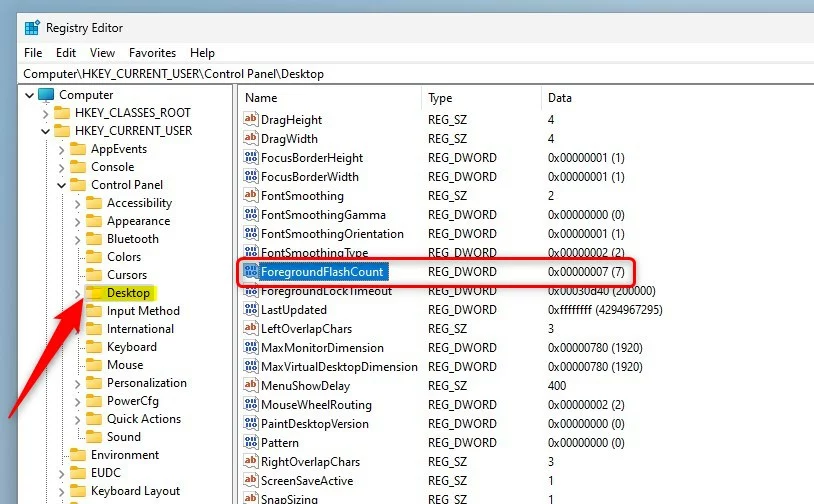
Win + R, typeregedit, and press Enter to open the Registry Editor. If Windows shows a User Account Control prompt, click Yes. The Registry Editor window opens, with a folder tree on the left and values on the right. - Navigate to the following path:
HKEY_CURRENT_USER\Control Panel\DesktopYou can expand the folders in the left pane one by one, or paste the path into the address bar at the top of the window and press Enter. When you reach the last folder, its values appear in the right pane. - Locate the
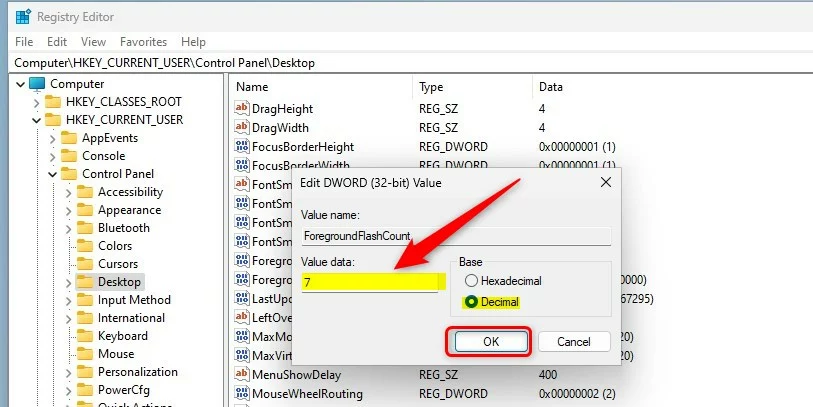
ForegroundFlashCountDWORD value on the right side. If you don’t see it, it has not been set on your PC. Right-click an empty area of the right pane, choose New DWORD (32-bit) Value, and name itForegroundFlashCountexactly, then press Enter. - Double-click the value. In the Edit DWORD (32-bit) Value window, select Decimal under Base, then type your preferred number in the Value data box. For example, enter 3 for three blinks, or 0 for continuous blinking until you click the icon.
- Click OK. The new number now shows in the Data column. Close the Registry Editor, then restart your computer or sign out and back in. The change does not take effect until you do.
Advanced Configuration: Group Policy and Win32 API
The setting is stored per user, so it has to be deployed to user accounts rather than to the machine. Test it on one PC before rolling it out to everyone. Developers, on the other hand, can use the Win32 API (the set of functions Windows exposes to programs) to make an app's window flash.
C# Implementation Example
Developers can trigger a window flash using the following code snippet:
using System.Runtime.InteropServices;
[DllImport("user32.dll")]
static extern bool FlashWindowEx(ref FLASHWINFO pwfi);
// Implementation logic goes here
Summary
Changing ForegroundFlashCount in Windows 11 lets you decide how often apps flash on your taskbar to get your attention. Set a low number if the blinking distracts you, or set it to 0 for constant flashing so you never miss an alert. If you don't like the result, edit the value again and set it back to 7, the default, then sign out and back in.
Have a question about this guide?
Answered by AI from this guide. Good questions may be added to this page — please don't include personal details.
Did this guide fix your problem?

About the Author
Richard
Tech Writer, IT Professional
Richard is a writer at Geek Rewind who turns complex IT tasks into clear, step-by-step guides. He draws on years of hands-on experience in system administration and enterprise IT operations, focusing on Windows, Linux and WordPress: the problems people actually run into, and the fixes that work. His server and WordPress guides come from systems he runs himself. Richard builds and maintains the platform behind Geek Rewind, from its Ubuntu servers and Nginx configuration to its custom WordPress plugins. Many new tutorials start with readers' questions, and he's always glad to answer them in the comments.
No comments yet — be the first to share your thoughts!