How to Change Narrator Voice in Windows 11


- 11 steps
- Needs administrator rights
Changing the Narrator voice in Windows 11 lets you pick a different sound for Narrator, the built-in screen reader that reads on-screen text aloud. Windows offers natural voices (speech profiles that sound far less robotic), such as Microsoft Aria. You can also adjust the speed, pitch and volume to suit how you listen.
You make the change in the Narrator settings. If the voice you want isn’t installed yet, you can download it there. No special account or administrator rights are needed.
Natural voices need Windows 11 version 22H2 or later, plus the language pack for the voice’s language. Check under Settings System About that you are on a currently supported version (25H2 or 26H2). Version 23H2 is out of support.
To customize the Narrator voice in Windows 11, press Win+I, click Accessibility, then select the Narrator tile under Vision. Under Choose a voice, pick a profile such as Microsoft Aria, then adjust speed, pitch and volume with the sliders. The change applies immediately, and no administrator rights are needed.
How to Change Narrator Settings
The speed, pitch and volume controls sit next to the voice choice, and you can test each change right away. If Narrator isn’t running, press Win+Ctrl+Enter to turn it on so you can hear your changes as you make them. Press the same keys again to turn it off.
There is also a shortcut. Press Win+Ctrl+N to open the Narrator settings directly, which skips the first four steps below. When Narrator starts, it can also show Narrator Quick Start (a short introduction) and the Narrator home window. Both give you a quicker route to the voice settings.
- Press Win+I to open Settings. The Settings window opens, usually on the System page.
- Click Accessibility in the left-hand menu. The accessibility options appear on the right.
- Scroll to the Vision group and click the Narrator tile.

- Select the Narrator tile if the Narrator page hasn’t opened yet. The Narrator on/off switch appears at the top, with more options below it.

- Scroll down to the Choose a voice section. This is where the voice, speed, pitch and volume controls are.
If you don’t see this section, check that your Windows 11 is up to date. Older builds lay out the Narrator page differently, and the natural voices arrived with the 22H2 release. If the page still looks different, confirm your version under Settings System About.
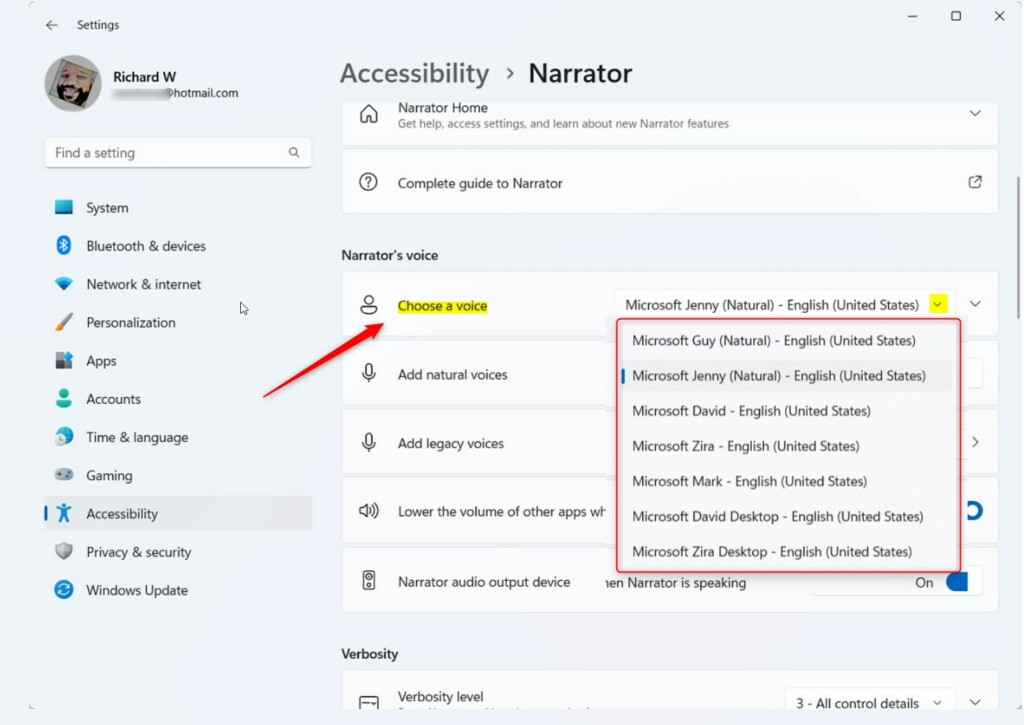
- Open the Choose a voice menu. It lists the speech profiles installed on your PC.
- Pick a voice from the list. Narrator switches to it straight away, so you hear the change in the new voice.
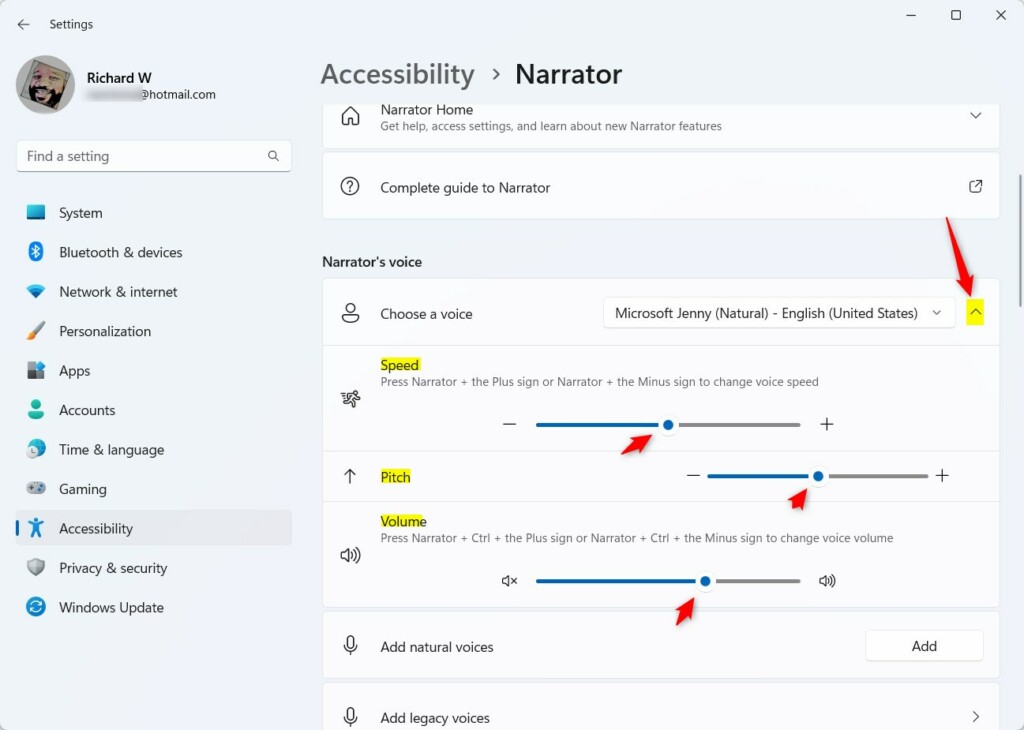
- Adjust the pitch and reading speed until the output is comfortable to listen to. Each slider changes Narrator’s speech as you move it.
That’s it. Narrator now reads with the voice you chose, at the speed and pitch you set.
If the voice you want isn’t in the list, you can download it from the same section. Natural voices are large files, so keep the PC online until the download finishes. Once downloaded, they work without an internet connection.
- In the same section, select the option to add natural voices. Windows shows the voices available to download.
- Pick the voice you want. Windows starts the download. Give it a minute and keep the PC online.
- When the download finishes, open the Choose a voice menu again and select the new voice.
You should now have the new voice installed and active. If it doesn’t download, make sure the language pack for that voice’s language is installed.
- SpeedMove the slider to make the voice faster or slower. You can also use the keyboard shortcut
Narrator + Plus signorNarrator + Minus sign. - PitchMove the slider to change how high or low the voice sounds.
- VolumeMove the slider to make the voice louder or quieter. You can also use the keyboard shortcut
Narrator + Page UporNarrator + Page Down.
To undo a change, open the same menu and choose your previous voice. Move the sliders back to where they were if you don’t like the new pitch or speed.
Natural Voices and Language Packs
Windows Narrator vs. AI Voice Generators
Narrator is a real-time screen reader built for accessibility. AI voice generators serve a different purpose, because they are made for content creators. Narrator reads out what is happening on your desktop as you work, while a generator turns a written script into an audio file for media production. Don’t expect Narrator to export audio for a video or podcast.
Troubleshooting Narrator Voice Issues
If you can’t hear Narrator at all, or it sounds wrong, the cause is usually the playback device. Windows may be sending audio to the wrong output, such as a monitor with no speakers or a disconnected headset.
To check, open Settings System Sound and look at which device is selected under Output. Choosing a device there also makes it the default. For a quicker check, select the Speakers icon on the taskbar, then the arrow beside the volume slider to list your audio devices.
Also make sure the volume isn’t muted. Narrator’s own volume slider is separate from the main Windows volume, so check both.
Related Topics
Summary
Changing the Narrator settings lets you tailor Windows 11 to the way you work. Adjusting speed, pitch and volume improves accessibility, and none of it needs administrator permissions. The changes apply immediately without a restart or sign-out, and you can reverse any of them from the same settings page.
How do I change the Narrator voice speed in Windows 11?
Can I add new voices to Windows Narrator?
Frequently asked questions
How to increase speech rate in narrator iwth shortcut?
Press the Narrator key with the Plus sign (+) to make Narrator read faster. Each press raises the speed a little. Press the Narrator key with the Minus sign (-) to slow it down. For an exact setting, open Settings, go to Accessibility, select Narrator, and move the Speed slider under Choose a voice.
What numbers are the best for Windows narrator voice settings?
No single number works best for everyone. Start near the middle of the speed and pitch sliders, then adjust until the voice is easy to follow. Each slider changes Narrator's speech as you move it, so you can test settings right away.
How to change Windows voice?
Open Settings with Win+I, select Accessibility, scroll to the Vision group, and click Narrator. Under Choose a voice, pick a voice from the list, and Narrator switches to it straight away. Natural voices need Windows 11 version 22H2 or later.
Still have a question?
Answered by AI from this guide. Good questions may be added to this page — please don't include personal details.
Did this guide fix your problem?

About the Author
Richard
Tech Writer, IT Professional
Richard is a writer at Geek Rewind who turns complex IT tasks into clear, step-by-step guides. He draws on years of hands-on experience in system administration and enterprise IT operations, focusing on Windows, Linux and WordPress: the problems people actually run into, and the fixes that work. His server and WordPress guides come from systems he runs himself. Richard builds and maintains the platform behind Geek Rewind, from its Ubuntu servers and Nginx configuration to its custom WordPress plugins. Many new tutorials start with readers' questions, and he's always glad to answer them in the comments.
[…] app, you can turn on or off its keyboard shortcuts, launch it automatically, adjust the voice, speed, and volume, manage natural voices, and […]
[…] use the Narrator app, you can turn on or off its keyboard shortcuts, launch it automatically, adjust the voice, speed, and volume, manage natural voices, lower other apps volume when Narrator is speaking, and […]
[…] use the Narrator app, you can turn on or off its keyboard shortcuts, launch it automatically, adjust the voice, speed, and volume, manage natural voices, lower other apps volume when Narrator is speaking, change Narrator audio […]
[…] use the Narrator app, you can turn on or off its keyboard shortcuts, launch it automatically, adjust the voice, speed, and volume, manage natural voices, lower other apps volume when Narrator is speaking, change Narrator audio […]
[…] use the Narrator app, you can turn on or off its keyboard shortcuts, launch it automatically, adjust the voice, speed, and volume, manage natural voices, lower other apps volume when Narrator is speaking, change Narrator audio […]
[…] use the Narrator app, you can turn on or off its keyboard shortcuts, launch it automatically, adjust the voice, speed, and volume, manage natural voices, lower other apps volume when Narrator is speaking, change Narrator audio […]
[…] use the Narrator app, you can turn on or off its keyboard shortcuts, launch it automatically, adjust the voice, speed, and volume, manage natural voices, lower other apps volume when Narrator is speaking, change Narrator audio […]
[…] use the Narrator app, you can turn on or off its keyboard shortcuts, launch it automatically, adjust the voice, speed, and volume, manage natural voices, lower other apps volume when Narrator is speaking, change Narrator audio […]
[…] use the Narrator app, you can turn on or off its keyboard shortcuts, launch it automatically, adjust the voice, speed, and volume, manage natural voices, lower other apps volume when Narrator is speaking, change Narrator audio […]
[…] use the Narrator app, you can turn on or off its keyboard shortcuts, launch it automatically, adjust the voice, speed, and volume, manage natural voices, lower other apps volume when Narrator is speaking, change Narrator audio […]
[…] use the Narrator app, you can turn on or off its keyboard shortcuts, launch it automatically, adjust the voice, speed, and volume, manage natural voices, lower other apps volume when Narrator is speaking, change Narrator audio […]
[…] use the Narrator app, you can turn on or off its keyboard shortcuts, launch it automatically, adjust the voice, speed, and volume, manage natural voices, lower other apps volume when Narrator is speaking, change Narrator audio […]
[…] app, you can turn on or off its keyboard shortcuts, launch it automatically, adjust the voice, speed, and volume, manage natural voices, lower other apps volume when Narrator is speaking, change […]
[…] Change the voice, speed, and volume […]
[…] Change the voice, speed, and volume […]
[…] Change the voice, speed, and volume […]
[…] Change the voice, speed, and volume […]
[…] Change voice, speed, and volume […]
[…] Change how fast or loud the Narrator’s voice sounds […]