How to Enable Email Forwarding in Outlook for Windows 11

Email forwarding in Outlook for Windows 11 sends incoming messages automatically to another address, so you don’t miss important mail. Both the new Outlook app and Classic Outlook can do this. Many work and school accounts block automatic forwarding, because it can move company data outside the organization. If an option is missing or greyed out, that is the first thing to suspect.
Open the new Outlook app and click the Settings gear icon Mail Forwarding. Switch Enable forwarding to On, enter your destination email address, and click Save. For Classic Outlook, use Home > Rules Manage Rules & Alerts to create a forwarding rule instead.
New Outlook vs. Classic Outlook
The new Outlook app has a forwarding switch in its settings. Classic Outlook has no such switch, so you build a message rule instead. If you’re not sure which one you have, look for a New Outlook toggle in the top right of the window. The toggle appears in Classic Outlook, and the new app doesn’t show it in the same way.
How to Enable Forwarding in New Outlook
In the new Outlook app, forwarding is a single setting in your account options. Turn it on and every incoming message goes to the address you choose. Follow these steps in order.
- Open the new Outlook for Windows app and sign in to the account you want to forward from.

- Click the Settings gear icon in the top right corner. The Settings window opens.

- Go to Mail Forwarding The forwarding options for the selected account appear on the right.
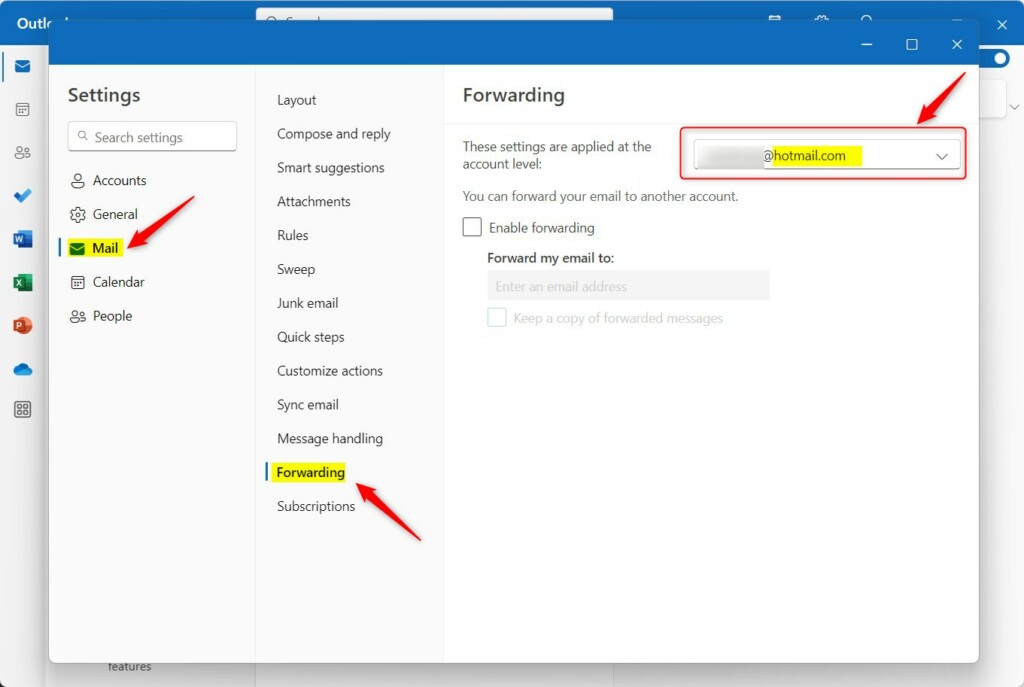
- Switch Enable forwarding to On. An address field appears below the switch.
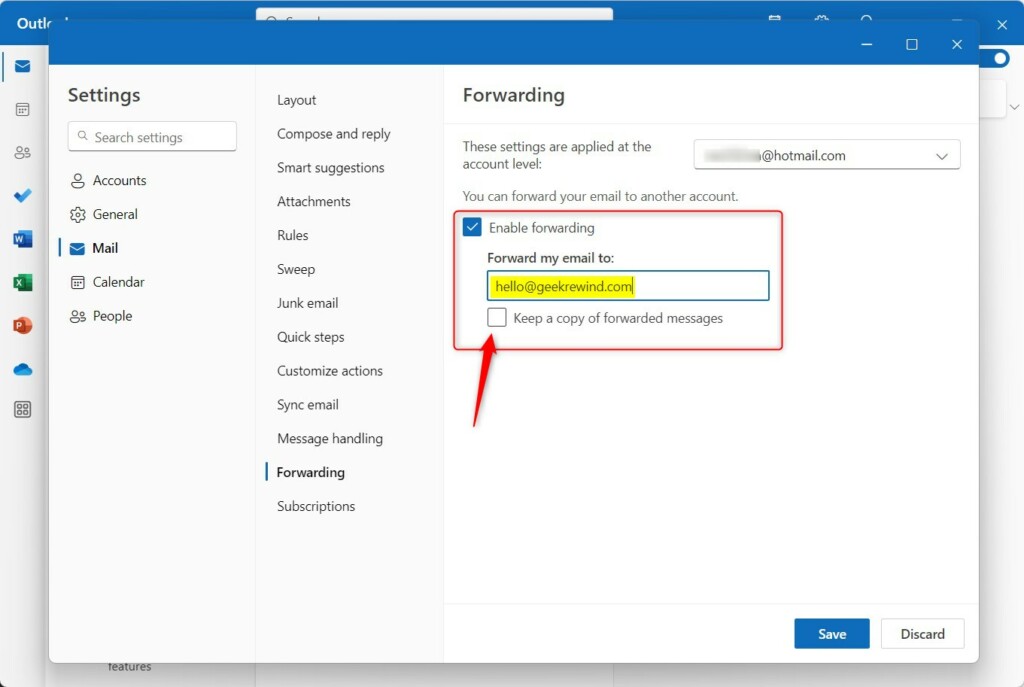
- Enter the destination email address in the address field.
- If you want a copy to stay in your own mailbox, tick Keep a copy of forwarded messages when it is shown.
- Click Save.
Send a test message to yourself from another account to confirm it arrives at the new address. To undo the change, return to the same page, switch Enable forwarding to Off and click Save. No restart is needed either way.
If the forwarding page is missing, or saving gives an error, your administrator has probably blocked forwarding for your account. Only they can change that.
How to Enable Forwarding in Classic Outlook
Classic Outlook forwards mail through a rule, which you build with the Rules wizard. The rule below applies to every message you receive. Follow these steps in order.
- Open Classic Outlook and go to the Home tab.
- Click Rules and select Manage Rules & Alerts. The Rules and Alerts dialog opens.
- Click New Rule, then under "Start from a blank rule" choose Apply rule on messages I receive, and click Next.
- On the conditions page, decide whether to filter. If you leave every box unticked and click Next, the rule applies to every incoming email. Outlook will ask you to confirm that. Click Yes. If you tick a condition, such as mail from a certain person or public group, only messages that match are forwarded.
- On the actions page, tick the action to forward the message to people or a public group. The rule description at the bottom now shows underlined text.
- Click the underlined text to enter the email address. Type the address in the To box and click OK. Then click Next and finish the wizard.
Before the wizard ends, you can add exceptions, name the rule and make sure Turn on this rule is ticked. Click Finish, then OK to close the dialog.
Untick the rule to pause it, or select it and click Delete to remove it. Outlook may have saved the rule on your computer rather than on the mail server. In that case it only runs while Outlook is open.
Troubleshooting and Security
If forwarding doesn't work, the cause is usually a restriction on the mail server, often at the SMTP (Simple Mail Transfer Protocol) level. Administrators commonly block automatic forwarding to outside addresses. Forwarding sensitive information to personal accounts often violates company security policy as well, so check those guidelines first.
Check these things next:
- Confirm the destination address has no typos.
- Look in the Junk or spam folder of the receiving account.
- Try forwarding to an address inside your own organization. If that works, external forwarding is blocked.
- Ask your IT administrator if you use a work or school account.
Summary
Automatic forwarding keeps your mail in front of you, whether the PC runs the new Outlook or Classic Outlook. Test it once after you set it up, and remove it when you no longer need it.
Can I forward emails to multiple addresses?
Have a question about this guide?
Answered by AI from this guide. Good questions may be added to this page — please don't include personal details.
Did this guide fix your problem?

About the Author
Richard
Tech Writer, IT Professional
Richard is a writer at Geek Rewind who turns complex IT tasks into clear, step-by-step guides. He draws on years of hands-on experience in system administration and enterprise IT operations, focusing on Windows, Linux and WordPress: the problems people actually run into, and the fixes that work. His server and WordPress guides come from systems he runs himself. Richard builds and maintains the platform behind Geek Rewind, from its Ubuntu servers and Nginx configuration to its custom WordPress plugins. Many new tutorials start with readers' questions, and he's always glad to answer them in the comments.
[…] app has many features, including support for subscription management, email forwarding, setting default From address, backing up your mailbox, changing the reading […]
[…] app has many features, including support for subscription management, email forwarding, setting default From address, backing up your mailbox, changing the reading […]
[…] app has many features, including support for subscription management, email forwarding, setting default From address, backing up your mailbox, changing the reading […]
[…] app has many features, including support for subscription management, email forwarding, setting default From address, backing up your mailbox, changing the reading pane, opening a […]
[…] app has many features, including support for subscription management, email forwarding, setting default From address, backing up your mailbox, changing the reading pane, opening a […]
[…] app has many features, including support for subscription management, email forwarding, setting default From address, backing up your mailbox, changing the reading […]
[…] app has many features, including support for subscription management, email forwarding, setting default From address, backing up your mailbox, changing the reading pane, opening a […]
[…] app has many features, including support for subscription management, email forwarding, setting default From address, backing up your mailbox, changing the reading […]
[…] app has many features, including support for subscription management, email forwarding, setting default From address, backing up your mailbox, changing the reading […]
[…] app has many features, including support for subscription management, email forwarding, setting default From address, backing up your mailbox, changing the reading […]
[…] app has many features, including support for subscription management, email forwarding, setting default From address, backing up your mailbox, changing the reading […]
[…] automatic replies, email sorting, subscription management, email forwarding, setting default From address, backing up your mailbox, and […]
[…] app has many features, including support for subscription management, email forwarding, setting default From address, backing up your mailbox, changing the reading […]
[…] accounts, setting out-of-office automatic replies, email sorting, subscription management, email forwarding, setting default From address, choosing between HTML and Plain text format, and […]
[…] app has many features, including support for subscription management, email forwarding, setting default From address, backing up your mailbox, changing the reading […]