How to Manage Read Receipts in Outlook on Windows 11


- 7 steps
- Needs administrator rights
Read receipts in Outlook on Windows 11 let you control whether people know the exact moment you open their emails. A read receipt is a notification that confirms someone has seen your message. When a sender asks for one, Outlook can send it, hold it back, or ask you first.
You can set Outlook to always send these receipts, never send them, or ask you first every time. This helps you manage your privacy and decide who gets to know when you read their mail on your PC. The steps below cover the new Outlook for Windows, the app with the gear icon in the top right corner. Classic Outlook, the older desktop version, keeps the same choices in a different place (File Options Mail Tracking).
Configure read receipts in Outlook by going to Settings Mail Message handling. Choose to always send, never send, or be prompted each time to control notifications sent to senders when you open their emails.
How to change read receipt settings
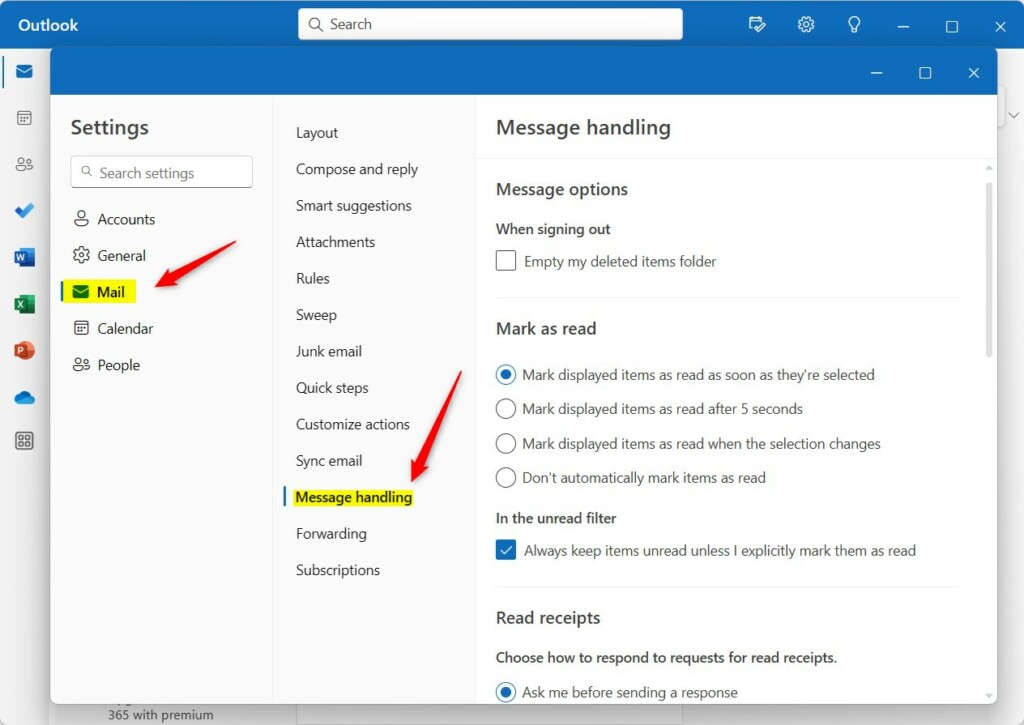
You can manage read receipt settings by opening the application options and choosing how Outlook handles incoming messages that request a read confirmation. The short version: open Outlook, click the gear icon in the top right corner, select Mail, and then click Message handling to find the read receipts section. There you choose whether to always send a response, never send one, or ask every time.
The setting applies to your account in Outlook. It only affects messages that ask for a receipt, and it does not change what you request when you send mail yourself.

- Open Outlook from the Start menu and wait for your mailbox to load. You should see your folder list on the left and your inbox in the middle.
- Click the Settings gear icon in the top right corner. A Settings window opens over the mailbox.
If you don’t see a gear icon and the top of the window shows a ribbon with File, Home and View tabs, you are in classic Outlook. In that case go to File Options Mail and scroll to the Tracking section instead.

- On the Settings screen, click Mail in the left pane. The right pane lists mail-related options.
- In the right pane, select Message handling. The Read receipts section is on this page.
In full, the path is Settings Mail Message handling. If you manage more than one account, check that you are looking at the settings for the account you want to change.
Three primary choices exist. Read them through before you pick, because the right one depends on how much you want senders to know:
- Ask me before sending a responseYou decide each time an email asks for a receipt. Outlook shows a prompt when you open such a message. This is a good middle ground, since you can approve receipts from your manager and decline the rest.
- Always send a responseYou automatically tell the sender you opened the email. Nothing is shown to you, so the sender gets the confirmation every time they ask for it.
- Never send a responseYou ignore all requests for receipts. The sender gets no confirmation from you, and they are not told that you declined.
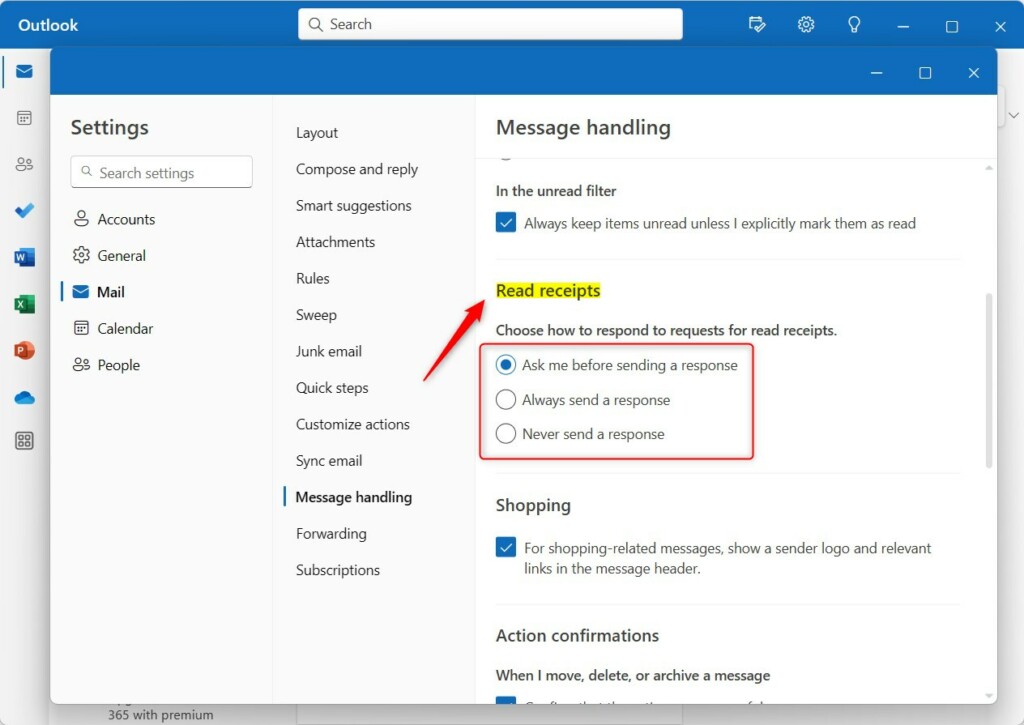
- Select the option you prefer in the Read receipts section.
- If a Save button is shown, click it. Otherwise the change applies as soon as you pick the option.
- Close Outlook completely and open it again so the new setting takes effect.
To undo the change, return to Settings Mail Message handling and select a different option. The default of asking you each time is a safe one to go back to.
If the options are greyed out or missing on a work or school account, your organization probably controls them with a policy. Only your administrator can change that.
Reliability and Limitations
Read receipts in Outlook are often unreliable because delivery depends on the recipient’s email client and settings. The recipient may use an app that ignores receipt requests, may have receipts set to never send, or may read the message in a preview pane that doesn’t trigger one. Treat a receipt as a courtesy, not as proof. A missing receipt doesn’t mean the message went unread, and a received one only means the recipient agreed to send it.
Cross-Platform Variability
The behavior of read receipts shifts depending on the specific Outlook edition in use, such as the desktop application, web version, or mobile app. Menu names and available options can differ between them, and some editions offer fewer choices. If you use Outlook on more than one device, check the setting in each one rather than assuming a change carries over.
Advanced Management: GPO and Exchange
Network administrators manage Outlook read receipts across corporate networks using Exchange Server and Group Policy (GPO, a collection of settings that control computer environments) alongside administrative commands. This lets an organization set one rule for many mailboxes and PCs instead of changing each one by hand. When a policy like this is in place, you may find the read receipt options locked, and any change you make may be reset.
Summary
Managing read receipts in Outlook assists with privacy and professional communication, though dependable delivery relies heavily on the recipient’s software. Pick the setting that suits how you work, and revisit it if your needs change. If you are unsure, Ask me before sending a response gives you control without much effort.
Have a question about this guide?
Answered by AI from this guide. Good questions may be added to this page — please don't include personal details.
Did this guide fix your problem?

About the Author
Richard
Tech Writer, IT Professional
Richard is a writer at Geek Rewind who turns complex IT tasks into clear, step-by-step guides. He draws on years of hands-on experience in system administration and enterprise IT operations, focusing on Windows, Linux and WordPress: the problems people actually run into, and the fixes that work. His server and WordPress guides come from systems he runs himself. Richard builds and maintains the platform behind Geek Rewind, from its Ubuntu servers and Nginx configuration to its custom WordPress plugins. Many new tutorials start with readers' questions, and he's always glad to answer them in the comments.
No comments yet — be the first to share your thoughts!