How to Publish Your Calendar in Outlook for Windows 11

Publishing your calendar in Outlook for Windows 11 creates a web link that lets people view your schedule in any web browser. They do not need a Microsoft account. Nobody who opens the link can edit your events.
How much they see depends on the permission level you choose when you publish. With Can view when I’m busy, people see only your free and busy times. With Can view all details, they also see event details. You can set the link to stay active anywhere from 7 days up to an indefinite period. That lets you share your availability while keeping control over your personal appointments.
The steps below use the new Outlook app for Windows, where settings sit behind the gear icon. Classic Outlook has different menus, so what you see there will not match these steps exactly.
Open the Outlook app, click the Settings gear icon, select Calendar then Shared calendars, pick your calendar under Publish a calendar, choose your permission level, and click Publish. Outlook generates HTML and ICS links you can share with others to view your availability in a web browser.
What happens when you are done?
Publishing a calendar in Outlook generates two links. Each one suits a different use.
- The HTML link opens your schedule in a web browser. Use it when you just want someone to look at your availability.
- The ICS link is for subscriptions. Use it when someone wants your calendar to appear inside another calendar app, such as Google Calendar or Apple Calendar. The subscribed calendar updates as yours changes.
Anyone who has either link can use it, so treat the links like a password and send them only to people you trust.
Prerequisites and Permissions
Work or school accounts sometimes have the option to publish calendars turned off. If the Publish a calendar section is missing or greyed out, your IT administrator has most likely disabled the feature for security reasons. Personal accounts, such as Outlook.com, Hotmail or Live, normally don’t have this restriction.
You can’t override this from your own Outlook. Changing it requires administrator access to your organization’s Exchange Online settings. If you aren’t an administrator, ask your IT team whether they can allow calendar publishing for your account, or whether they have another approved way to share your availability with people outside the company.
How to publish your calendar
To publish your calendar, open the Outlook app, click the Settings gear icon in the top right corner, and go to the calendar sharing options. Outlook then creates a link you can send to anyone. They can view your availability in a web browser without needing their own Outlook account.
The whole process takes eight short steps. Each step below says what you should see on screen, so you can tell whether you are on the right page.
1. Open the Outlook app on your computer. Your mailbox or calendar should load. Make sure you are signed in to the account whose calendar you want to publish.

2. Click the Settings gear icon in the top right corner. A Settings panel opens with a list of categories on the left.

3. Select Calendar, then click Shared calendars. The page that opens lists the sharing and publishing options for your calendars.

- Choose the account you want to share. This matters if you have more than one account added to Outlook. Only the account you pick here will have its calendars listed in the next step.
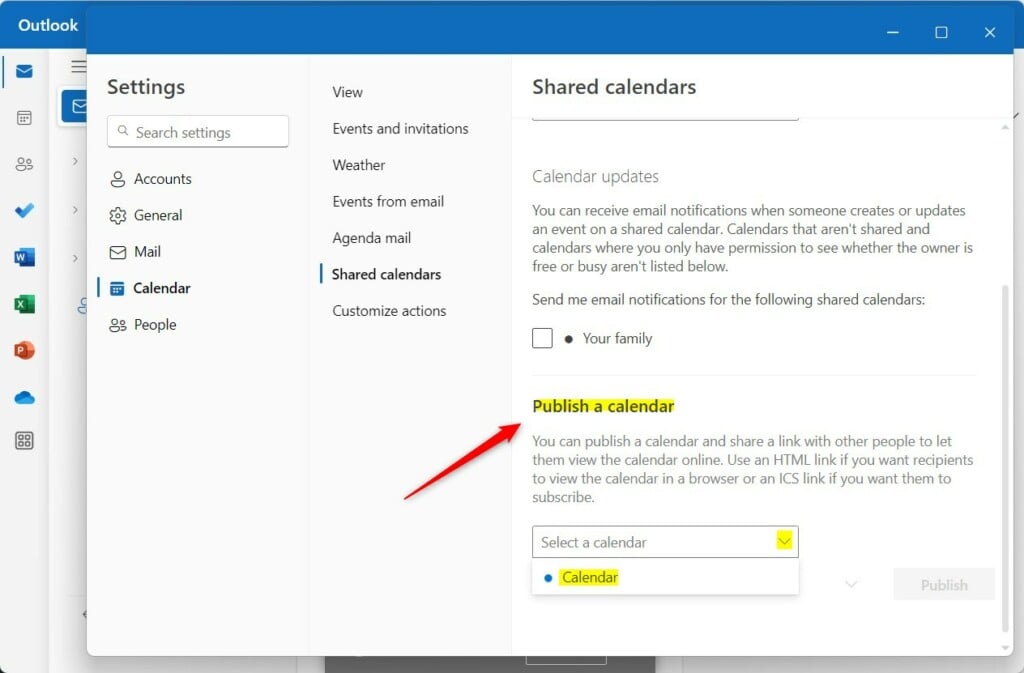
- Under Publish a calendar, pick the specific calendar you want to share. If you don’t see this section, see the note above about work or school accounts, where an administrator may have blocked it.
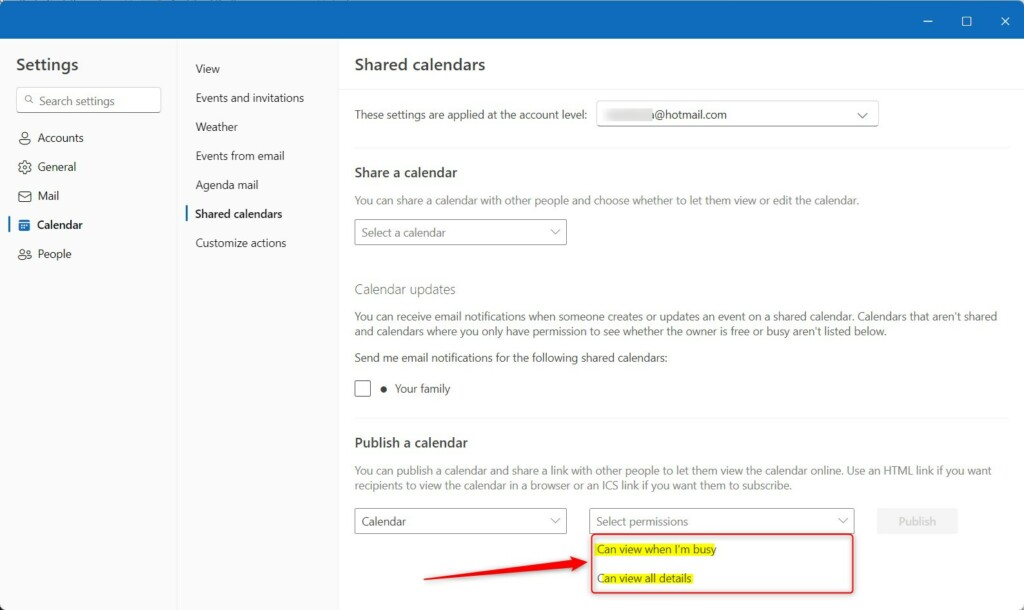
- Select the permission level: Can view when I’m busy or Can view all details. Choose the first if you only want to show when you are free or busy. Choose the second only if the people with the link should see event titles and details. If you are unsure, start with the busy-only option, since it exposes less.
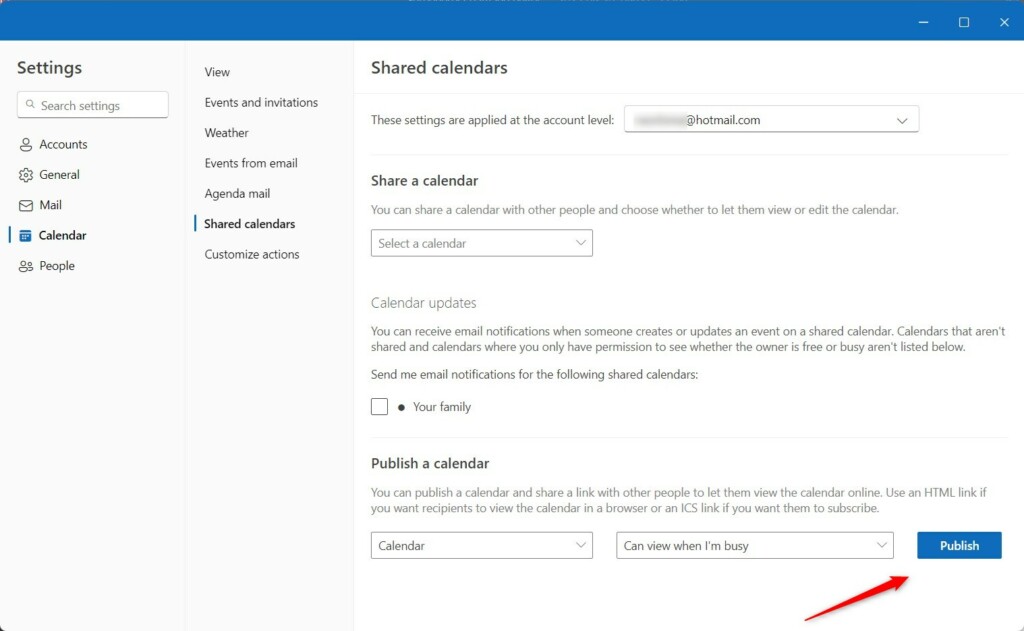
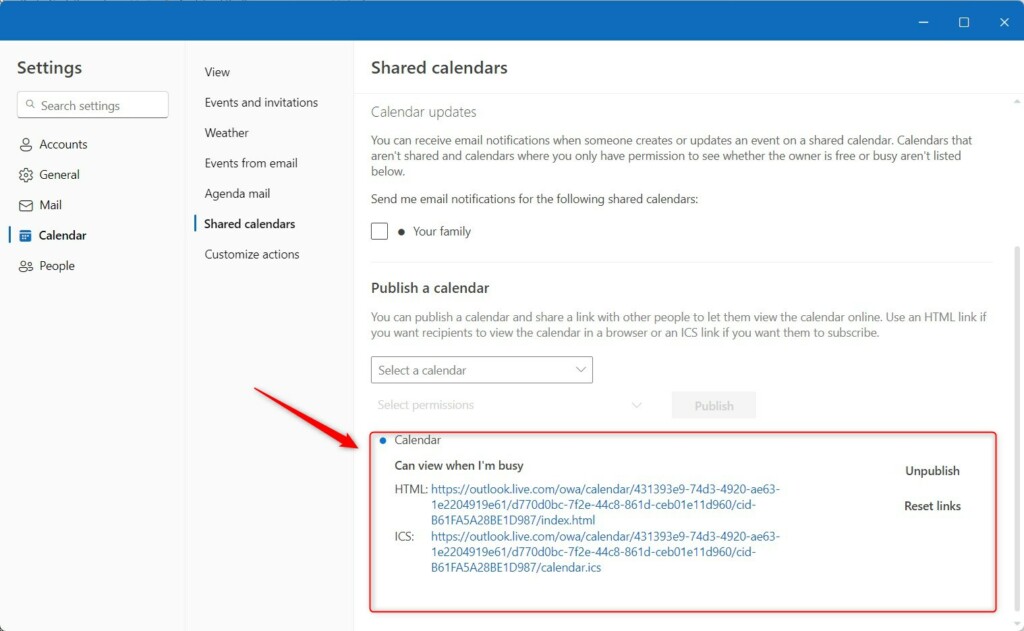
- Click Publish to generate your links. Outlook should now show the HTML and ICS links for the calendar you selected.
- Copy the HTML or ICS link to share with others. Send the HTML link to people who just want to look at your schedule in a browser. Send the ICS link to people who want to subscribe from another calendar app. Open the HTML link yourself in a private browser window to check what other people will see.
Difference between sharing and publishing
Traditional calendar sharing requires recipients to hold a Microsoft account so they can view the calendar inside Outlook apps. Public links created by publishing open in any standard web browser, with no sign-in.
That makes publishing a good fit for wide, view-only access. Examples are a link on a website or in an email signature, or a link sent to clients who don’t use Outlook. Collaborative scheduling is different. If people need to see your calendar inside their own Outlook, or to edit events, use standard sharing instead.
Troubleshooting Common Issues
Resetting a broken Outlook calendar link usually gets it working again in seconds. To do it, open the Shared calendars page (Settings Calendar Shared calendars) and click Reset links. Outlook generates a fresh URL that resolves the underlying glitch.
Anyone who still has the old link will need the new one, so send it to them again. Resetting is also a quick way to cut off someone you no longer want to have access.
Summary
Publishing your calendar is a quick way to share your availability. The ICS or HTML links let people view your schedule without special software. Before you send a link, check which permission level you chose.
When you no longer need the calendar to be public, unpublish it from the same Shared calendars page. That prevents unwanted long-term online access.
Have a question about this guide?
Answered by AI from this guide. Good questions may be added to this page — please don't include personal details.
Did this guide fix your problem?

About the Author
Richard
Tech Writer, IT Professional
Richard is a writer at Geek Rewind who turns complex IT tasks into clear, step-by-step guides. He draws on years of hands-on experience in system administration and enterprise IT operations, focusing on Windows, Linux and WordPress: the problems people actually run into, and the fixes that work. His server and WordPress guides come from systems he runs himself. Richard builds and maintains the platform behind Geek Rewind, from its Ubuntu servers and Nginx configuration to its custom WordPress plugins. Many new tutorials start with readers' questions, and he's always glad to answer them in the comments.
[…] primary account, sharing a calendar, changing language, date and time format, public a calendar, show week numbers in Outlook calendar, deleting your search history, export your […]
[…] or off, switch primary account, sharing a calendar, changing language, date, and time format, public a calendar, show week numbers in Outlook calendar, deleting your search history, export your search […]
[…] primary account, sharing a calendar, changing language, date and time format, public a calendar, show week numbers in Outlook calendar, deleting your search history, export your […]
[…] primary account, sharing a calendar, changing language, date and time format, publishing a calendar, and […]
[…] primary account, sharing a calendar, changing language, date, and time format, public a calendar, show week numbers in Outlook calendar, deleting your search history, export your […]