How to Show Week Numbers in Outlook Calendar on Windows 11


Week numbers in Outlook for Windows 11 show the week of the year (usually 1 to 52, and 53 in some years) right on your calendar grid. They help you track project deadlines and plan schedules across teams without counting dates by hand.
The feature is built into the new Outlook app for Windows 11. You turn it on in the calendar settings, and the numbers then appear in your monthly and weekly views. It only takes a few clicks.
Enable week numbers in Outlook Calendar by going to File, Options, Calendar, and then checking “Show week numbers.” This setting will then display the week number next to each date in your calendar view.
Show or hide “Week numbers” in the Outlook calendar
To show week numbers, open the Outlook settings, go to the calendar options, and check the box that turns on week numbers. Outlook then shows the week of the year next to your dates, so you can plan over long periods without counting weeks on screen.
These steps are for the new Outlook app. Classic Outlook, the older desktop version, keeps this setting elsewhere (File Options Calendar), so the screens below will not match it.
Follow these steps.
- Open the Start menu and go to Start All apps Outlook. Alternatively, type Outlook into the Start menu search bar and open the result.
- Wait for the window to load. You should see your mailbox, with the navigation icons for Mail and Calendar on the left. If you are asked to sign in, use the account you normally use with Outlook.

- Click the
Settingsbutton, the gear icon in the top right corner. The Settings window opens.

- Select the
Calendartab in the left-hand sidebar of the Settings window. The calendar options appear on the right. - Find the View section.
- Check the box next to Show week numbers. If you cannot find it, make sure you are in the new Outlook app and that the Calendar settings page is the one on screen.
The change applies right away, and you do not need to restart Outlook. To undo it, clear the checkbox and the numbers disappear. This is handy if the extra data feels cluttered.
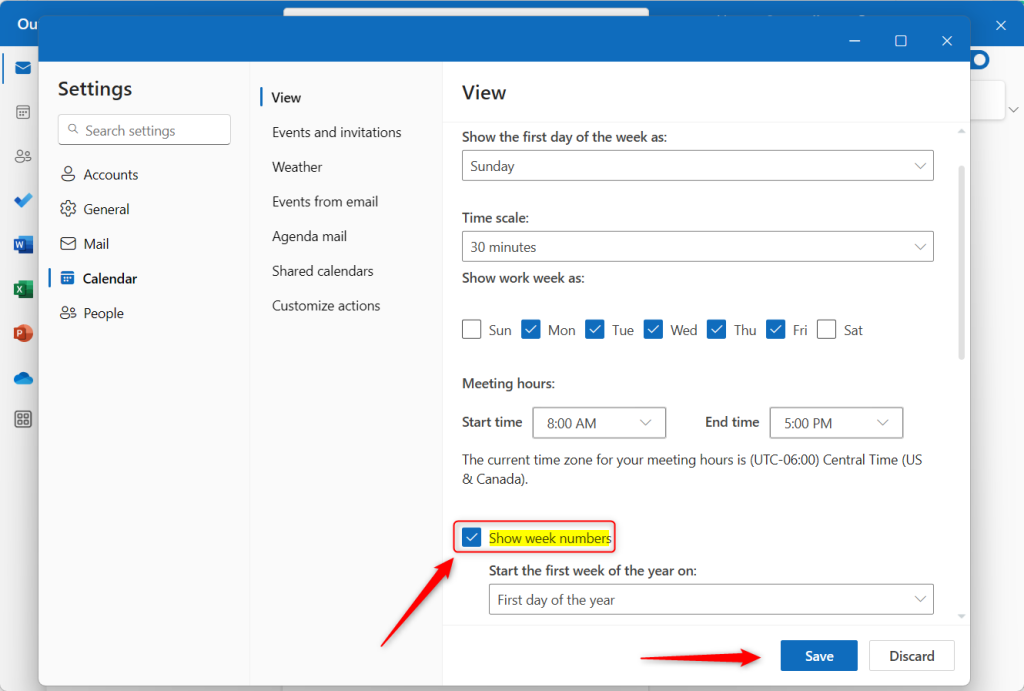
Switch to the calendar and the week numbers now appear alongside your normal schedule, under Week numbers.
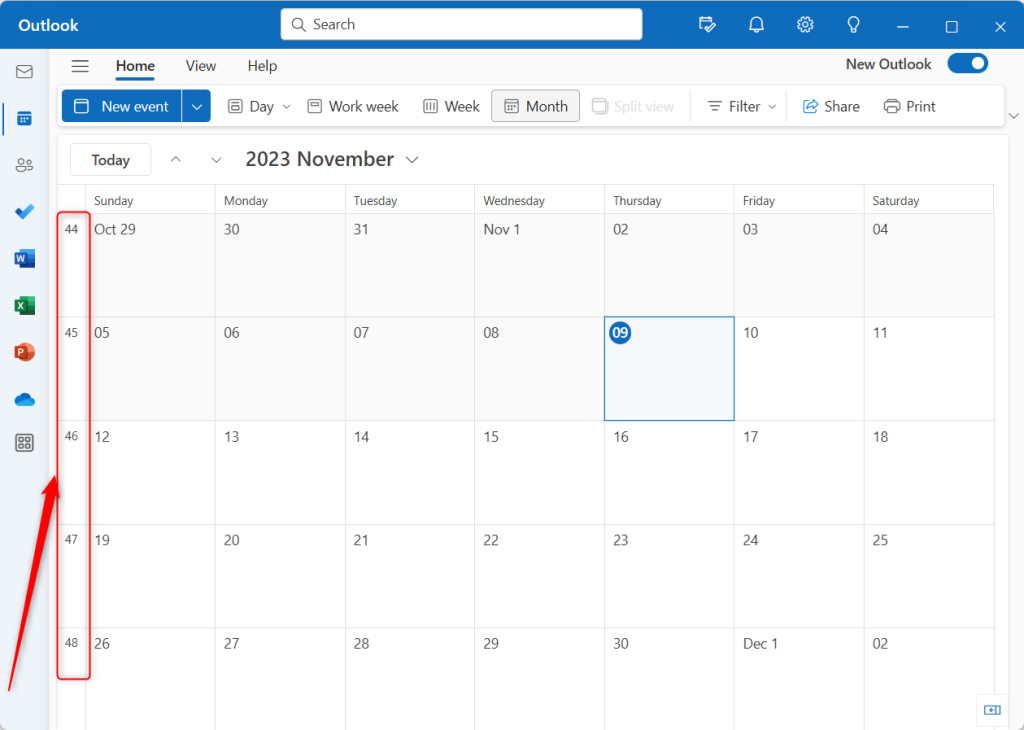
The configuration is complete.
Conclusion:
- Showing or hiding week numbers in the Outlook calendar helps with scheduling and planning, mainly when you work with people or teams across different time zones.
- Turning on Show week numbers keeps you aware of the current week of the year, which helps with organization and productivity.
- If week numbers are irrelevant or distracting, clear the same checkbox for a simpler calendar view.
You can show or hide week numbers again at any time with the same few clicks if you change your mind later.
Frequently asked questions
How to add week number in Outlook calendar?
To add week numbers in the new Outlook calendar, open Settings (the gear icon), select Calendar, and turn on the Week numbers option. The week of the year then appears on your monthly and weekly views. Classic Outlook uses a different path, so this applies only to the new app.
How to see week number in Outlook calendar?
You see week numbers in the Outlook calendar once you turn them on in Settings. Open Settings from the gear icon, go to Calendar, and check Week numbers. The numbers then show beside the dates in Month and Week views, so you can spot the week of the year at a glance. This works in the new Outlook app.
How to show week number in Outlook?
To show week numbers in Outlook, open Settings, select Calendar, and turn on Week numbers. Outlook then displays the week of the year next to each date in your calendar grid. This applies to the new Outlook app on Windows 11. Classic Outlook stores the same option under File Options Calendar.
How to get week n umbers to showe on calendar?
Week numbers appear on your calendar once you switch them on in Outlook's settings. Click the gear icon, open the Calendar section, and enable Week numbers. The numbers then show in the monthly and weekly views. If you use classic Outlook, look under File Options Calendar instead.
How to set calendar weeks in new Outlook?
In the new Outlook, set calendar weeks by turning on Week numbers in Settings. Click the gear icon, choose Calendar, and enable Week numbers. Each week is then labeled with its number of the year, running from 1 to 52 or 53. Classic Outlook keeps this option under File Options Calendar.
How to add week numbers in Outlook?
To add week numbers in Outlook, open Settings from the gear icon and choose Calendar. Turn on the Week numbers option, and the week of the year will appear on your calendar. This covers the new Outlook app for Windows 11. Classic Outlook uses File Options Calendar instead.
Still have a question?
Answered by AI from this guide. Good questions may be added to this page — please don't include personal details.
Did this guide fix your problem?

About the Author
Richard
Tech Writer, IT Professional
Richard is a writer at Geek Rewind who turns complex IT tasks into clear, step-by-step guides. He draws on years of hands-on experience in system administration and enterprise IT operations, focusing on Windows, Linux and WordPress: the problems people actually run into, and the fixes that work. His server and WordPress guides come from systems he runs himself. Richard builds and maintains the platform behind Geek Rewind, from its Ubuntu servers and Nginx configuration to its custom WordPress plugins. Many new tutorials start with readers' questions, and he's always glad to answer them in the comments.
[…] account, sharing a calendar, changing language, date and time format, public a calendar, show week numbers in Outlook calendar, deleting your search history, export your search history, and […]
[…] a calendar, changing language, date and time format, public a calendar, show week numbers in Outlook calendar, deleting your search history, export your search history, add or remove events from […]
[…] a calendar, changing language, date, and time format, public a calendar, show week numbers in Outlook calendar, deleting your search history, export your search history, add or remove events from […]
[…] account, sharing a calendar, changing language, date, and time format, public a calendar, show week numbers in Outlook calendar, deleting your search history, export your search history, add or remove events from emails to […]
[…] account, sharing a calendar, changing language, date, and time format, public a calendar, show week numbers in Outlook calendar, deleting your search history, export your search history, add or remove events from emails to […]
[…] app has many features, including support for showing week numbers in Outlook calendar, deleting your search history, exporting your search history, adding or removing events from […]
[…] app has many features, including support for showing week numbers in Outlook calendar, deleting your search history, exporting your search history, adding or removing events from […]
[…] account, sharing a calendar, changing language, date and time format, public a calendar, show week numbers in Outlook calendar, deleting your search history, export your search history, add or remove events from emails to […]