How to Enable Daily Agenda Emails in Outlook for Windows 11

Daily agenda emails in Outlook for Windows 11 send an automated morning summary of your calendar events and to-do items to your inbox. The feature pulls data from your Microsoft account and lists your meetings and tasks for the day ahead, so you can plan your schedule without opening your calendar.
This guide shows where the switch is, how to turn it on and off, and what to check if the option does not appear. The steps are written for the new Outlook app on Windows 11. Microsoft changes labels and layout from time to time, so a name may differ slightly on your build.
Open Outlook on Windows 11, click the Settings gear icon at the top right, select your account, then click Calendar in the left sidebar and toggle the Agenda email switch to On. Your first daily agenda email arrives the next morning in your inbox.
Why use daily agenda emails?
Mornings run smoother with a daily agenda email waiting in your inbox. The message summarizes your upcoming meetings and tasks, so you can see the shape of the day at a glance before you open anything else.
It is also handy on days when you start on your phone or another PC. The email is a regular message in your mailbox, so you can read it on any device that has your mail.
What happens when you enable this?
Once you turn on daily agenda emails, Outlook scans your calendars automatically. A summary arrives in your inbox each morning, alongside your Microsoft To Do tasks.
You do not have to keep Outlook open for this. The message is generated on Microsoft’s side and delivered like any other email. Your first agenda email normally shows up the next morning, not right after you flip the switch.
Prerequisites and Compatibility
This feature connects directly to Microsoft's servers, so the setup is an online setting stored with your account. That has two practical effects:
- You need an internet connection when you change the setting.
- Managing these preferences through Outlook on the web (the web version of Outlook Calendar) gives the fastest and most reliable results. If the app does not show what you expect, try the web version with the same account.
How to enable or disable daily agenda emails
When daily agenda emails are on, Outlook sends you a morning summary of your calendar events. You can turn the feature on or off in your app settings. The toggle is reached through the Settings (gear) icon at the top right of the Outlook window.
- Open the Outlook app on your Windows 11 PC.
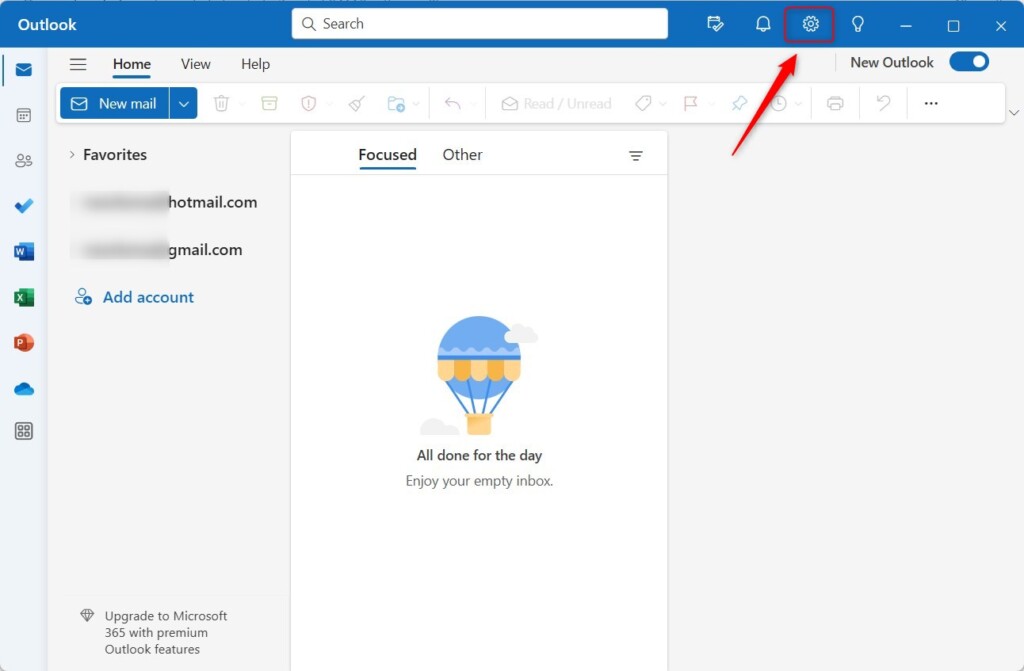
- Click the Settings (gear) icon at the top right of the window. The Settings panel opens, with a list of categories on the left.
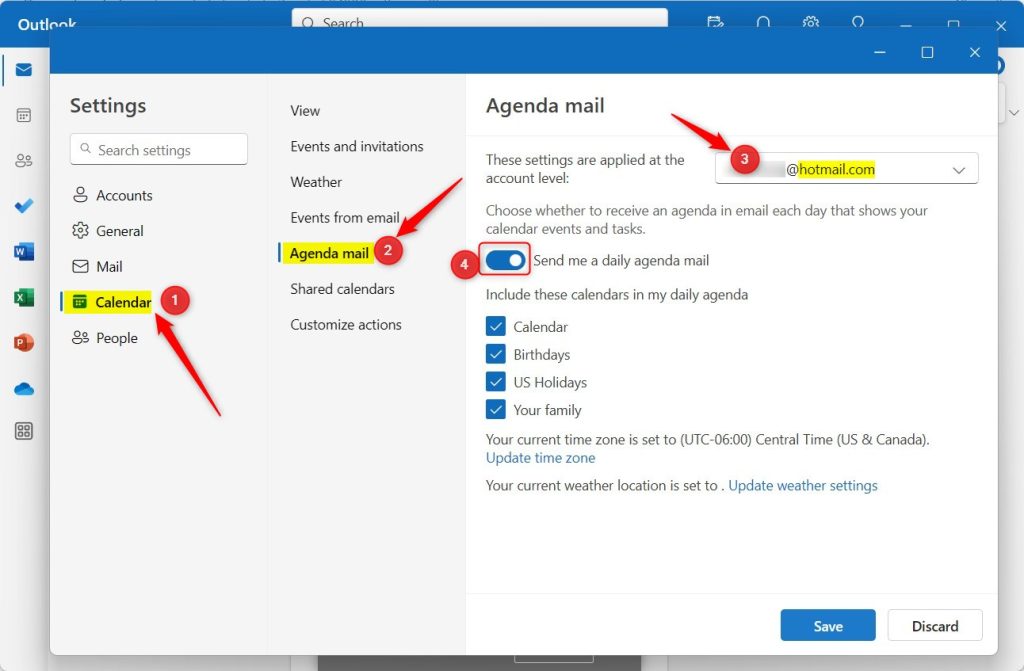
- If you have more than one email account, select the account you want to change from the menu. The setting belongs to the individual account, so pick the one whose calendar you want summarized.
- Click Calendar in the left-hand sidebar. The calendar options for that account appear on the right.
- Find the Agenda email section. You may need to scroll down to see it.
- Toggle the switch to the On position to enable it. The switch should now show as on.
If it does not, check your Junk Email folder before you assume something is wrong.
To turn the feature off, return to the same place and move the switch back to the Off position. The emails stop after that. Nothing else in your calendar or To Do list is affected.
You can also choose which calendars are included in or left out of the daily summary. If your agenda shows events you do not want, or misses a calendar you do, check the calendar choices in the same Agenda email section. Exact options depend on your account type and Outlook version.
Distinguishing Agenda Emails from My Day
The Daily Agenda Email and My Day are easy to mix up, but they work differently:
- Daily Agenda Email is an automated message that arrives in your inbox. It is a snapshot of the day, sent once.
- My Day is a live schedule shown in a sidebar inside Outlook. It updates as your calendar changes.
Both help you plan, just in different ways. Many people use the email for a quick morning read and My Day while they work.
Troubleshooting Common Issues
If you cannot find the Agenda email option, or the emails never arrive, work through these checks:
- Check your account type. Missing agenda options usually point to account compatibility, since older or unsupported setups lack the feature. A Microsoft account (Outlook.com, Hotmail, Microsoft 365) is the most likely to have it.
- Check that you are in the new Outlook app. The classic Outlook desktop app has a different Settings layout and may not show this option.
- Check your notification and mail settings. They must allow incoming mail from Microsoft, and your Junk Email folder or any mail rules should not catch the message.
- Try Outlook on the web. If the option appears there but not in the app, the setting is available for your account and the app is the problem. Update Outlook and look again.
In that case you will need to ask your IT team.
Summary
Morning organization improves noticeably once this is on. Flip the Agenda email switch in Settings and your schedule is waiting for you each morning. If you ever find it more noise than help, the same switch turns it off.
Have a question about this guide?
Answered by AI from this guide. Good questions may be added to this page — please don't include personal details.
Did this guide fix your problem?

About the Author
Richard
Tech Writer, IT Professional
Richard is a writer at Geek Rewind who turns complex IT tasks into clear, step-by-step guides. He draws on years of hands-on experience in system administration and enterprise IT operations, focusing on Windows, Linux and WordPress: the problems people actually run into, and the fixes that work. His server and WordPress guides come from systems he runs himself. Richard builds and maintains the platform behind Geek Rewind, from its Ubuntu servers and Nginx configuration to its custom WordPress plugins. Many new tutorials start with readers' questions, and he's always glad to answer them in the comments.
No comments yet — be the first to share your thoughts!