Windows 11 allows users to personalize the handwriting panel font when using touchscreen devices. You can change the font easily via Settings under Bluetooth & devices or, for advanced users, through the Windows Registry Editor. This customization can enhance the handwriting recognition experience and overall usage comfort.
In Windows 11, the handwriting panel allows users to adjust font sizes for handwritten text to small, medium, or large. This can be done easily via the Settings app under Bluetooth & devices, or for advanced users, through the Windows Registry Editor. For assistance, users are encouraged to leave comments.
This guide explains how to modify User Account Control (UAC) settings in Windows 11, which governs permission requests for programs needing admin access. Users can choose to automatically deny requests, prompt for credentials on a secure desktop, or use the default prompt method by adjusting settings via the Local Security Policy or Registry Editor.
This guide explains how to find your Wi-Fi password on a Windows 11 PC if you're already connected. It outlines methods using Windows Settings, Quick Settings, and Command Prompt to retrieve the saved password. Accessing your Wi-Fi password is useful for connecting other devices and sharing the network with others.
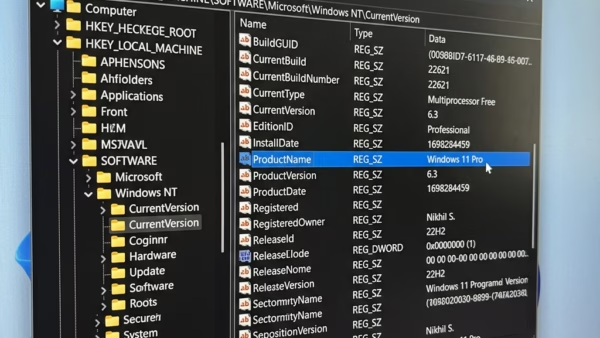
Windows 11 no longer automatically saves registry backups during restarts, a change made to conserve hard drive space. Users can re-enable this feature by adjusting settings in the Registry Editor, ensuring protection against potential registry issues. Maintaining system restore points is also recommended for comprehensive backup security.
This guide outlines how to check for app updates in Windows 11, which features the new Unified Update Orchestration Platform (UOP) for smoother updates. Users can monitor progress in one place via Settings. While currently limited, more apps will adopt this feature, with advanced users able to access it early.
This guide explains how to enable or disable the experimental AI agents feature in Windows 11, which assists with tasks like organizing files and scheduling. Users maintain control over the agents' access to their files, but only administrators can activate this feature. Caution is advised as it may impact PC performance.
You can easily use the Print Screen key on Windows 11 to open the Snipping Tool for quick screenshots, which also allows drawing on images. This feature can be activated or deactivated in Settings. With recent updates, it opens by default, but a restart may be needed for changes to take effect.
Windows 11 users can customize scrollbar visibility, choosing between always showing or hiding them until hovered over. This can be adjusted easily via the Settings app or through the more advanced Registry Editor. Users are advised to proceed cautiously with registry changes and consider backing it up for safety.
This guide explains TRIM, a feature for SSDs in Windows 11 that optimizes performance by informing the drive about deleted data. Keeping TRIM enabled is recommended for better function and longevity, while disabling it briefly can aid in data recovery. Users can check and modify TRIM settings via Windows Terminal commands.
You can adjust the keyboard repeat rate on Windows 11 to optimize typing speed. This can be done through the Control Panel by modifying the Repeat rate and Repeat delay sliders. For advanced users, changes can also be made via the Windows Registry Editor by setting a value between 0 and 31.
Windows 11 allows users to hide the mouse pointer while typing, enhancing focus and visibility. This feature can be activated or deactivated through the Control Panel or the Windows Registry Editor. The guide outlines steps for both methods, highlighting that some applications may not adhere to this setting.
Microsoft Defender Antivirus on Windows 11 protects your PC from threats using regular security updates. You can check for updates manually via the Windows Security app's Virus & threat protection section. Keeping these updates current enhances your computer's security against new viruses and threats, ensuring effective protection.
This guide provides methods to stop frozen programs in Windows 11 to improve computer performance. It outlines using Task Manager for a simple solution, along with the more advanced Command Prompt and PowerShell options using commands like taskkill and Stop-Process, ensuring users can manage their system effectively.
Windows 11 allows users to download fonts for multiple languages, enhancing text display and usability. This can be done through the Settings app or the Control Panel. Users should ensure adequate disk space, as downloading all fonts may consume significant storage and potentially impact computer speed.