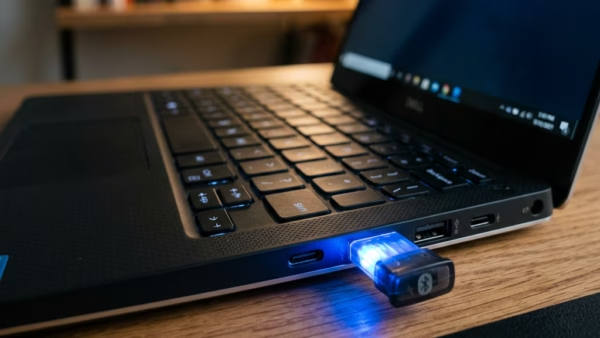
BitLocker in Windows 11 secures drives through encryption and password protection, ensuring only authorized users can access data. It allows users to lock various drives, including the main system and external USB drives. Drives can be locked via Windows Terminal or Command Prompt with specific commands for added security.
Windows
This guide explains how to prevent Windows 11 from saving files to unprotected USB or removable drives by using BitLocker encryption. It details steps to deny write access via the Local Group Policy Editor or Windows Registry, enhancing data security and minimizing risks associated with unsafe drives.
This guide explains how to enable Windows 11's Narrator to announce the names of modifier keys like Shift and Alt, assisting users who rely on audio feedback. Users can easily adjust this feature through the Accessibility settings in the Settings app, using the Windows key + I shortcut for quick access.
This guide explains how to enable or disable the Narrator feature in Windows 11 that announces navigational keys like Arrow and Tab. The Narrator tool assists users with visual impairments by reading screen content aloud and providing auditory feedback on key presses, making computer navigation and typing easier.
This guide explains how to prevent Windows 11 from saving files to unprotected drives by using BitLocker encryption. It details steps to configure this setting via the Group Policy Editor or Registry Editor. Ensuring only encrypted drives allow file changes enhances data security and minimizes risks of accidental alterations.
This guide explains how to configure BitLocker encryption for removable drives on Windows 11, offering options for full encryption or used space only encryption. Users can enforce a preferred encryption type using the Local Group Policy Editor or the Windows Registry Editor, enhancing data security without user prompts for each use.
BitLocker is a built-in Windows 11 feature that encrypts drives to secure data access. Users can choose between full encryption or used space only encryption for their fixed drives. By using the Group Policy Editor or Registry Editor, you can set a default encryption type. Remember to restart your computer after changes.
This guide explains how to change the storage limit for snapshots in Windows 11, allowing users to manage disk space effectively. It outlines the steps to adjust settings through the Privacy & security section and offers tips for optimizing storage based on the PC's available space. Users can easily delete snapshots if necessary.
Windows 11 features Recall & Snapshots, which capture screen images for easy access later. However, these snapshots can consume storage. Users can delete snapshots from specific timeframes—past hour, day, week, or month—through the Privacy & Security settings to manage space effectively. This guide provides straightforward steps for deletion.
Windows 11 features Recall & Snapshots, which saves screen "pictures" for easy retrieval. Users can manage storage by deleting old snapshots, especially when space is limited. To delete, access Settings, choose Privacy & security, and then Recall & snapshots. Users can then delete all snapshots to free up space.
This guide provides instructions on how to change your BitLocker password in Windows 11 to enhance data security. Users can update their password via File Explorer, Control Panel, or Windows Terminal, ensuring the drive is unlocked first. Regular password changes contribute to better protection of your files.
Windows 11 features Recall & Snapshots, allowing users to save screen images for easy access later. Users can control space and exclude specific websites for privacy. Supported browsers like Microsoft Edge and Chrome enable website filtering, while private browsing sessions remain unsaved. Users can adjust settings through Privacy & Security.
Windows 11 offers convenient methods to type special characters and symbols, including the Emoji Panel for quick access to emojis and symbols, the Touch Keyboard for touchscreen users, and the Character Map for finding specific symbols. These tools enhance typing, making it easier to include diverse character sets in documents and messages.
Windows 11 version 24H2 enables users to share their Wi-Fi passwords effortlessly via QR codes. Users can generate a QR code in the Settings app, allowing friends to connect without typing lengthy passwords. This feature simplifies the connection process for any device capable of scanning QR codes, enhancing convenience for guests.
This guide explains how to enable a shortened time and date display on the Windows 11 taskbar. Users can activate this feature using the ViVeTool command or by modifying the ShowShortenedDateTime setting in the Windows Registry. Both methods simplify the taskbar appearance while saving space.