How to Schedule Automatic Wake Time in Windows 11

Automatic wake time in Windows 11 turns on your PC by itself from sleep or hibernation at a time you choose. Your computer can then start up and run tasks, or be ready for you before you sit down at your desk.
Setup takes about 5 minutes with built-in Windows settings and Task Scheduler (a tool that runs programs on a schedule). You need administrator privileges on your Windows 11 Home or Pro PC to make these power and schedule changes. Task Scheduler is included in both editions.
One limit to know up front: this works only from sleep or hibernation. A PC that is fully shut down will not wake from a Task Scheduler timer.
Use Task Scheduler to create a task. Name it, set it to run when logged off with highest privileges, and configure triggers for your desired wake time. In the Conditions tab, check “Wake the computer to run this task.
How to wake a PC at a specific time
To schedule a wake time, use the built-in Task Scheduler app. You create a task that has the “wake the computer” option turned on. When the task’s start time arrives, your PC leaves sleep and runs it, so background updates, downloads or scripts can run without you pressing the power button.
The setup has three parts. You build the task in Task Scheduler, you allow wake timers in your power plan, and, if the PC still won’t wake, you check the BIOS or UEFI. The sections below follow that order.
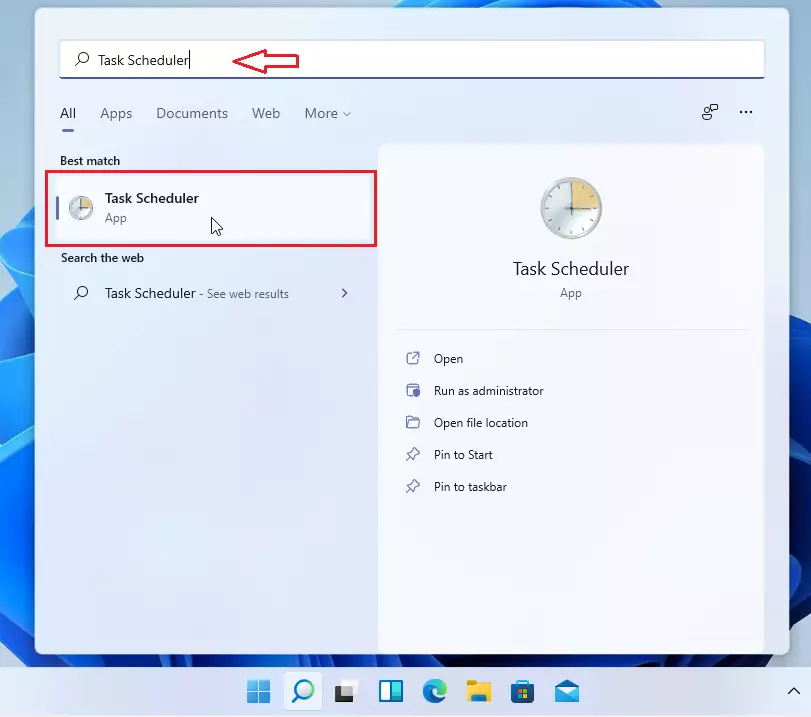
First, open the Task Scheduler in Windows.
- Go to the Start Menu .
- Type Task Scheduler in the search box.
- Click the Task Scheduler app in the results.
The Task Scheduler window should now open, with a list of tasks in the middle and an Actions pane on the right. If it asks for permission, click Yes. If it asks for an administrator password, sign in with an admin account.
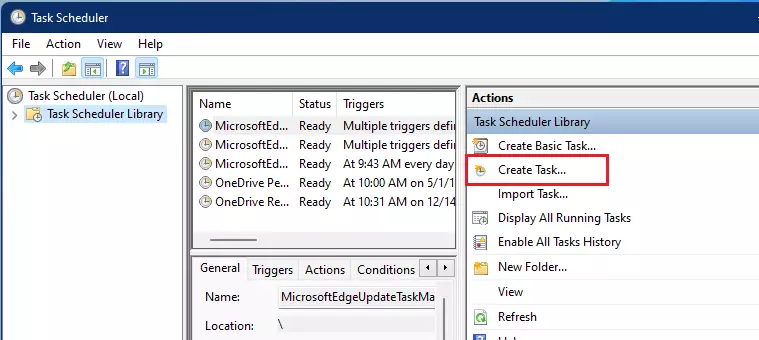
- In the left pane of Task Scheduler, click Task Scheduler Library.
- In the Actions pane on the right, click Create Task.
A Create Task window opens with several tabs: General, Triggers, Actions, Conditions and Settings. Don’t pick Create Basic Task. The basic wizard has no option to wake the computer.
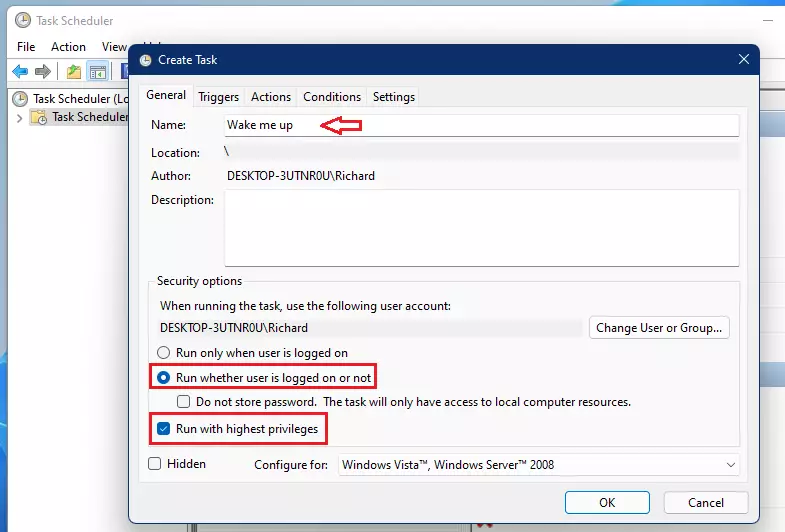
- Open the General tab.
- In the Name box, type a name you will recognize later, such as “Wake me up.”
- Select Run whether user is logged on or not. This lets the task run even if nobody is signed in when the PC wakes.
- Check the box for Run with highest privileges. This needs administrator rights.
If you only need the PC awake while you are signed in, Run only when user is logged on also works, and it won’t ask for a password when you save.
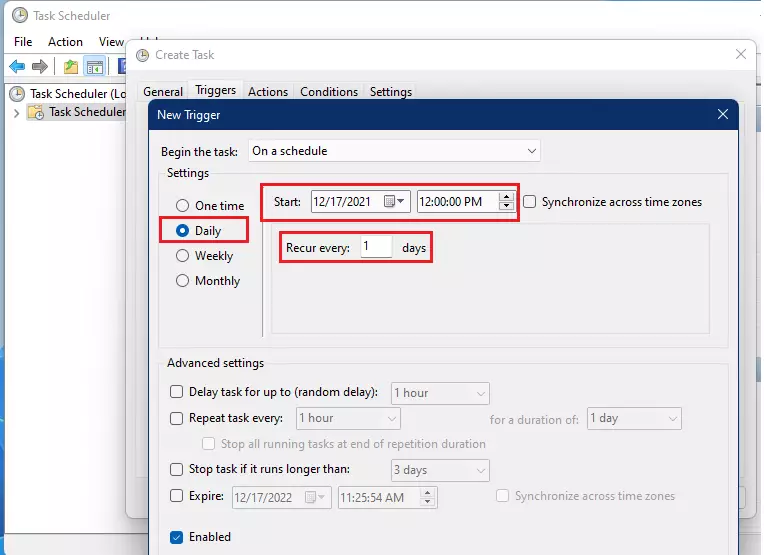
- Open the Triggers tab.
- Click New.
- In the Begin the task list, choose On a schedule.
- Pick One time for a single wake, or Daily or Weekly for a recurring one.
- Set the Start date and time to when you want the computer to wake up.
- Make sure the Enabled box at the bottom is checked, then click OK.
The new trigger should now appear in the Triggers list with the schedule you picked. Pick a time at least 10 minutes after the PC will have gone to sleep. Otherwise it may still be awake when the task starts and the wake is never tested.
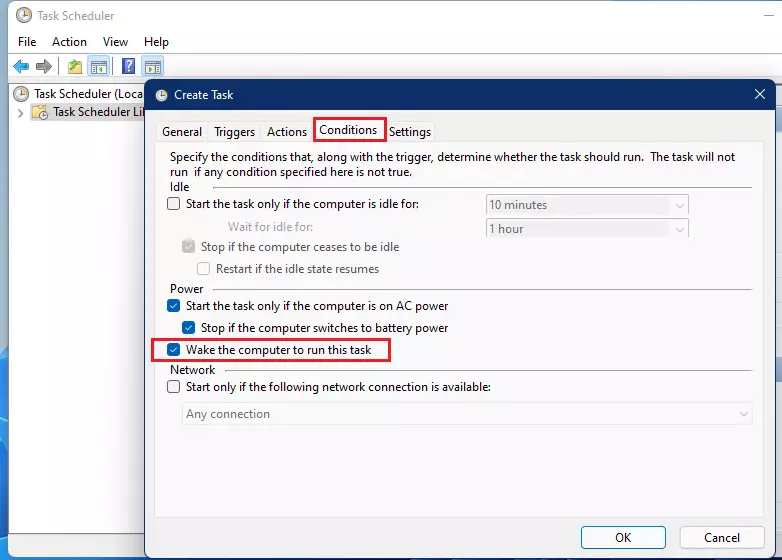
- Open the Conditions tab.
- Under Power, select the checkbox labeled Wake the computer to run this task.
This setting is what wakes the computer from sleep to run the task. On a laptop, Start the task only if the computer is on AC power is usually checked by default. If you want the wake to work on battery too, clear that box. Otherwise the task will be skipped whenever the charger is unplugged.
A task needs at least one action, so give it a small one. This action will briefly open and close a command window, which is harmless.
- Open the Actions tab.
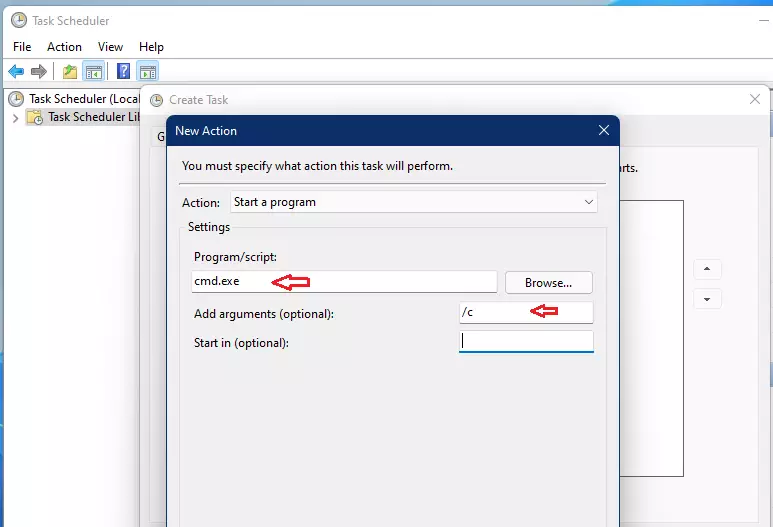
- Click New. The New Action window opens with Start a program already selected in the Action list.
- In the Program/script box, enter
C:\Windows\System32\cmd.exe. - In the Add arguments (optional) box, enter
/c. - Click OK.
The action should now be listed on the Actions tab.
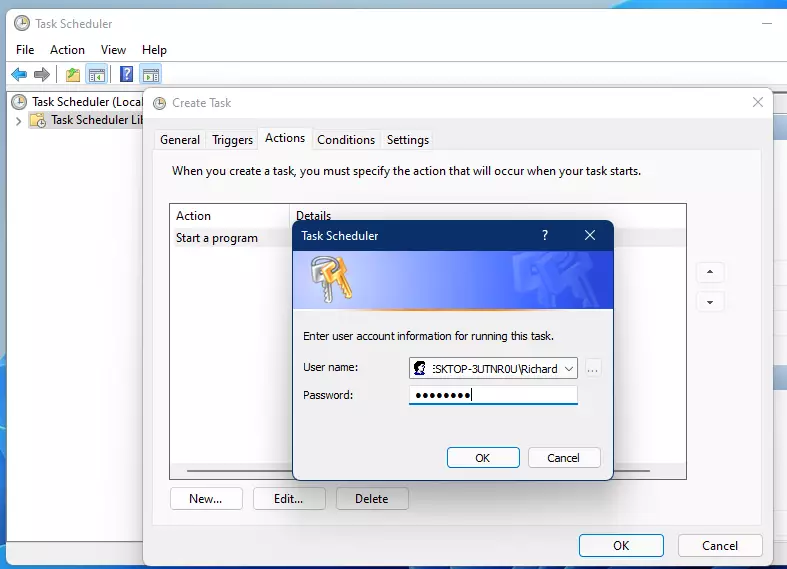
- Click OK at the bottom of the Create Task window to save the task.
- When Windows asks, enter your account password to confirm the changes.
Windows needs a password because the task is set to run whether you are signed in or not. An account with no password usually can’t save this kind of task. If you sign in with a PIN, use the password of the same account. After saving, the task appears in the Task Scheduler Library list.
To undo this later, right-click the task in the Task Scheduler Library and choose Disable to pause it or Delete to remove it.
BIOS/UEFI Wake Configuration
Sometimes Windows settings aren’t enough. If the PC fails to wake, check your computer’s BIOS or UEFI settings. BIOS and UEFI are the low-level motherboard configuration software that runs before Windows starts. Some boards ship with the timer wake feature turned off, and Windows can’t override that.
Look for an option called a wake alarm or RTC alarm. The exact name differs between manufacturers, so check the power management or advanced pages of your firmware. Turn it on and save your changes.
On most UEFI PCs you can reach the firmware settings from Windows:
- Go to Settings System Recovery
- Next to Advanced startup, click Restart now.
- After the restart, choose Troubleshoot Advanced options > UEFI Firmware Settings.
If you don't see UEFI Firmware Settings, your PC may use legacy BIOS. In that case, press the key shown at startup (often Del, F2 or F10) to open the BIOS. Your PC's manual or the manufacturer's support page will list the exact key.
Troubleshooting Power Options
If your PC doesn't wake up as scheduled, check your Windows 11 power options next. Settings like Fast Startup can sometimes interfere. Fast Startup puts a "shut down" into a hybrid hibernation state, and it can make a shut-down PC look like a sleeping one. A PC that was shut down won't wake from a timer. Test with the PC set to sleep or hibernate, not shut down.
Laptops with Modern Standby may also behave differently from older PCs. If you still can't get a wake to work after the steps in this guide, check your manufacturer's support page for known sleep or wake issues.
How to turn on Wake Timers
Wake timers in Windows 11 give scheduled tasks permission to turn on your computer from sleep or hibernation. If this power plan setting is off, your PC stays asleep and ignores any automatic wake times you set up in Task Scheduler, even when the task itself is correct.
- Search for and open the Control Panel.
- Go to Hardware and Sound Power Options
- Next to your active plan, click Change plan settings.
- Click Change advanced power settings.
A small Power Options window opens with a list of settings you can expand. If you use more than one plan, repeat these steps for the plan you actually use.
- In the list, expand the Sleep section.
- Expand Allow wake timers.
- Set On battery to Enable.
- Set Plugged in to Enable.
The other choices in the list are Disable and Important Wake Timers Only. Don't use Important Wake Timers Only here. It blocks most scheduled tasks. A desktop PC has no battery, so you will only see Plugged in.
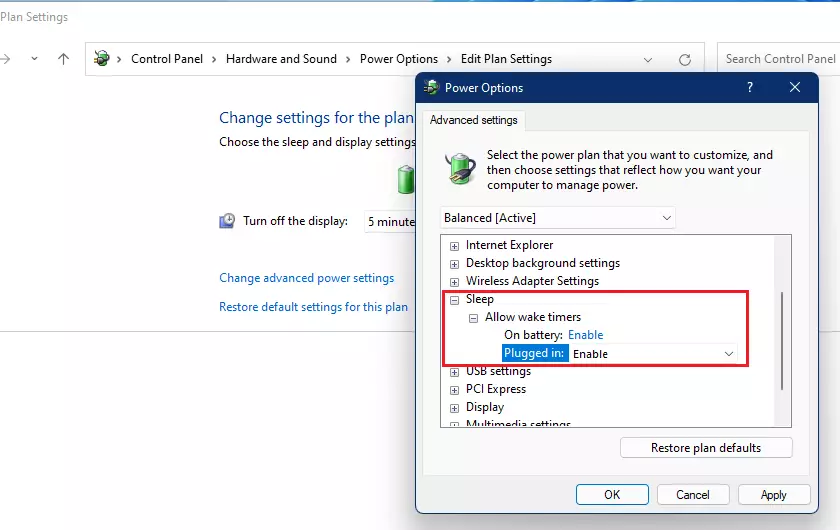
Click OK to save your settings. The change applies right away and doesn't need a restart. To undo it, come back and set the same options to Disable. For more details, refer to official Microsoft documentation on power management.
Summary
By using Task Scheduler, configuring BIOS wake alarms, and enabling wake timers in your power settings, you can have your Windows 11 computer wake at the time you choose. Your PC is then ready for remote access or daily tasks without manual input.
Before you rely on it, run a quick test. Set the task's trigger a few minutes ahead, put the PC to sleep, and see whether it wakes on time. If it does, change the trigger to the schedule you actually want.
Have a question about this guide?
Answered by AI from this guide. Good questions may be added to this page — please don't include personal details.
Did this guide fix your problem?

About the Author
Richard
Tech Writer, IT Professional
Richard is a writer at Geek Rewind who turns complex IT tasks into clear, step-by-step guides. He draws on years of hands-on experience in system administration and enterprise IT operations, focusing on Windows, Linux and WordPress: the problems people actually run into, and the fixes that work. His server and WordPress guides come from systems he runs himself. Richard builds and maintains the platform behind Geek Rewind, from its Ubuntu servers and Nginx configuration to its custom WordPress plugins. Many new tutorials start with readers' questions, and he's always glad to answer them in the comments.
completely useless, my problem is that even though I move or press the left button on the mouse, it doesn’t start