How to Enable or Disable FilterKeys in Windows 11


FilterKeys is a Windows 11 accessibility feature that ignores brief or repeated key presses to stop typing mistakes. When it is on, Windows waits 0.1 seconds or longer before it puts a typed letter on your screen. A key that is tapped too lightly, or bounced twice, never reaches the document.
This setting helps if you have shaky hands, muscle tremors, or trouble lifting your fingers quickly after pressing a key. You can also turn FilterKeys on or off in seconds by holding down the right Shift key for eight seconds. This guide covers that shortcut, the sign-in screen, the Settings app and Control Panel , so you can use whichever is closest.
To enable or disable FilterKeys in Windows 11, open Settings, go to Accessibility, then Keyboard, and toggle the Filter keys switch. You can also use the right SHIFT key shortcut or adjust settings in the Control Panel ’s Ease of Access Center.
Understanding FilterKeys Sub-Settings
FilterKeys has three sub-settings that let you tune how the keyboard responds to keystrokes. Slow Keys makes the computer wait until you hold a key down before typing. Bounce Keys ignores fast and repeated key presses. Repeat Keys controls how quickly a held key repeats. Together they help prevent typos caused by accidental double taps.
The options below are the main ones. Which you need depends on your problem. If letters double up, Bounce Keys is the one to try. If stray letters appear when your hand brushes a key, Slow Keys is usually the better fit.
- Slow Keys: Tells the computer to wait for a key to be held down for a set time before it registers. Light, accidental touches are ignored, but you have to press each key a little more deliberately.
- Bounce Keys: Ignores repeated keystrokes that happen in quick succession. This is the one to use if a single press often types the same letter twice.
- Repeat Keys: Allows you to adjust the keyboard repeat rate or disable the repeat function entirely. Turning repeat off stops a held key from filling the line with the same character.
FilterKeys differs from Sticky Keys. Sticky Keys lets you press key combinations like Ctrl+Alt+Del one key at a time, which works well for users who find holding down several keys simultaneously difficult. FilterKeys deals with the timing and repetition of single key presses instead. You can run both at once if you need to.
Enable or Disable FilterKeys on the Sign-in Screen
You can turn FilterKeys on or off directly from the Windows 11 sign-in screen if your keyboard behaves strangely before you log in. This is handy when a delayed or repeating key makes it hard to type your PIN or password. You can change the setting without signing in to your user profile.
The change applies to the sign-in screen itself. To be sure it also carries over once you are signed in, check the setting in Settings afterwards, as shown in the later sections.
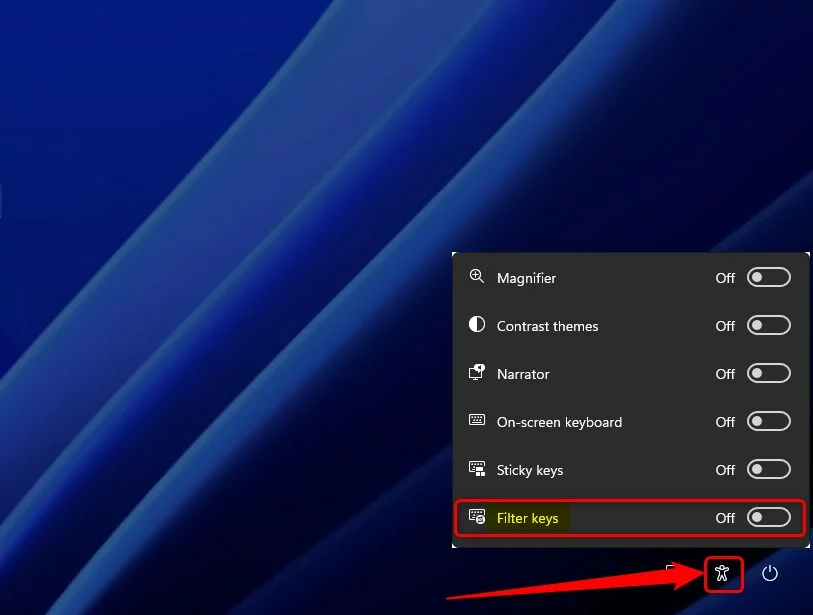
- On the sign-in screen, look for the Accessibility icon in the bottom right corner. It is a small icon, next to the network and power icons.
- Click the icon and find the FilterKeys option. A small panel of accessibility switches opens.
- Toggle the switch to turn it On or Off. The switch changes position right away, and your next key presses follow the new behavior.
If a switch is greyed out or will not stay in the position you set, sign in with an administrator account or ask your IT administrator.
Enable or Disable FilterKeys Using a Shortcut
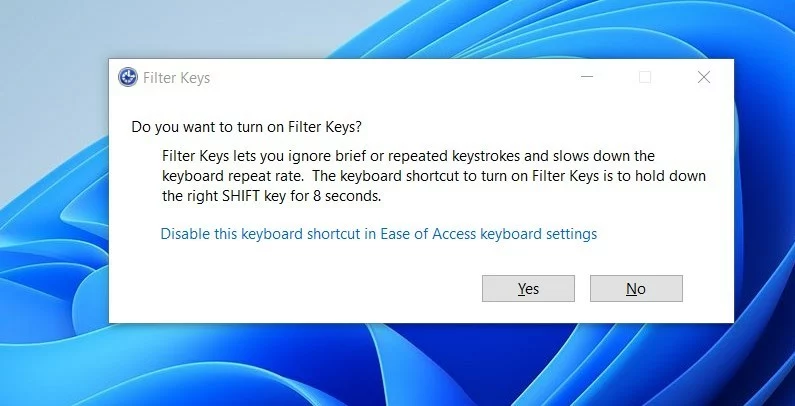
You can turn FilterKeys on or off quickly in Windows 11 using a simple keyboard shortcut. Press and hold the right Shift key on your keyboard for eight seconds until you hear a beep and a confirmation prompt appears on your screen, then click Yes to turn the feature on or off. Repeat the same steps later to reverse the change.
The shortcut only works while the Keyboard shortcut for Filter keys option is enabled in Settings. It is on by default. If nothing happens when you hold the key, check that option first.
- Locate the Right SHIFT key on your keyboard. Use the one on the right side, because the left Shift key does not trigger this shortcut.
- Press and hold this key for eight seconds. Do not tap it or let go early, or the count starts over.
- Wait for a beep sound. Keep holding the key until you hear it.
- A prompt will appear asking if you want to turn the feature on or off. Click Yes to confirm. Click No if the shortcut fired by accident and you want to leave things as they were.
How to Disable the Shortcut
If you hold the right Shift key by accident, the prompt can appear when you do not want it. To prevent accidental activation, turn the shortcut off:
- Open Settings Accessibility Keyboard
- Click Filter keys to expand its options.
- Uncheck the box labeled Keyboard shortcut for Filter keys. On some builds this appears as a switch, so turn it Off.
Holding right Shift for eight seconds will no longer do anything. You can still turn FilterKeys on or off from Settings. To bring the shortcut back, check the box again.
Enable or Disable FilterKeys in Settings
This setting can be managed through the main Windows Settings app menu. It works the same on Windows 11 Home and Pro, and you do not need to restart afterwards.
- Click the Start button and open Settings. You can also press the Win plus I.
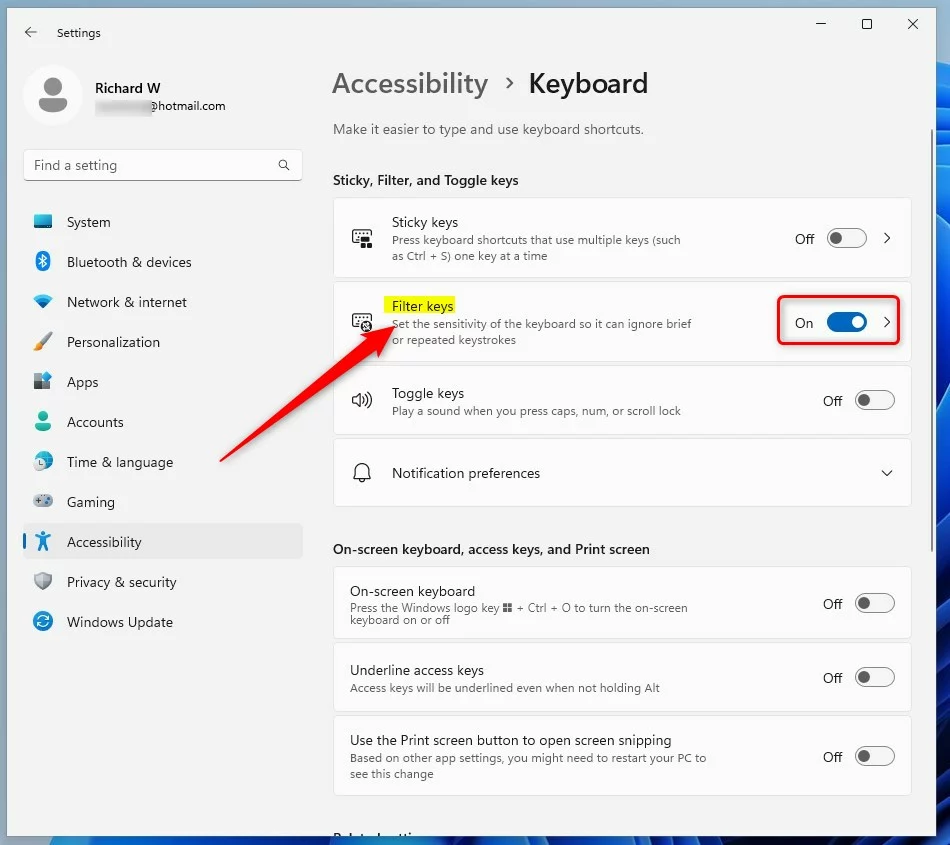
- Go to Accessibility in the left sidebar. The accessibility options appear on the right.
- Select Keyboard. This page lists Sticky keys, Filter keys, Toggle keys and the on-screen keyboard options.
- Look for the Filter keys section and toggle the switch to the On or Off position. Click the section name to expand it if you want to see the extra options. The change takes effect immediately.
Troubleshooting and Tones
Delayed key responses usually indicate that FilterKeys is active. If your keyboard feels slow, or some letters never appear, check this setting first and turn it Off to see whether typing returns to normal.
FilterKeys can also play a sound each time it is switched on or off. To disable the notification sound:
- Open Settings Accessibility Keyboard
- Expand the Filter keys section.
- Uncheck Play a sound when Filter keys is turned on or off.
The sound stops, but FilterKeys itself keeps working as before.
Enable or Disable FilterKeys in Control Panel
The classic Control Panel app interface provides another management option. It is useful if you are used to older versions of Windows or cannot get to the Settings app. Both places control the same feature, so a change in one shows up in the other.
- Open the Control Panel. Search for it in the Start menu if it is not pinned.
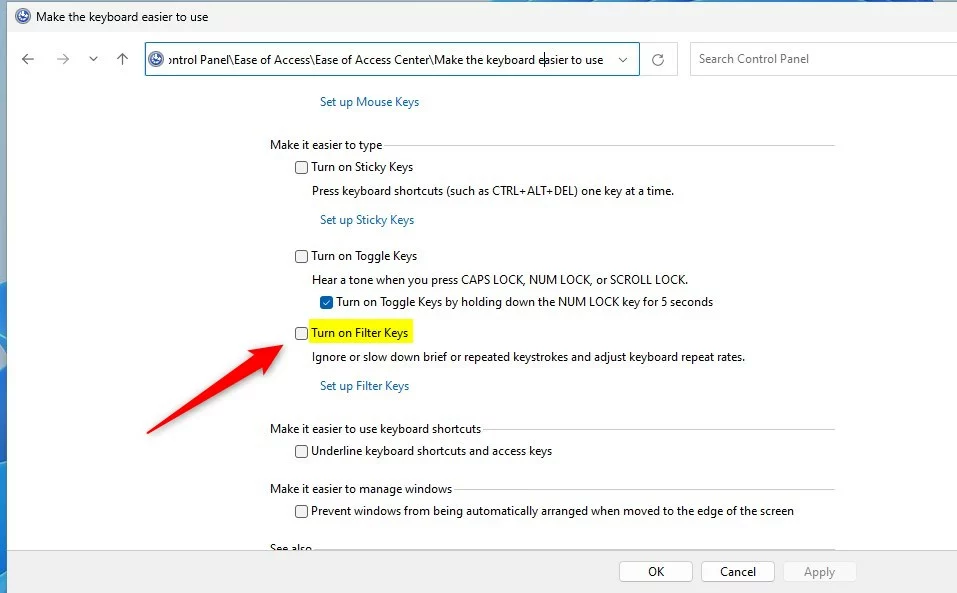
- Go to Ease of Access, then Ease of Access Center. If your view is set to icons, go straight to Ease of Access Center.
- Select Make the keyboard easier to use. A page with keyboard options opens.
- Check or uncheck the box next to Turn on Filter Keys. Check it to enable FilterKeys, or uncheck it to disable it.
- Click Save to apply your changes. On some builds the button reads Apply or OK instead. Click whichever is shown.
Summary
FilterKeys in Windows 11 improves typing accuracy by allowing users to configure settings like Slow Keys and Bounce Keys. You can switch it on or off from the sign-in screen, the right Shift shortcut, Settings or Control Panel. If you only turn it on when you need it, turn off the shortcut so it does not trigger by accident.
Reference: Microsoft.com
Have a question about this guide?
Answered by AI from this guide. Good questions may be added to this page — please don't include personal details.
Did this guide fix your problem?

About the Author
Richard
Tech Writer, IT Professional
Richard is a writer at Geek Rewind who turns complex IT tasks into clear, step-by-step guides. He draws on years of hands-on experience in system administration and enterprise IT operations, focusing on Windows, Linux and WordPress: the problems people actually run into, and the fixes that work. His server and WordPress guides come from systems he runs himself. Richard builds and maintains the platform behind Geek Rewind, from its Ubuntu servers and Nginx configuration to its custom WordPress plugins. Many new tutorials start with readers' questions, and he's always glad to answer them in the comments.
[…] Filter Keys make the keyboard ignore brief or repeated keystrokes that could cause typing errors. […]
[…] Filter Keys – ignores extra repeated key presses. […]
[…] Filter Keys: Ignore repeated or accidental key presses. […]
[…] How to use Filter Keys […]