How to Change Notification Display in Windows 11 Phone Link App

Change notification display in Phone Link by opening the app, clicking the Settings gear, selecting Features, and choosing your preferred style: Hide all content, Show sender only, or Show with preview. You can also stop specific apps from sending alerts through the same menu.
How to Configure Notification Display
Phone Link shows your phone’s text messages and app alerts on your PC. Notification settings let you hide the message text, show only the sender’s name, or turn alerts off entirely, so private chats stay private when someone is near your screen.
Phone Link connects an Android phone running version 9.0 or newer to your Windows 11 PC. The app works the same on Home and Pro editions, so there is no edition difference to worry about. Changing these settings cuts down on pop-ups and keeps personal details off the screen.
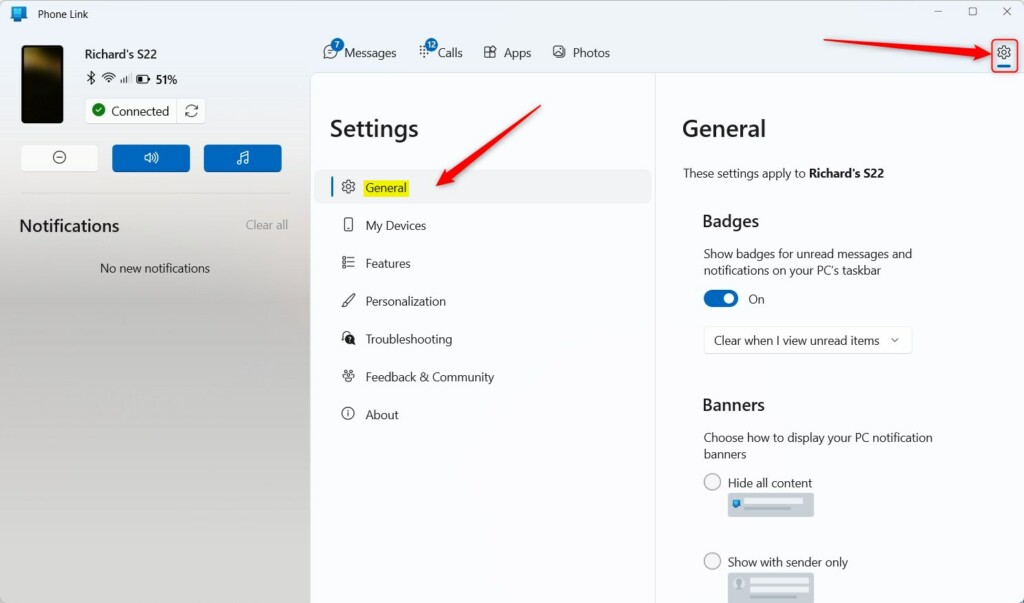
You change the display settings inside the Phone Link desktop app. Open Phone Link on your PC and click the Settings gear icon in the top right. Select Features from the menu, then find the Notifications section. There you can pick your preferred display style, such as hiding all content or showing the sender only. Work through the steps below.
- Open the Phone Link app on your PC.
- Click the Settings gear icon in the top right.
- Select Features from the menu.
- Find the Notifications section.
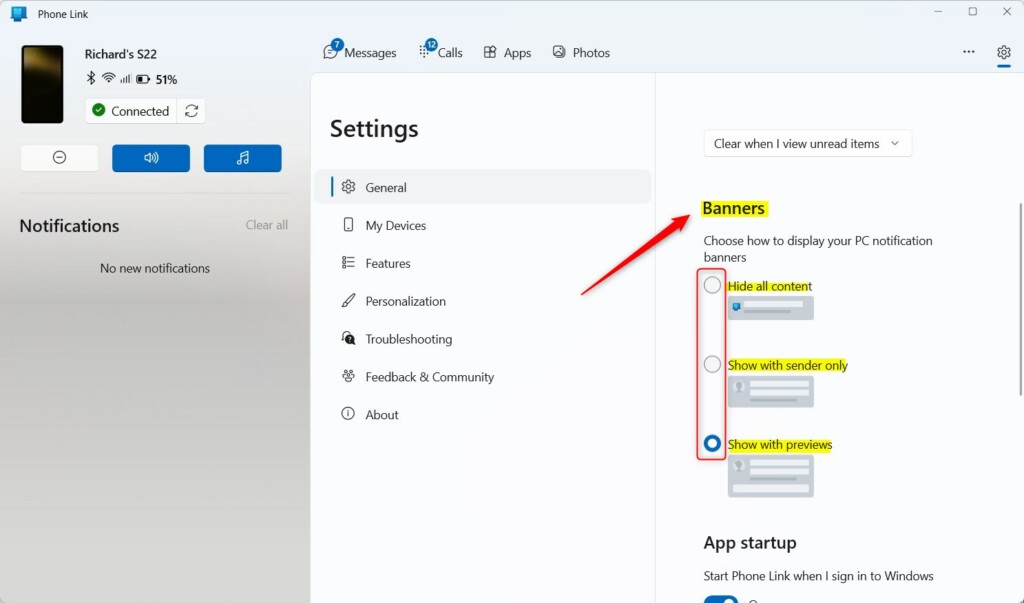
- Choose your preferred display style: Hide all content, Show sender only, or Show with preview.
Your changes save automatically, keeping your notification mirroring private. There is no Save or Apply button, and no restart is needed. To undo a change, go back to the same Notifications section in Phone Link and choose the display style you had before.
To check the result, send yourself a test text from another phone. The alert on your PC should follow the style you picked. If it still shows the full message, close Phone Link and open it again.
Troubleshooting Phone Link Sync Issues
Notification sync problems usually start when the connection between your phone and PC drops, or when a background setting on the phone stops the service. Start on the Android phone. Check the Link to Windows service, make sure it is turned on, and confirm your battery settings do not stop the app from running in the background.
Battery settings are the most common culprit. Many phone makers stop background apps to save power, and Phone Link is often caught by this. Setting the app to unrestricted battery use usually fixes it. The exact menu names vary by phone brand, so look under the app's battery or background activity options. Use the checks below.
- Check Link to Windows: Ensure the Link to Windows service is active on your Android phone.
- Battery Optimization: Go to your Android settings, find the Link to Windows app, and set battery usage to Unrestricted.
- Focus Assist: Ensure Do Not Disturb or Focus Assist is not blocking notifications on your PC.
- Official Help: Visit the Microsoft Support troubleshooting page for deep technical fixes.
Also confirm that both devices are online and that your phone still shows as connected in the Phone Link app on your PC. If the connection looks stale, restarting Phone Link on the PC often brings it back.
Managing App-Specific Notifications
You can stop specific apps from sending alerts to your PC. In the Phone Link Features menu, look for the Choose which apps I get notifications from link. Open it and toggle off any apps that distract you. This keeps your notification center clean and relevant.
This only affects what appears on the PC. Your phone still receives the alerts as normal. To get an app's alerts back, return to the same list and toggle it on again.
Checking Android Permissions
Missing Android permissions frequently cause notification problems. If alerts never reach your PC, or only some of them do, the phone may be blocking Phone Link from reading them.
[Requires Android device access]Work through the steps below on your Android phone, in order.
- Open Settings on your Android phone.
- Search for Apps or Special App Access.
- Find Link to Windows.
- Ensure Notification Access is toggled ON.
After you change a permission, send a test message to your phone and see whether it shows up on the PC. If it does not, close and reopen Phone Link on the PC and try again.
Summary
Managing your Phone Link app notifications is worth a few minutes for both privacy and focus. Adjust the display settings, check the Android permissions, and filter out the apps you do not need. If sync problems come up, check the battery settings first and make sure the Link to Windows service is running.
Why are my Phone Link notifications not showing up?
Your Phone Link notifications might not show up because of permission problems on your Android phone or if Focus Assist (Windows features that silence notifications) is turned on on your Windows PC.
How do I stop specific apps from sending notifications to my PC?
Open the Phone Link app, go to Settings, and select Features. Click the link labeled Choose which apps I get notifications from. A list appears showing all apps currently sending alerts. Toggle the switch to Off for any specific app you want to silence.
Are Phone Link notifications secure?
Phone Link uses end-to-end encryption for data transmission between your phone and PC. However, displaying these notifications on your screen creates a privacy concern. Use the Hide all content or Show sender only settings if you work in public spaces to protect your data.
Have a question about this guide?
Answered by AI from this guide. Good questions may be added to this page — please don't include personal details.
Did this guide fix your problem?

About the Author
Richard
Tech Writer, IT Professional
Richard is a writer at Geek Rewind who turns complex IT tasks into clear, step-by-step guides. He draws on years of hands-on experience in system administration and enterprise IT operations, focusing on Windows, Linux and WordPress: the problems people actually run into, and the fixes that work. His server and WordPress guides come from systems he runs himself. Richard builds and maintains the platform behind Geek Rewind, from its Ubuntu servers and Nginx configuration to its custom WordPress plugins. Many new tutorials start with readers' questions, and he's always glad to answer them in the comments.
[…] your phone connected to your PC, you can choose how to display notifications, choose to hear audio from the PC or phone, turn allow the phone link app to sync over […]
[…] your phone is linked to your computer, you can choose how to display notifications, choose to hear audio from the PC or phone, turn allow the phone link app to sync over mobile […]