How to Control Text Message Notifications in Windows 11 Phone Link

Phone Link is a built-in Windows 11 tool that mirrors text messages, calls, and app alerts from your phone to your computer screen. Controlling text message notifications in Phone Link lets you stop constant pop-ups and sounds from breaking your concentration while you work on your PC.
You can adjust these settings in the Phone Link app to hide message previews, block specific contacts from interrupting you, or turn off all text alerts at once. Some of the controls live in Phone Link, some in Windows 11 itself, and some on your phone. This guide covers each one, what you should see after you change it, and how to undo it.
The steps are written for the current Phone Link app on Windows 11. Microsoft updates the app often, so a label or the position of an icon may differ slightly on your build. I point that out where it is likely.
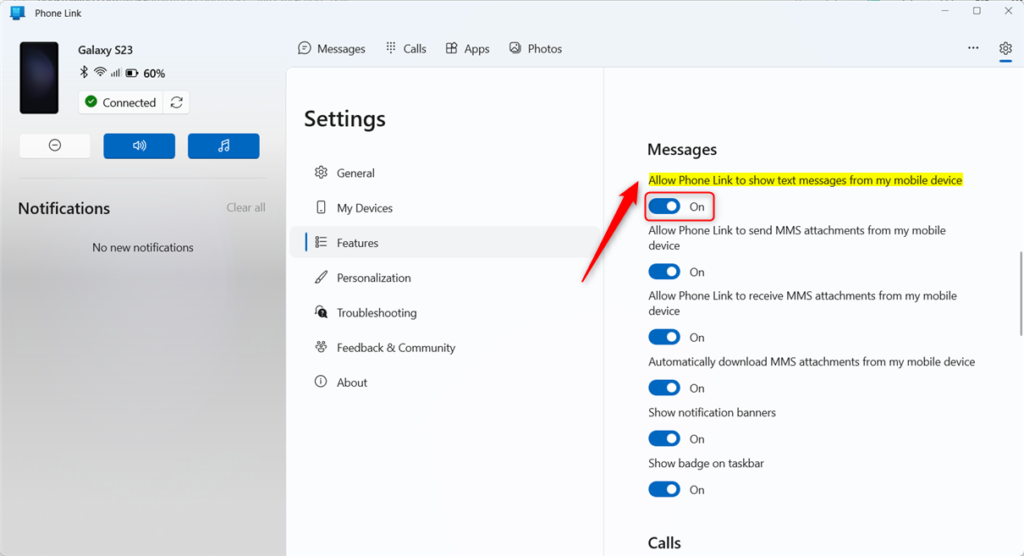
Open the Phone Link app on your PC, click Settings at the top right, select the Features tab, then toggle Allow this app to show text messages from my phone on or off. The change takes effect immediately without restarting.
Why Control 🪟 Windows 11 Phone Link Notifications?
Minimizing text message pop-ups helps maintain focus throughout the workday. Every banner and sound pulls your attention away from what you are doing, even if you do not reply.
You do not have to choose between all alerts and none. You can keep messages syncing so you can read them when you are ready, and silence only the banners and sounds. Or you can stop text messages from appearing on the PC at all. The sections below start with the simplest switch and move to finer control.
How to Configure Text Message Notifications
- Open the Phone Link app on your PC. Use the Start menu search if you cannot find it. You should see your phone’s name and the tabs for messages, calls, and photos. If you see a pairing screen instead, your phone is not linked yet. Finish pairing first.
- Click the Settings (gear icon) at the top right. The Phone Link settings page opens. On some builds the gear sits in a different corner, so look around the window edges if you do not see it.
- Select the Features tab. This tab lists the main functions of the app, such as messages, notifications, and calls.
- Locate the Messages section. You should see the switch for text message sync.
- Toggle the switch for Allow this app to show text messages from my phone to On or Off. The change takes effect right away. You do not need to restart the app or the PC. To undo it, flip the same switch back.
Check that the phone shows as connected in Phone Link, then see the permissions section further down. These steps work the same on Windows 11 Home and Pro.
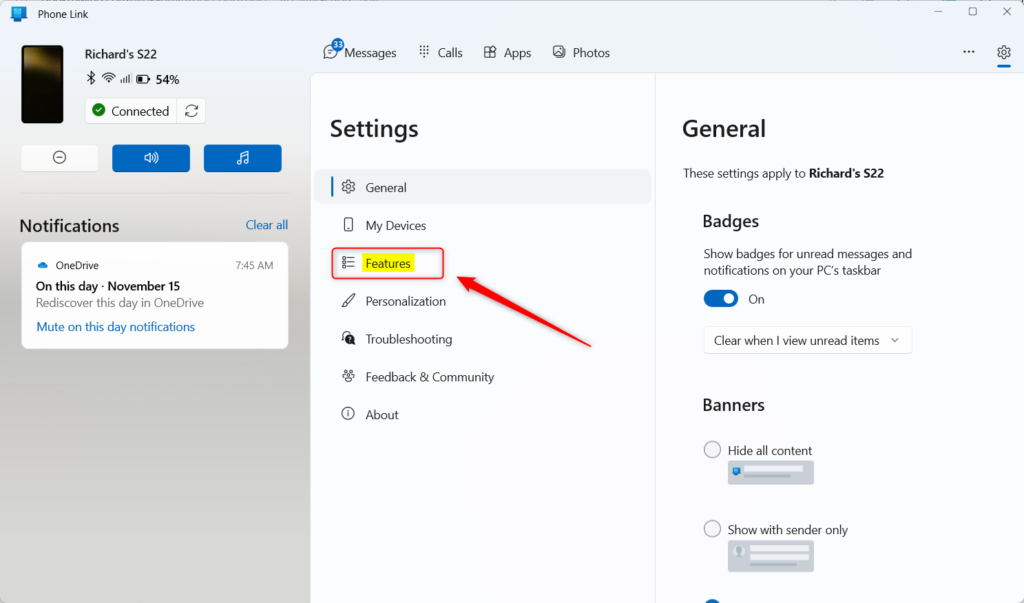
Windows 11 Phone Link notifications let you see and reply to text messages directly on your computer screen. You can control these alerts by opening the Phone Link app, heading to the settings menu, and turning the message notifications switch on or off under the features tab.
Two things are easy to mix up here. The switch in Phone Link decides whether your phone's messages and alerts show up on the PC at all. The notification settings in Windows 11 decide how those alerts look and sound once they arrive. If you want a quiet PC but still want to read messages later, leave Phone Link on and turn down the Windows 11 settings covered below.
Troubleshooting Phone Link Sync Issues
If messages are not syncing, start by checking your phone's battery settings. Aggressive power-saving modes frequently delay incoming alerts.
Messages then arrive late, in bursts, or only when you open the app on the phone. Look in your phone's battery settings for the Link to Windows app and set it to unrestricted or "not optimized". The exact wording depends on your phone's maker.
Also confirm that both devices are online and that the phone still shows as connected in Phone Link. If a notification setting does not behave as expected after these checks, close Phone Link and open it again before you change anything else.
Checking Android Notification Access
Proper functionality requires granting permission to read text message notifications. Android users grant this access by opening Phone Link settings and enabling the "Notifications" toggle.
Android also keeps its own list of apps that may read your notifications, and Link to Windows has to be on that list. If you turned on the toggle in Phone Link and still get nothing, check the phone side as well. The steps below are for Android. The names can differ a little between phone makers.
- Open Settings on your phone.
- Search for Special App Access. The search box at the top of Settings is the quickest route. You should see a result with that name.
- Tap Notification Access. You should see a list of apps that can read your notifications.
- Ensure Link to Windows is toggled On. Android may show a confirmation prompt. Accept it. To stop notifications from reaching your PC, turn the toggle off again.
On an iPhone the setup is different, because notifications travel over Bluetooth. If alerts are missing, check that Bluetooth is on and that your phone allows the PC to show notifications in its Bluetooth settings.
Advanced Notification Management
Advanced notification management in Windows 11 Phone Link handles how alerts display inside the Action Center while supporting direct replies from pop-up banners.
Once alerts reach your PC, Windows 11 treats Phone Link like any other app. You can quiet it from the Windows notification settings without touching your phone:
- Open Settings System Notifications You should see the master notification switch, followed by a list of apps.
- Scroll through the app list and find Phone Link. If it is not listed, the app has not sent a notification yet.
- Turn the Phone Link switch off to stop all of its alerts, or click the app name to open its options.
- In the options, turn off the banner or the sound, or both, depending on what bothers you. Notifications that still arrive will sit quietly in the notification center.
If you only need silence for a while, turn on Do not disturb at the top of the same Notifications page. That mutes every app, including Phone Link, and you can switch it off again when you are done. All of these changes apply immediately and need no restart.
When a banner does appear, you can reply to a text from the banner itself instead of opening Phone Link, if your build offers that option. Any alerts you missed stay in the notification center, which you open by clicking the date and time area on the taskbar.
Summary
Adjusting these specific settings and permissions keeps notifications manageable without losing touch. Use the switch in Phone Link to decide what reaches your PC, the Windows 11 notification settings to decide how it looks and sounds, and the Android notification access setting to make sure the connection works.
If something stops working after a change, retrace the steps above and put the switch back. Every setting here can be reversed in a few clicks.
Have a question about this guide?
Answered by AI from this guide. Good questions may be added to this page — please don't include personal details.
Did this guide fix your problem?

About the Author
Richard
Tech Writer, IT Professional
Richard is a writer at Geek Rewind who turns complex IT tasks into clear, step-by-step guides. He draws on years of hands-on experience in system administration and enterprise IT operations, focusing on Windows, Linux and WordPress: the problems people actually run into, and the fixes that work. His server and WordPress guides come from systems he runs himself. Richard builds and maintains the platform behind Geek Rewind, from its Ubuntu servers and Nginx configuration to its custom WordPress plugins. Many new tutorials start with readers' questions, and he's always glad to answer them in the comments.
[…] your mobile devices from your PC instantly. This feature comes in handy when transferring files, sending messages, or receiving notifications from your phone while working on your […]