How to Manage Android Phone Link Suggestions in Windows 11

Phone Link suggestions in Windows 11 show pop-up tips on your screen when your Android phone gets a text message or a missed call. These prompts let you open links or reply to messages from your PC without picking up your phone.
You can turn these suggestions on or off in the Settings app whenever you want to control what appears on your desktop. This guide covers the Settings method first and then the Registry Editor method. Neither one needs any extra software.
Open Settings , go to Bluetooth & devices Mobile devices, then toggle Show me suggestions for using my mobile device with Windows on or off. The change takes effect immediately without restarting.
Connecting Your Phone and Computer
Once your Android phone is linked to your Windows 11 PC, the Phone Link app lets you read texts, take calls and view photos from the PC. Windows 11 can also suggest ways to use your phone with your PC, and those suggestions are what we are managing here.
You do not need to unlink your phone to change this. Turning suggestions off only stops the prompts. Your phone stays connected and Phone Link keeps working as before.
Managing Phone Suggestions in Settings
The easiest place to control these prompts is the Settings app. It works the same on Windows 11 Home and Pro, and you do not need administrator rights to change it for your own account.
Open Settings
First, open the Settings app. There are two quick ways to do it:
- Press Windows key + I at the same time. This is usually the fastest way.
- Click the Start button, then click the small gear icon that stands for Settings.
Either way, the Settings window should open with a list of categories in the left sidebar.
Go to Mobile Devices
The suggestion setting lives on the Mobile devices page. To get there:
- Open Settings, using one of the methods above.
- Click Bluetooth & devices in the left sidebar. The list of Bluetooth, printers and other device options appears on the right.
- Click Mobile devices. This page holds the options for the phone connected to your PC.
The full path is Settings Bluetooth & devices Mobile devices
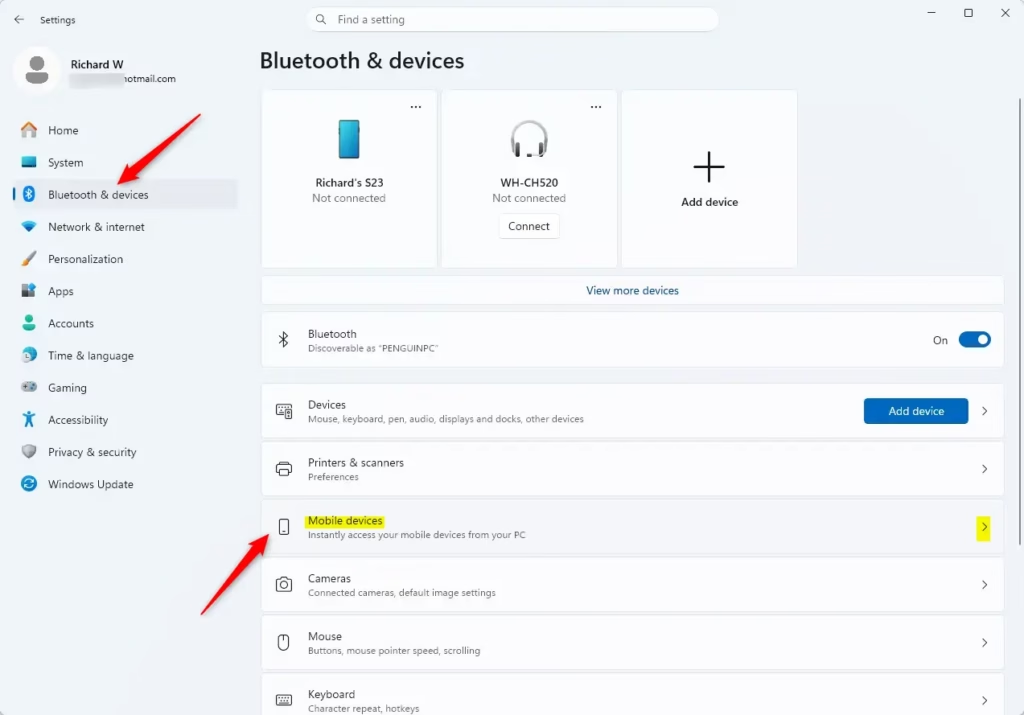
Don't worry if the name is slightly different; the location is the same. If you cannot find the page at all, run Windows Update and check again. Older builds may not have it, and in that case the Registry method below is your option.
Turn Suggestions On or Off
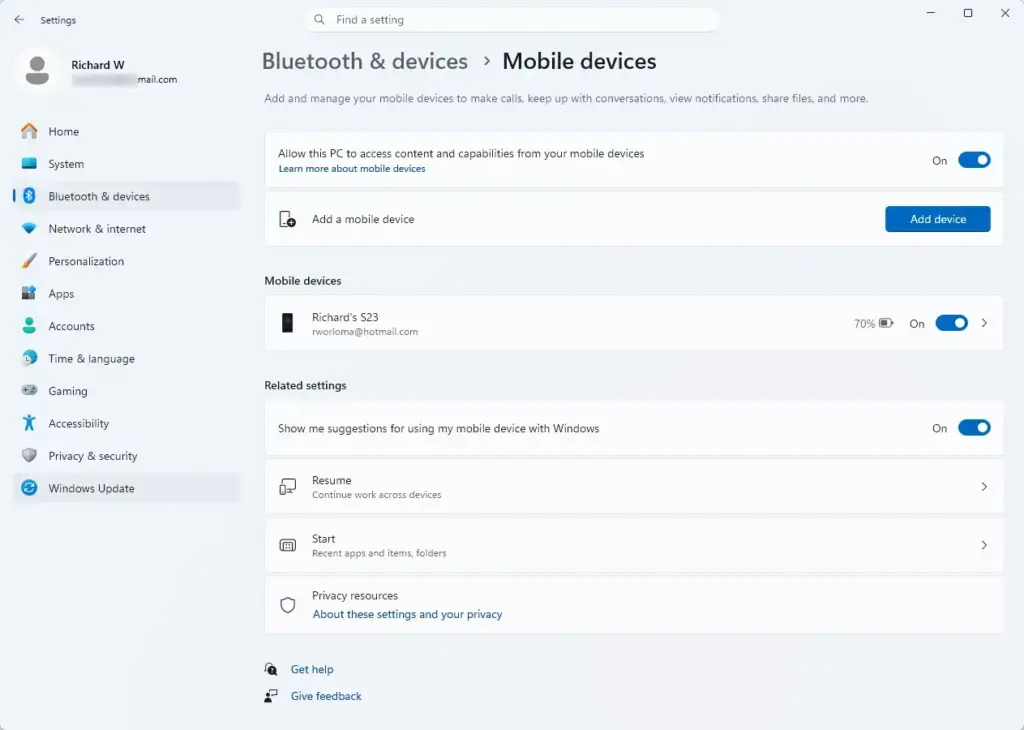
On the Mobile devices page, you can turn phone suggestions on or off:
- Find the option labeled Show me suggestions for using my mobile device with Windows.
- Click the toggle to switch it to On if you want suggestions, or to Off if you do not.
The toggle should change position and its label should change to match. If it is greyed out or missing, the page may be hidden on your build, or your PC may be managed by an organization that controls the setting.
Close Settings
Settings saves this choice automatically, so there is no Save or Apply button. You can close the Settings window once you have made your choice. You do not need to restart the PC. To undo the change, come back to the same page and flip the toggle again.
Changing Phone Suggestions Using Registry Editor
You can also manage Windows 11 phone suggestions by editing the Windows Registry, which is a database that holds system and app settings. This takes more care than using Settings, but it is useful if the Settings page is missing or you want to script the change. The steps below work on both Home and Pro.
Understanding the Registry Setting
The phone suggestion setting is stored at HKEY_CURRENT_USER\Software\Microsoft\Windows\CurrentVersion\Mobility. Inside that key, a value named OptedIn controls whether Windows shows you suggestions. A value of 1 means suggestions are on, and 0 means they are off. Because the key sits under HKEY_CURRENT_USER, the setting applies only to the account you are signed in with.
Steps to Turn On Suggestions
To turn Android phone suggestions on with the Registry Editor, set the OptedIn value to 1. This has the same effect as switching the toggle on in Settings.
- Open Registry Editor. Press Windows key + R to open the Run box. Type
regeditand press Enter, or click OK. If a User Account Control message asks whether to allow the app to make changes to your device, click Yes. The Registry Editor window should now open. - Go to the correct location. In the left pane, click the small arrows to expand the folders until you reach this path:
HKEY_CURRENT_USER\Software\Microsoft\Windows\CurrentVersion\Mobility
Click the Mobility folder to select it. Its values should now be listed in the right pane. - Set the OptedIn value to 1. Look in the right pane for a value named OptedIn. If it is not there, create it: right-click an empty area of the right pane, select New, then DWORD (32-bit) Value, and name it
OptedIn. Then double-click OptedIn. In the window that opens, set Value data to 1, which means "on" for this setting, and click OK. Setting OptedIn to 1 turns on Phone Link suggestions in Windows 11, the same as using the toggle in the Settings app. - Close Registry Editor. Close the window. Windows often applies the change right away. If the suggestions do not come back, sign out and back in, or restart the PC.
Steps to Turn Off Suggestions
To turn Android phone suggestions off, open the Registry Editor and change the same value in the Mobility key to 0. This stops the prompts about your phone without unlinking it.
- Open Registry Editor. Press Windows key + R, type
regedit, and press Enter. Click Yes if User Account Control asks for permission. The Registry Editor window should open. - Go to the correct location. In the left pane, go to this path:
HKEY_CURRENT_USER\Software\Microsoft\Windows\CurrentVersion\Mobility
Click the Mobility folder to select it. - Set the OptedIn value to 0. In the right pane, find OptedIn and double-click it. In the window that appears, change Value data to 0, which means "off" for this setting, and click OK. Tip: Setting this value to 0 is the same as turning the suggestion toggle off in Settings. If OptedIn is not there, the suggestions are probably already not being shown through this key, and you can create it as a DWORD (32-bit) Value as described in the previous section.
- Close Registry Editor. Close the window. The change often works right away, but you may need to sign out and back in, or restart the PC, for it to fully apply.
Always double-check that you are editing the correct locations and settings. It's a good idea to back up first: in Registry Editor, select the key you are about to change, click File Export, and save the file somewhere safe. Double-clicking that file later puts the saved values back. For this specific setting, the risk is usually low, but it's always best to be careful.
Summary
You can control suggestions for your Android phone on Windows 11 through Settings. Go to Settings Bluetooth & devices Mobile devices and switch the Show me suggestions for using my mobile device with Windows toggle on or off. The change saves on its own and needs no restart.
For advanced users, changing the OptedIn DWORD value in the Registry Editor to 1 (on) or 0 (off) gives the same result. Back up the key first, and sign out or restart if the change does not show up straight away.
Have a question about this guide?
Answered by AI from this guide. Good questions may be added to this page — please don't include personal details.
Did this guide fix your problem?

About the Author
Richard
Tech Writer, IT Professional
Richard is a writer at Geek Rewind who turns complex IT tasks into clear, step-by-step guides. He draws on years of hands-on experience in system administration and enterprise IT operations, focusing on Windows, Linux and WordPress: the problems people actually run into, and the fixes that work. His server and WordPress guides come from systems he runs himself. Richard builds and maintains the platform behind Geek Rewind, from its Ubuntu servers and Nginx configuration to its custom WordPress plugins. Many new tutorials start with readers' questions, and he's always glad to answer them in the comments.
[…] for all my apps on or off, show notifications in the Phone Link feature feed, enable or disable using Phone Link with Windows suggestions, open Phone Link notification banners in the mobile app or Phone Link, enable or disable […]
[…] show notifications for all my apps on or off, show notifications in the Phone Link feature feed, enable or disable using Phone Link with Windows suggestions, open Phone Link notification banners in the mobile app or Phone Link, enable or disable showing […]
[…] show notifications for all my apps on or off, show notifications in the Phone Link feature feed, enable or disable using Phone Link with Windows suggestions, open Phone Link notification banners in the mobile app or Phone Link, enable or disable Phone Link […]