How to Enable Noise Suppression in Microsoft Teams

This article explains how to enable or disable “Noise suppression” in Microsoft Teams to reduce unwanted ambient sounds and improve communication.
Open Microsoft Teams, click the three dots next to your profile picture, select Settings, then Devices. Under Audio settings, find Noise suppression and toggle it to On. This filters out background sounds from your microphone.
Microsoft Teams is a collaboration platform developed by Microsoft that integrates chat, video meetings, file storage, and application integration.
The free version is installed on Windows with its icon on the Taskbar.
There are many settings one can enable in the Microsoft Teams app. You can connect your Google calendar, turn the camera and mic on or off on the lock screen, turn read receipts on or off, auto start Teams, disable Teams chat, sync contacts with Teams, connect to Google Calendar, link your mobile device, turning message preview on or off, manage teams notifications during calls, set default speakers, set default microphone, enable high fidelity sound, change mic sensitivity, set default camera, enable auto-brightness, and more.
The new Microsoft Teams also has a “Noise suppression” feature that helps enhance audio quality.
Noise suppression refers to techniques and technologies to reduce unwanted ambient sounds, often to enhance audio quality or improve communication clarity. In practice, it filters out things like keyboard clicks, fan hum, barking dogs and street noise so that other people hear your voice more clearly.
The steps below walk you through enabling or disabling Noise suppression in Microsoft Teams.
Turn on "Noise suppression" in Microsoft Teams
As mentioned, users can turn on a "Noise suppression" feature to improve communication clarity when using Microsoft Teams. The setting applies to your own microphone, so it changes what other people hear from you, not what you hear from them.
Here's how to do it.
- Click the Start menu and select Microsoft Teams from the All Apps list.
The Microsoft Teams window should open.

You can also launch the app from the Taskbar or Taskbar overflow.

- In the full Teams window, click the Settings and more ( …) button next to your profile picture.
- Select Settings from the menu. The Settings page opens.

- Click the Devices tab on the left of the Settings page. The audio and video device options appear on the right.
- Under “Audio Settings,” choose one of the microphones on the drop-down menu if multiple devices are connected to Windows. Pick the microphone you actually use, because the noise suppression setting applies to the selected device.
- Turn on 'Noise suppression' to enable the feature. To disable it, toggle the button to the Off position.
Teams applies the change without a restart. If you don't see the option, make sure you're running the new Microsoft Teams and that the app is up to date. Some older builds and older computers don't offer every noise suppression choice.
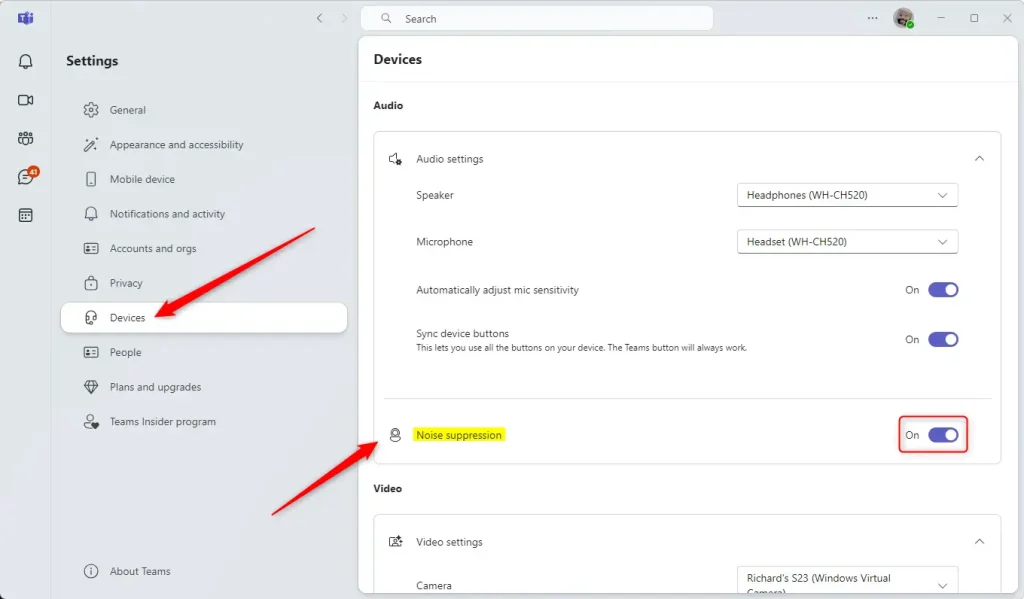
Depending on your version of Teams, the setting may appear as a simple on/off toggle or as a list with several levels. These are the levels you can choose from:
- Auto: Teams decides how much noise to remove based on what it hears. This is the default for most users and a good starting point.
- High: Removes as much background noise as possible. This level may use more CPU, and it requires supported hardware, so it may not be available on older or low-powered computers.
- Low: Removes only steady background noise, such as a fan or air conditioner. It uses less processing power and is useful if you want to share music or other sounds from your room.
- Off: Turns noise suppression off completely.
If your PC struggles during meetings (choppy audio, fans running hard), try switching from High to Auto or Low and see if it improves.
You don't have to leave the meeting to change this setting. Before you join, you can adjust noise suppression on the pre-join screen under the Audio settings. Once you're in a call, go to More Settings Device settings and change it there. This is handy when the background noise changes halfway through a meeting. To undo any change, return to the same place and select your previous level or turn the setting off.
That should do it!
Conclusion:
The Noise suppression feature in Microsoft Teams can significantly enhance your audio experience during calls and meetings. Here are some key takeaways:
- Improved communication clarity: Reduces background noise, allowing for clearer conversations.
- Easy to enable or disable: Simple toggling in Settings makes it user-friendly, and you can also change it during a meeting.
- Adjustable levels: Choose Auto, High, Low or Off to balance noise removal against CPU use.
- Variety of device compatibility: Works with multiple connected microphones for flexible user choices.
- Enhanced meeting experience: Helps maintain focus and professionalism in remote communications.
- Accessible support: Microsoft Teams provides ample resources for troubleshooting and feature exploration.
By leveraging this feature, you can ensure your interactions are as effective and distraction-free as possible.
Did this guide fix your problem?

About the Author
Richard
Tech Writer, IT Professional
Richard is a writer at Geek Rewind who turns complex IT tasks into clear, step-by-step guides. He draws on years of hands-on experience in system administration and enterprise IT operations, focusing on Windows, Linux and WordPress: the problems people actually run into, and the fixes that work. His server and WordPress guides come from systems he runs himself. Richard builds and maintains the platform behind Geek Rewind, from its Ubuntu servers and Nginx configuration to its custom WordPress plugins. Many new tutorials start with readers' questions, and he's always glad to answer them in the comments.
No comments yet — be the first to share your thoughts!