How to Sync Google Contacts with Microsoft Teams on Windows 11

- 13 steps
- Needs administrator rights
Syncing Google contacts with Microsoft Teams on Windows 11 lets you call and message people from your Google address book without switching apps. Teams has no direct button for Google accounts, so you export your contacts from Google as a CSV file (a simple spreadsheet format) and import that file into Outlook. The contacts then show up in Teams.
The whole job takes about 5 minutes for an average contact list. Afterwards your phone numbers and email addresses sit in one place on your PC. It works the same on Windows 11 Home and Pro, because it depends on your Google, Outlook and Teams accounts and not on the Windows edition.
Export your Google Contacts as a CSV file, then open Outlook, go to People Manage Contacts Import Contacts, select the CSV file, and complete the import. Your contacts sync to Microsoft Teams automatically and appear in your People list.
Why Sync Your Contacts?
Combining the two address books gives you one list to work from. You can find a colleague, friend or client and start a chat or call from Teams without opening Gmail or Google Contacts first. Having phone numbers and email addresses ready in Teams also saves you from searching through old messages for a contact detail.
What Happens When Done?
The path your contacts take matters, because it explains where to look when something is missing. Google contacts land in your Outlook account first, and Teams picks them up from there. Once they appear, you can call or message them directly inside Teams. If a contact is not in Teams, check Outlook first. If it is not in Outlook, the import did not finish.
Teams can take a little while to show newly imported contacts. If you don’t see them right away, give it a few minutes, then close and reopen Teams.
How to Sync via Outlook (The Middle-Man Method)
Teams does not connect to Google directly, so Outlook works as the bridge. First, save your contacts from Google as a CSV file (a spreadsheet file that stores data). Next, open Outlook, go to the People section, select Manage Contacts, and upload that file. Your contacts then appear in Outlook and sync over to your Microsoft Teams account. You need to sign in to Outlook with the same Microsoft account or work account that you use in Teams.
- Go to Google Contacts in your browser and sign in to the Google account that holds the contacts.
- Click Export to save your contacts as a .csv file. If Google asks which contacts to export and which format to use, choose the contacts you want and pick a CSV option such as Outlook CSV, then confirm. The file downloads to your Downloads folder.
- Open Outlook on the web or your desktop app and sign in.
- Go to People, select Manage Contacts, and choose Import Contacts.
- Click the browse option, pick the CSV file you just downloaded, and start the import. When it finishes, your Google contacts should be listed under People in Outlook.
- Open Teams. Once the import has synced with your Microsoft account, the contacts appear there.
Contacts you add or change in Google later are not updated automatically, so repeat the export and import when you want to refresh the list. To avoid duplicates when you repeat it, see the clean-up section below.
Automation Workarounds with Power Automate
Power Automate can build a workflow that moves contacts for you, which suits anyone who does not want to export and import by hand. It has connectors for both Google Contacts and Outlook. A flow can watch for new Google contacts and create matching ones in Outlook, so they reach Teams without repeated manual work. Setup takes longer than the CSV method, so use it if you add contacts often.
Third-Party Solutions and Data Privacy
Third-party tools (independent software made by other companies) offer an automated way to sync Google contacts without using Outlook. Check the privacy policy before you log in to any of them. Giving these apps access means they can read your personal contact data, so stick to well-known and trusted services. Check which permissions the tool asks for, and if you stop using it, remove its access from your Google account.
How to Avoid Duplicate Contacts
Importing Google contacts sometimes creates duplicate entries, especially if you have imported before or the same person is saved in both accounts. A little preparation reduces this problem.
- Clean up your Google contact list before you export it.
- Remove old or empty contact entries.
- If duplicates still appear after the import, Outlook users can run the Clean up contacts feature to merge them.
How to sync your contacts
To reach your address book in Microsoft Teams, first open the Teams app on your Windows 11 computer. Launch it from your taskbar or the Start menu. If a small pop-up window opens instead of the full app, click the expansion button to see the main interface, where your synced contacts will show up. The next steps cover the Teams settings that control contact syncing.

- Click the Teams icon on your taskbar , or in the overflow menu if it is hidden there. The Teams window or pop-up opens.

- If you see only a small pop-up window, click the expansion button on it. The full Teams interface should now open.

- Find the Settings and more button, the three dots near your profile picture, and click it. The Settings menu opens.

- Select the People tab on the left side.
- Click the Manage button under the Sync contacts section. A list of sources opens.
Some Teams versions show these options differently or leave out the Sync contacts section. If you can’t find it, use the Outlook import method above, which works whatever Teams version you have.
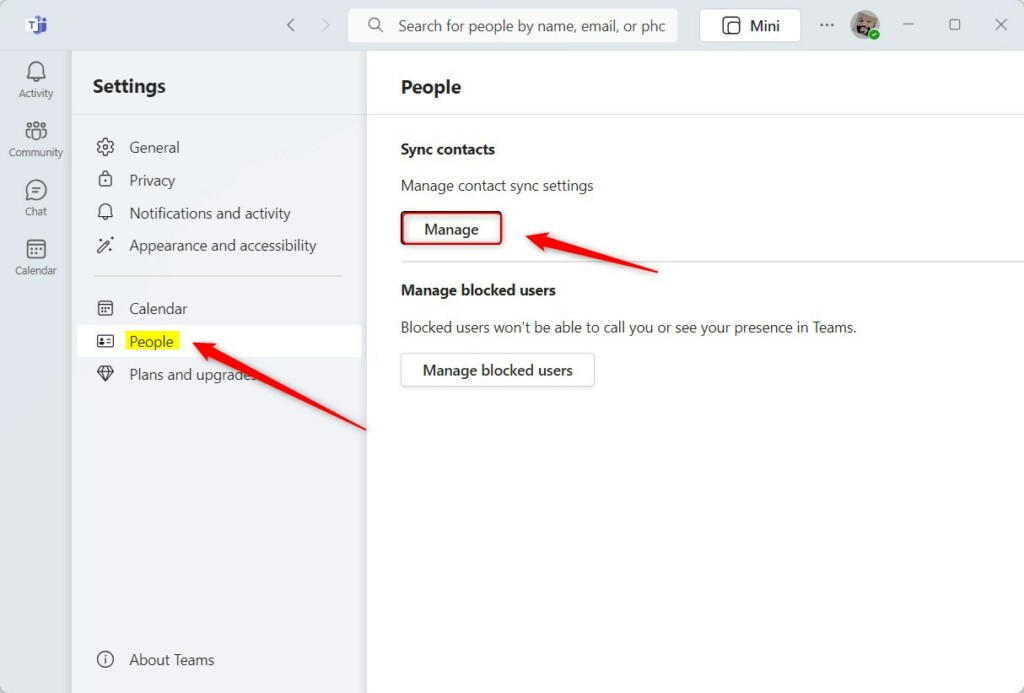
The list shows the places you can sync from. You can choose Google, Skype, Outlook.com, or a mobile device. Pick the source you want to bring into Teams, which here is Google.
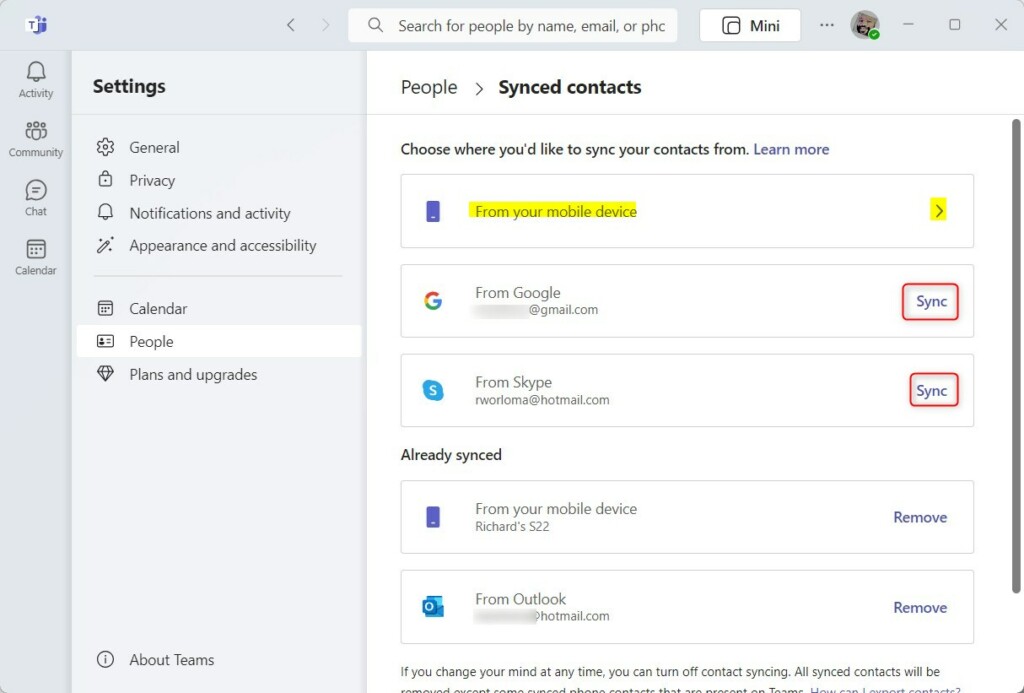
- Click the Sync link for Google.
- Scan the QR code on screen with your phone. This grants the app access to the contacts on your mobile device.
Managed work computers running corporate group policies might restrict these settings, however. If the options are hidden or greyed out, contact your IT department.
You can turn syncing off at any time through the same menu. To remove all Google data from Microsoft services entirely, visit Privacy settings..
Summary
Google Contacts and Microsoft Teams have no direct integration. To bring your contacts across, use Outlook as the go-between with a CSV export, or set up Power Automate for a hands-off connection. The CSV method is the quicker one to try first, and you can undo it by deleting the imported contacts in Outlook.
Have a question about this guide?
Answered by AI from this guide. Good questions may be added to this page — please don't include personal details.
Did this guide fix your problem?

About the Author
Richard
Tech Writer, IT Professional
Richard is a writer at Geek Rewind who turns complex IT tasks into clear, step-by-step guides. He draws on years of hands-on experience in system administration and enterprise IT operations, focusing on Windows, Linux and WordPress: the problems people actually run into, and the fixes that work. His server and WordPress guides come from systems he runs himself. Richard builds and maintains the platform behind Geek Rewind, from its Ubuntu servers and Nginx configuration to its custom WordPress plugins. Many new tutorials start with readers' questions, and he's always glad to answer them in the comments.
[…] screen, turn read receipts on or off, auto start Teams, disable Teams chat, sync contacts with Teams, connect to Google Calendar, link your mobile device, turning message preview on or […]
[…] the lock screen, turn read receipts on or off, auto start Teams, disable Teams chat, sync contacts with Teams, connect to Google Calendar, and […]
[…] are many settings one can enable in the Microsoft Teams app. You can sync contacts with Teams, connect to Google Calendar, link your mobile device, turn message preview on or off, manage […]
[…] are many settings one can enable in the Microsoft Teams app. You can sync contacts with Teams, connect to Google Calendar, link your mobile device, turn message preview on or off, manage […]
[…] are many settings one can enable in the Microsoft Teams app. You can sync contacts with Teams, connect to Google Calendar, link your mobile device, turn message preview on or […]
[…] are many settings one can enable in the Microsoft Teams app. You can sync contacts with Teams, connect to Google Calendar, link your mobile device, turn message preview on or off, manage […]
[…] are many settings one can enable in the Microsoft Teams app. You can sync contacts with Teams, connect to Google Calendar, link your mobile device, turn message preview on or off, and […]
[…] are many settings one can enable in the Microsoft Teams app. You can sync contacts with Teams, connect to Google Calendar, link your mobile device, turn message preview on or off, manage […]
[…] are many settings one can enable in the Microsoft Teams app. You can sync contacts with Teams, connect to Google Calendar, link your mobile device, turn message preview on or off, manage […]
[…] are many settings one can enable in the Microsoft Teams app. You can sync contacts with Teams, connect to Google Calendar, link your mobile device, turn message preview on or […]
[…] are many settings one can enable in the Microsoft Teams app. You can sync contacts with Teams, connect to Google Calendar, link your mobile device, turn message preview on or […]
[…] How to sync contacts with Teams […]
[…] on or off on the lock screen, turn read receipts on or off, auto start Teams, disable Teams chat, sync contacts with Teams, connect to Google Calendar, link your mobile device, and turning message preview on or […]
[…] or off on the lock screen, turn read receipts on or off, auto start Teams, disable Teams chat, sync contacts with Teams, connect to Google Calendar, link your mobile device, turning message preview on or off, manage […]