How to Connect Google Calendar to Microsoft Teams in Windows 11

Connecting Google Calendar to Microsoft Teams in Windows 11 lets you see your personal and work schedules in one place, so you don’t have to keep switching apps. Your Google events sync into the Teams calendar view. Teams shows only one primary calendar service at a time.
That means Google Calendar and Outlook can’t both run inside Teams at once. Switching back to Outlook takes only a few clicks in your account settings, so the change is easy to undo.
The Google Calendar option appears in the Teams app that Windows 11 installs for personal use. If you use Teams with a work or school account, your organization may control which calendars you can connect. If the Google tile is missing later in this guide, that is the most likely reason, and your IT admin can confirm.
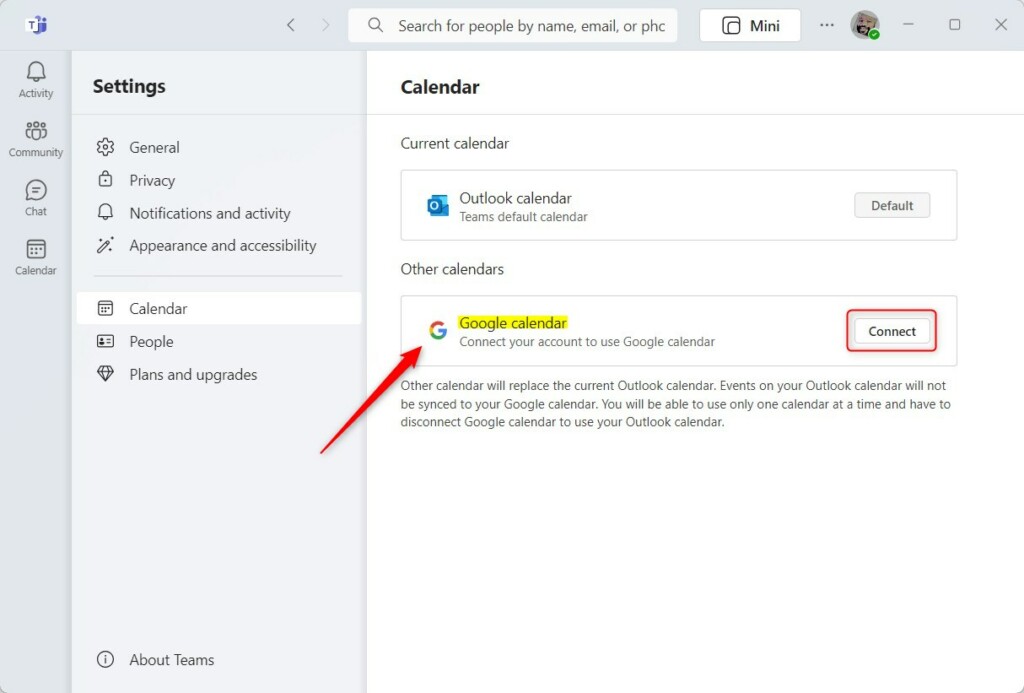
Open Microsoft Teams, go to Settings , then Calendar, and click Connect on the Google calendar tile. Authorize the connection in your web browser by signing into your Google account and granting permissions. This integrates your Google Calendar directly into your Teams interface.
Switch to Google calendar in Microsoft Teams
The process has four parts. You open Teams, switch to the full window, add your Google account in the settings , and approve the connection in your browser. Once that is done, your Google appointments and meetings show up inside Teams, with no window switching.
Before you start, have your Google account email and password ready. You will sign in to Google in your browser partway through.
- Open Microsoft Teams from the Start menu , the Taskbar, or the All Apps list.
- Wait for the Teams window to appear. If you haven’t signed in before, sign in with your Microsoft account first.

If you use Teams often, pin it to the Taskbar or Taskbar overflow. That gives you a quicker way to launch it next time.

Teams may first open as a compact mini window. The settings you need are in the full window, so switch to it before you continue.
- Find the expansion button on the menu bar of the mini window.
- Click it. The mini window should grow into the full Teams window.

Now open the settings from the profile area.
- Click the three dots (…) next to your profile picture.
- Select Settings from the menu. The Settings window should open with a list of categories on the left.

Next, pick the calendar service you want Teams to use.
- In the left-hand menu, choose the Calendar tab.
- On the right, find the Google calendar tile.💡If you can't find the Google calendar tile
The Google calendar tile has been removed from Microsoft Teams, so it no longer appears in the Calendar settings. Microsoft has taken away the option to connect Google Calendar, and there is no direct replacement in Teams. Don't keep searching the Calendar tab or changing other settings, because the option isn't there. If you need to see your Google events, open Google Calendar in your web browser instead.
- Select the tile, then click Connect.
If you don’t see a Google calendar tile, you are probably on a work or school account, or on a version of Teams that doesn’t offer it. See the note at the top of this guide.
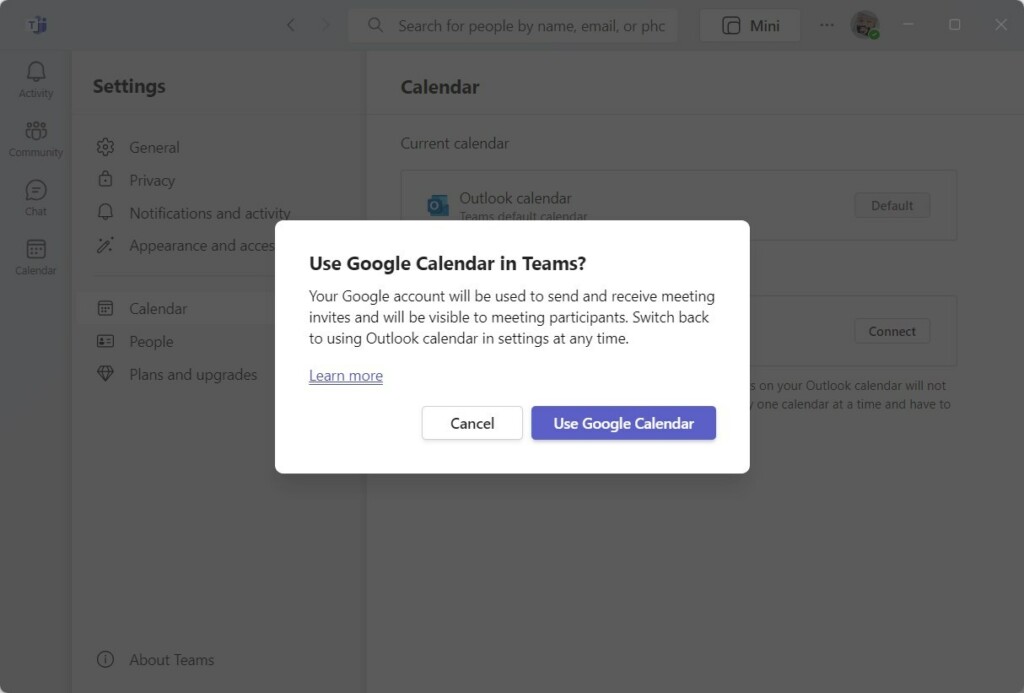
Teams now asks you to confirm that you want to connect Google Calendar.
- Read the prompt asking you to authorize the Google calendar integration.
- Confirm it to continue. Your default browser should open on its own.
Your default browser opens to finish the sign-in. Teams needs your permission to read and manage your scheduling data.
- In the browser window, sign in to the Google account whose calendar you want to use.
- Review the permissions Teams asks for, then grant them. Granting them authorizes Teams to manage your calendar data.
- When the browser says the connection is complete, return to the Teams window.
If you later want to remove the link, you can revoke Teams’ access from your Google account’s security settings.
Once authorization succeeds, Google Calendar becomes the default calendar option in Microsoft Teams. Open the calendar view in Teams to check that your Google events appear. Syncing can take a few moments the first time.
You can now close the Teams app. The setup is finished, and no restart of Windows is needed.
To go back to Outlook, return to your account settings in Teams and switch the calendar back.
Conclusion:
- Connecting your Google calendar to Microsoft Teams keeps your schedule in one place and makes it easier to manage.
- By following the steps in this guide, you can switch from your Outlook calendar to your Google calendar within Teams.
- If you run into problems or have tips of your own, please share them in the comments. Your input is appreciated.
Questions readers asked
Is Google Calendar still in Microsoft Teams?
No. Microsoft has removed the option to connect Google Calendar to Teams, so the Google calendar tile no longer appears in the Calendar settings. There is no direct replacement in Teams. The steps in this guide from step 8 onward will not work. If you still need your Google events, open Google Calendar in your web browser and check them there.
Still have a question?
Answered by AI from this guide. Good questions may be added to this page — please don't include personal details.
Did this guide fix your problem?

About the Author
Richard
Tech Writer, IT Professional
Richard is a writer at Geek Rewind who turns complex IT tasks into clear, step-by-step guides. He draws on years of hands-on experience in system administration and enterprise IT operations, focusing on Windows, Linux and WordPress: the problems people actually run into, and the fixes that work. His server and WordPress guides come from systems he runs himself. Richard builds and maintains the platform behind Geek Rewind, from its Ubuntu servers and Nginx configuration to its custom WordPress plugins. Many new tutorials start with readers' questions, and he's always glad to answer them in the comments.
[…] are many settings one can enable in the Microsoft Teams app. You can connect your Google calendar, turn the camera and mic on or off on the lock screen, turn read receipts on or off, auto start […]
[…] are many settings one can enable in the Microsoft Teams app. You can connect your Google calendar, turn the camera and mic on or off on the lock screen, turn read receipts on or […]
[…] are many settings one can enable in the Microsoft Teams app. You can connect your Google calendar, turn the camera and mic on or off on the lock screen, turn read receipts on or […]
[…] are many settings one can enable in the Microsoft Teams app. You can connect your Google calendar, turn the camera and mic on or off on the lock screen, turn read receipts on or […]
[…] are many settings one can enable in the Microsoft Teams app. You can connect your Google calendar, turn the camera and mic on or off on the lock screen, turn read receipts on or […]
[…] are many settings one can enable in the Microsoft Teams app. You can connect your Google calendar, turn the camera and mic on or off on the lock screen, turn read receipts on or off, auto start […]
[…] are many settings one can enable in the Microsoft Teams app. You can connect your Google calendar, turn the camera and mic on or off on the lock screen, turn read receipts on or off, auto start […]
[…] are many settings one can enable in the Microsoft Teams app. You can connect your Google calendar, turn the camera and mic on or off on the lock screen, turn read receipts on or […]
[…] are many settings one can enable in the Microsoft Teams app. You can connect your Google calendar, turn the camera and mic on or off on the lock screen, turn read receipts on or […]
[…] are many settings one can enable in the Microsoft Teams app. You can connect your Google calendar, turn the camera and mic on or off on the lock screen, turn read receipts on or […]
[…] are many settings one can enable in the Microsoft Teams app. You can connect your Google calendar, turn the camera and mic on or off on the lock screen, turn read receipts on or off, auto start […]
[…] are many settings one can enable in the Microsoft Teams app. You can connect your Google calendar, turn the camera and mic on or off on the lock screen, turn read receipts on or off, auto start […]
[…] are many settings one can enable in the Microsoft Teams app. You can connect your Google calendar, turn the camera and mic on or off on the lock screen, turn read receipts on or off, auto start […]
[…] are many settings one can enable in the Microsoft Teams app. You can connect your Google calendar, turn the camera and mic on or off on the lock screen, turn read receipts on or off, auto start […]
[…] are many settings one can enable in the Microsoft Teams app. You can connect your Google calendar, turn the camera and mic on or off on the lock screen, turn read receipts on or off, auto start […]
[…] are many settings one can enable in the Microsoft Teams app. You can connect your Google calendar, turn the camera and mic on or off on the lock screen, turn read receipts on or off, auto start […]
[…] are many settings one can enable in the Microsoft Teams app. You can connect your Google calendar, turn the camera and mic on or off on the lock screen, turn read receipts on or off, auto start […]
[…] are many settings one can enable in the Microsoft Teams app. You can connect your Google calendar, turn the camera and mic on or off on the lock screen, turn read receipts on or […]
[…] are many settings one can enable in the Microsoft Teams app. You can connect your Google calendar, turn the camera and mic on or off on the lock screen, turn read receipts on or […]
[…] are many settings one can enable in the Microsoft Teams app. You can connect your Google calendar, turn the camera and mic on or off on the lock screen, turn read receipts on or […]
[…] are many settings one can enable in the Microsoft Teams app. You can sync contacts with Teams, connect to Google Calendar, link your mobile device, turn message preview on or off, manage teams notifications during […]
[…] are many settings one can enable in the Microsoft Teams app. You can sync contacts with Teams, connect to Google Calendar, link your mobile device, turn message preview on or off, manage teams notifications during […]
[…] are many settings one can enable in the Microsoft Teams app. You can sync contacts with Teams, connect to Google Calendar, link your mobile device, turn message preview on or off, manage filters, and […]
[…] are many settings one can enable in the Microsoft Teams app. You can sync contacts with Teams, connect to Google Calendar, link your mobile device, turn message preview on or off, manage filters, enable or disable […]
[…] Connect Google Calendar to Microsoft Teams […]
[…] can connect your Google calendar, turn the camera and mic on or off on the lock screen, turn read receipts on or off, auto start […]
[…] can connect your Google calendar, turn the camera and mic on or off on the lock screen, turn read receipts on or off, auto start […]