Change Windows Terminal Startup Behavior in Windows 11


Windows Terminal is a built-in Microsoft app that brings tools like Command Prompt, PowerShell, and WSL (Windows Subsystem for Linux, a feature that lets you run Linux tools on Windows) into one single window with tabs. Changing the startup behavior in Windows 11 lets you pick exactly what opens when you launch the app, such as a specific PowerShell tab or your previous session.
You can update these startup settings inside the app’s Settings page or by editing the settings .json file. This guide uses the Settings page, which is the safer route because you pick from a list and can’t break the file with a typo. The change saves time every time you open your PC command tools. It works the same on Windows 11 Home and Pro, and you don’t need to restart the PC.
The setting has two choices:
- Open a tab with the default profile
- Open windows from a previous session
Configure startup behavior using the steps below.
To change Windows Terminal startup behavior in Windows 11, open Terminal, click the down arrow next to the new tab button, and select Settings (or press Ctrl +,). Click Startup, then set When Terminal starts to either Open a tab with the default profile or Open windows from a previous session. Click Save.
What should be shown when Windows Terminal starts in 🪟 Windows 11
Windows Terminal startup behavior can be set to open a fresh tab using your default profile or to automatically restore all open tabs and windows from your previous session. You can change this setting from the app settings menu to control exactly what appears on your screen the moment you launch the program.
Here is what each choice does:
- Open a tab with the default profile: Terminal starts clean with one tab. That tab uses whichever profile is set as the default, which is usually Windows PowerShell. This is the standard behavior and a good fit if you like a blank start every time.
- Open windows from a previous session: Terminal reopens the windows, tabs and panes that were open when you last closed it. It restores the layout, not the old output or any programs that were running. A long task that was still running when you closed Terminal will not be running when it comes back.
Configure startup behavior using the steps below.
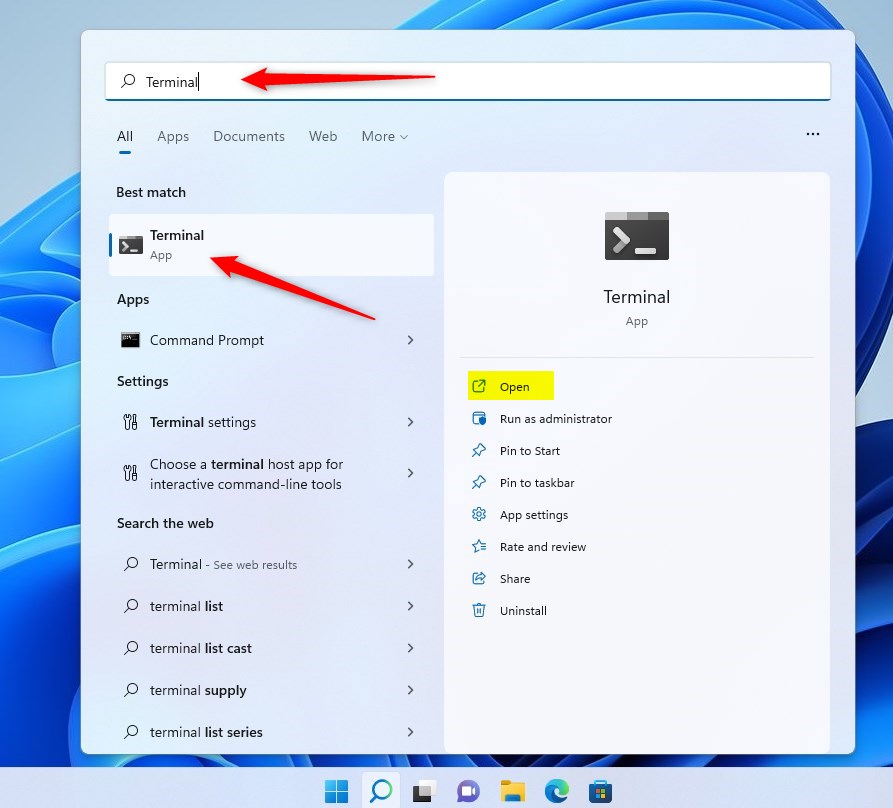
- Press the Windows key.
- Type Terminal.
- Press Enter to launch the app.
If Terminal doesn't show up in search, install Windows Terminal from the Microsoft Store. Some earlier Windows 11 builds don't include it.
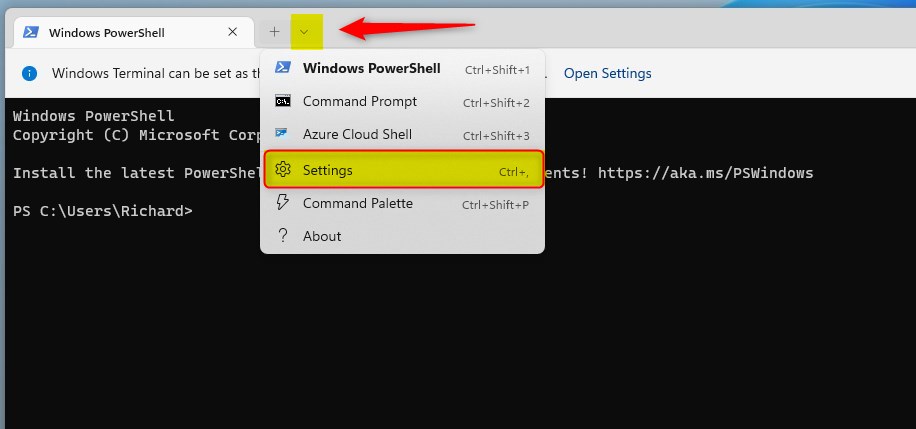
- With the app open, click the down arrow button on the top bar, next to the plus button that opens a new tab.
- From the menu that appears, select Settings. You can also press Ctrl + , (comma) from anywhere in the app.
The Settings page should open in the Terminal window, with a list of categories down the left side.
- In the left-hand list, click Startup.
- Find the When Terminal starts option. It is a drop-down list.
- Open the drop-down and change it to one of the following:
- Open a tab with the default profile
- Open windows from a previous session
If you chose the first option, this is the profile that opens in that first tab, so set it here if you want PowerShell, Command Prompt or a WSL distribution to come up first.
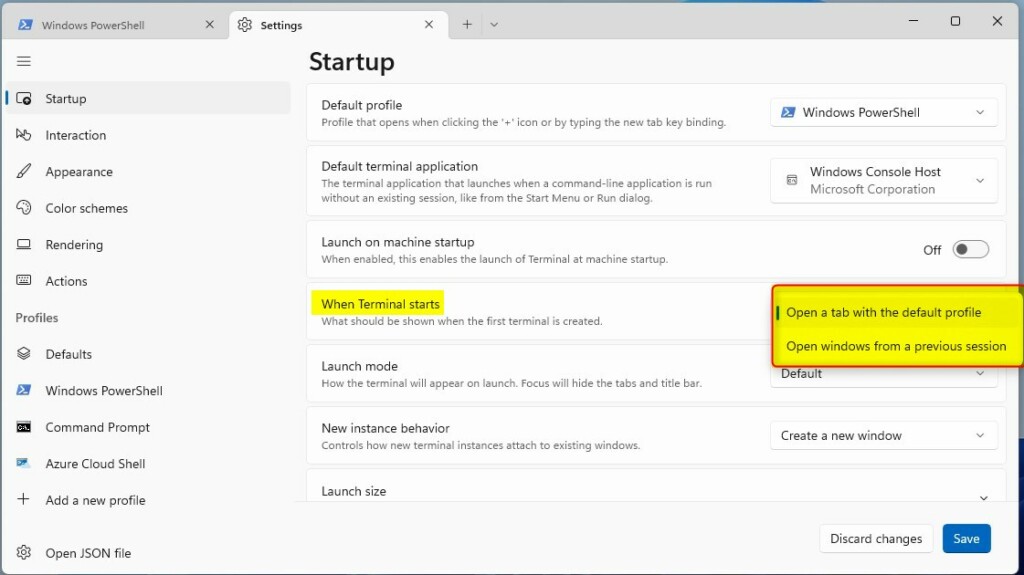
Select your preferred option and save your changes.
- Click Save at the bottom of the window.
The new setting applies the next time Terminal starts. To test it, open a couple of tabs, close Terminal completely, then launch it again. If you picked the previous-session option, your tabs should come back. If the Save button is greyed out, you haven't changed anything yet. To undo a change, return to Settings Startup, pick the other option and click Save again.
Conclusion:
- Windows Terminal in Windows 11 offers advanced features for command-line interfaces, including multiple tabs, panes, Unicode and UTF-8 character support, and customizability.
- Users can select the default behavior when opening the Windows Terminal: opening a tab with the default profile or restoring windows from a previous session.
- To change the start behavior, users can access the Settings pane in Windows Terminal, navigate to the Startup section, and choose their preferred option.
- After selecting, users should save the changes to apply the new start behavior in Windows Terminal.
Tailor how Windows Terminal boots up to keep your workflow smooth without forcing you to manually restore old sessions every time.
Have a question about this guide?
Answered by AI from this guide. Good questions may be added to this page — please don't include personal details.
Did this guide fix your problem?

About the Author
Richard
Tech Writer, IT Professional
Richard is a writer at Geek Rewind who turns complex IT tasks into clear, step-by-step guides. He draws on years of hands-on experience in system administration and enterprise IT operations, focusing on Windows, Linux and WordPress: the problems people actually run into, and the fixes that work. His server and WordPress guides come from systems he runs himself. Richard builds and maintains the platform behind Geek Rewind, from its Ubuntu servers and Nginx configuration to its custom WordPress plugins. Many new tutorials start with readers' questions, and he's always glad to answer them in the comments.
[…] install or uninstall the VBScript feature is via the command line. You can do that by opening the Windows Terminal app and using either the Windows PowerShell or Command Prompt […]
[…] app in Windows. You can change the language, adjust the launch size, set the default profile, change the startup behavior, open the admin window, open Terminal automatically at startup, add copy selection to the […]
[…] open the Windows Terminal and select Windows […]
[…] open the Windows Terminal app and select the Command Prompt […]
[…] open the Windows Terminal app as […]
[…] First, open the Windows Terminal app. […]
[…] app in Windows. You can change the language, adjust the launch size, set the default profile, change the startup behavior, open the admin window, open Terminal automatically at startup, add copy selection to the clipboard […]
[…] the Windows Terminal app. You can do this by searching for “Terminal” in your Start […]
[…] you find the Windows Terminal window too small or too large when you open it? You can easily set a specific size so it looks […]