How to Center Launch Windows Terminal in 11


Centering Windows Terminal (an app that puts Command Prompt, PowerShell, and other command-line tools in one place) on your screen stops you from hunting for windows across large displays or multiple monitors.
This trick works on Windows Terminal version 1.16.10332.0 and newer. Turn on one setting and the app opens in the middle of your screen every time you launch it. You do this in the Settings page, which writes the change to Terminal’s settings file for you, so you don’t need to edit the file by hand.
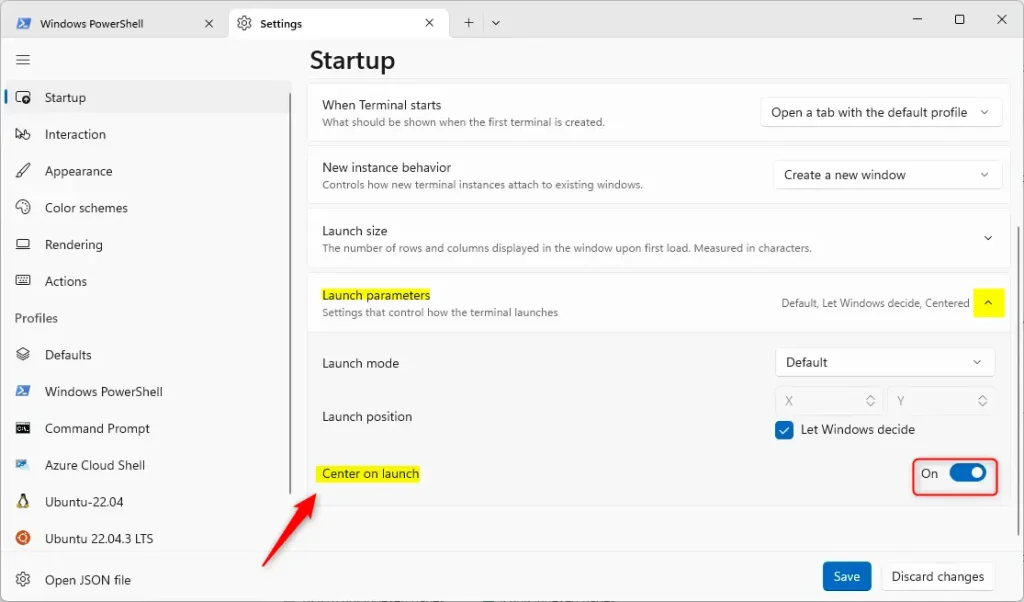
Center Windows Terminal on launch by opening Settings, navigating to the Appearance tab, expanding Launch parameters, and toggling “Center on launch” to On. Save your changes to have the Terminal open in the middle of your screen.
Why Center the Terminal App?
To center Windows Terminal on launch means the window opens in the middle of your monitor instead of the top left corner. This keeps your workspace neat and saves you from hunting for the window each time you open it. It is especially useful on a large ultra-wide screen.
Why would you want this? A window that always appears in the same predictable spot helps you stay focused when you are juggling several windows at once.
The setting only affects where the window appears when it starts. You can still drag it anywhere afterward, and it will be centered again the next time you launch it.
How to Center Launch the Terminal App
Step 1Open the Terminal App
- Click the Start menu.
- Type Terminal in the search box.
- Under Best match, select the Windows Terminal app to open it.
You should see a Terminal window with a tab open, usually PowerShell. If you only see an older Command Prompt or PowerShell window, check that Windows Terminal is installed and up to date in the Microsoft Store. The centering option needs version 1.16.10332.0 or newer.

Step 2Open Settings
- In the Terminal window, find the down arrow button on the top bar, next to the tabs, and click it.
- Select Settings. You can also press Ctrl + , (Ctrl and the comma key) instead.
The Settings page opens in a new tab, with a list of sections on the left.

Step 3Enable Center on Launch
- In the list on the left, click the Startup tab. Some older guides list this setting under Appearance. If you don't see it there, check Startup.
- Expand the Launch parameters section if it is collapsed.
- Find Center on launch and flip the toggle switch to On.
The toggle now shows as On. If you can't find the option, your Terminal is probably older than version 1.16.10332.0, so update it first.
To disable it: Flip the Center on launch toggle switch to Off, then save as described below.
Step 4Save Your Changes
- Click the Save button at the bottom of the Settings page.
- Close the Settings tab or window.
- Close Windows Terminal completely, then open it again from the Start menu.
The Terminal app now opens in the center of the display. No Windows restart is needed. If the window still opens in the old position, make sure you clicked Save and that no other Terminal window was still running when you reopened it.
Summary
Centering the Windows Terminal launch puts the app right in the middle of the screen, making the workspace feel more balanced.
Have a question about this guide?
Answered by AI from this guide. Good questions may be added to this page — please don't include personal details.
Did this guide fix your problem?

About the Author
Richard
Tech Writer, IT Professional
Richard is a writer at Geek Rewind who turns complex IT tasks into clear, step-by-step guides. He draws on years of hands-on experience in system administration and enterprise IT operations, focusing on Windows, Linux and WordPress: the problems people actually run into, and the fixes that work. His server and WordPress guides come from systems he runs himself. Richard builds and maintains the platform behind Geek Rewind, from its Ubuntu servers and Nginx configuration to its custom WordPress plugins. Many new tutorials start with readers' questions, and he's always glad to answer them in the comments.
[…] app in the notification area when minimized, keep the Terminal icon visible on the taskbar, launch at the center of the screen, and […]