How to Set Default Profile in Windows Terminal

- 2 ways to do it
- Needs administrator rights
Windows Terminal puts your command-line tools, such as PowerShell, Command Prompt and Ubuntu, into one window with tabs, so you can switch between them quickly. The app opens a default profile each time you launch it. On a fresh install that profile is usually PowerShell (on Windows 11 22H2 and later, Terminal itself is the default console app). You can change it to whatever shell you use most.
The change takes a few clicks in the Settings page. There is also a second method, which edits the configuration file by hand. Both are covered below, plus what to check if the change doesn’t stick.
Open Windows Terminal, click the down arrow, select Settings, then choose Startup. Select your preferred shell from the “Default profile” dropdown and click Save. This sets the shell that automatically opens when you launch Windows Terminal.
Why change your default profile?
You might prefer Command Prompt, or a specific Linux distribution such as Ubuntu, for your daily work. If you set that shell as the default, it opens every time you launch the app, and you no longer have to open the new-tab menu and pick it each time.
A profile is one entry in the Terminal’s tab menu. It tells Terminal which program to run and how it looks, including its font, color scheme and starting folder. The default profile is simply the one Terminal opens when you give it no other instruction.
What happens when you are done?
Once you save your settings, every new window starts with your selected profile. A new tab you open with the + button or the keyboard shortcut for a new tab also uses it. This does not change your existing tabs, which keep running whatever shell they already have. It only affects new sessions.
To undo the change, open the same setting, pick your old profile again and save. Nothing is deleted or uninstalled either way, because you are only choosing which profile opens first.
Method 1Using the Settings UI
The Settings UI is the easiest way to change the default profile. You open the app, go to Settings, pick a profile from the default profile drop-down menu on the Startup page and click Save. You don’t need to touch any code.
- Open Windows Terminal from your Start menu . A terminal window opens with a tab bar along the top, showing your current default shell.
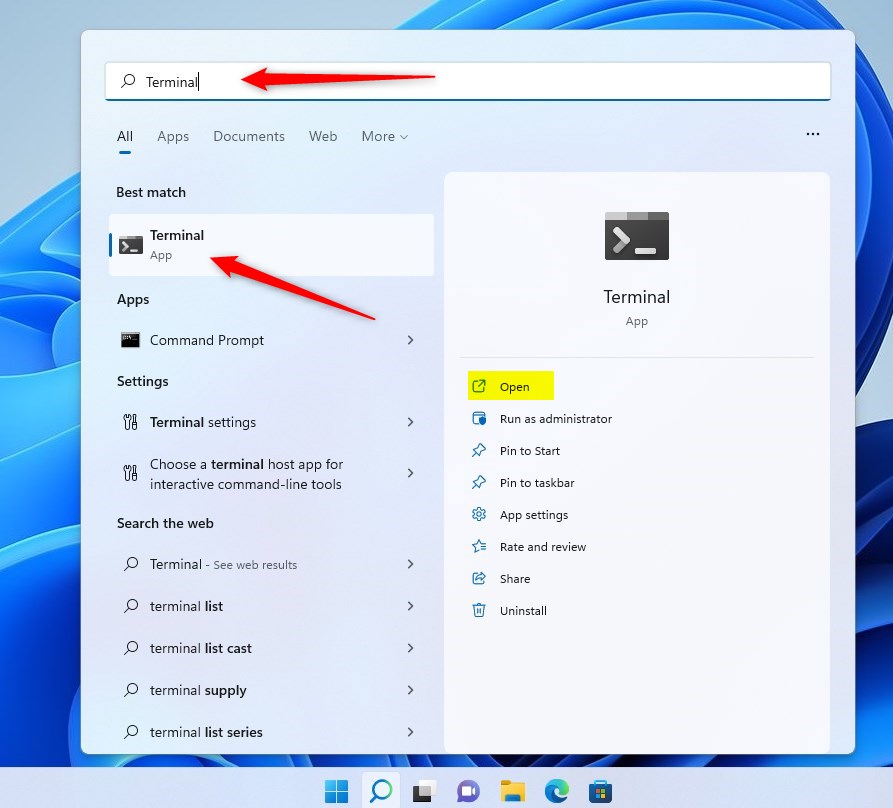
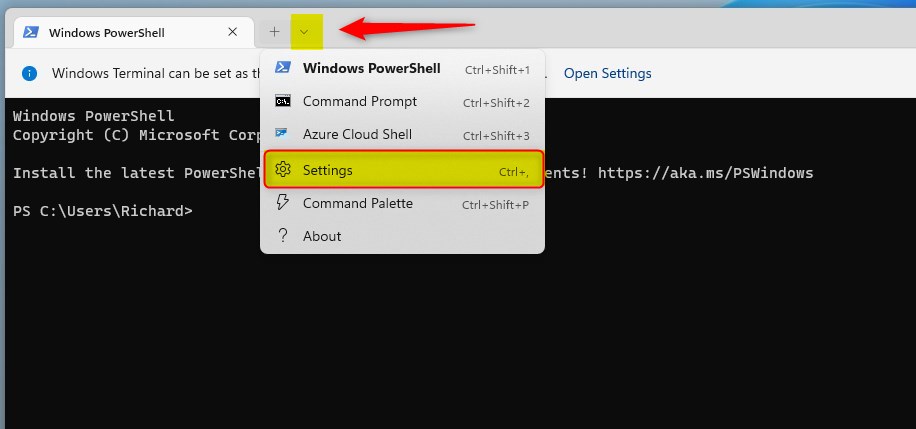
windows 11 open terminal app - Click the down arrow in the top tab bar, next to the + button. A menu opens that lists your profiles, followed by Settings and other entries.
- Select Settings or press Ctrl + , on your keyboard. A Settings tab opens inside the Terminal window, with a list of pages on the left.
windows terminal settings context menu - In the left sidebar, click Startup. This is normally the first page in the list. The right side now shows the options for what happens when Terminal launches.
- Find the Default profile dropdown menu. It shows the profile that is currently set.
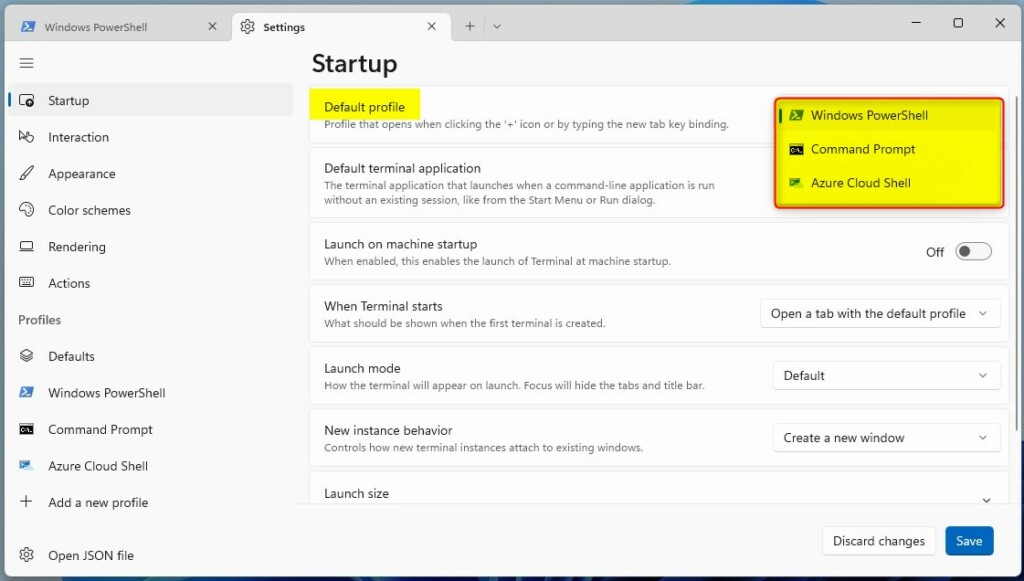
windows terminal default profile - Select your preferred shell from the list. The list contains the profiles Terminal knows about. Terminal normally creates entries for Windows PowerShell, Command Prompt and any installed WSL distributions on its own. If a shell you expect is missing, check that it is actually installed.
- Click Save at the bottom right. Open a new tab or a new window to check that your chosen shell starts.
They work the same on Windows 11 Home and Pro.
Method 2Using the settings.json File
You can also set the default profile by editing the settings.json configuration file directly. Open the file in a text editor like Notepad, find the defaultProfile line, and replace its current ID string with the unique GUID of the profile you want to open by default. This method suits you if you manage several machines, keep your settings in version control, or just like working in the file.
Back up your settings.json file before making changes. Copy it to another folder or give the copy a different name, so you can restore it if you break something. You can find the settings.json file at 📂%LOCALAPPDATA%\
- Open Settings in Windows Terminal. The Settings tab opens with its list of pages on the left.
- Click Open JSON file at the bottom left. The file opens in your default text editor. If Windows asks which app to use, pick Notepad or another plain-text editor.
- Look for the defaultProfile line. It is near the top of the file, and its value is a GUID in quotes and curly braces.
- Replace the existing GUID with the GUID of your desired profile. Keep the quotation marks, the curly braces and the comma at the end of the line exactly as they were. Then save the file with Ctrl+S. Terminal reloads the settings on its own, so you don’t need to restart it.
"defaultProfile": "{00000000-0000-0000-0000-000000000000}"You can find the GUID for each profile listed under the profiles section in the same file. Each profile has a name line, such as the name you see in the tab menu, and a guid line just above or below it. Match the name to the profile you want, then copy its GUID, including the curly braces. Copying it is safer than typing it, because one wrong character stops it from matching any profile.
Troubleshooting Common Issues
If your default profile in Windows Terminal isn't changing, the most common reason is an incorrect save or a syntax error in the settings.json file. Check the following:
- You clicked Save in the Settings UI, or saved the file in your text editor.
- You opened a new tab or window. Tabs that are already open keep their old shell.
- The JSON is still valid. A missing comma, a missing quotation mark or a stray bracket is enough to break it. When Terminal can't read the file, it shows a warning and may fall back to default settings.
- The GUID in defaultProfile exactly matches the guid of a profile in the profiles section, including the curly braces.
- You edited the right file. Using Open JSON file from Settings avoids mix-ups between the regular and Preview versions.
If you can't find the mistake, restore the backup you made and repeat the change. Or use the Settings UI, which writes the value for you.
Summary
Customizing your Windows Terminal startup settings improves your productivity. Whether you use the simple Settings UI or the advanced settings.json file, you can control exactly how your terminal environment behaves. For more advanced configuration, visit the official Microsoft Learn documentation.
Have a question about this guide?
Answered by AI from this guide. Good questions may be added to this page — please don't include personal details.
Did this guide fix your problem?

About the Author
Richard
Tech Writer, IT Professional
Richard is a writer at Geek Rewind who turns complex IT tasks into clear, step-by-step guides. He draws on years of hands-on experience in system administration and enterprise IT operations, focusing on Windows, Linux and WordPress: the problems people actually run into, and the fixes that work. His server and WordPress guides come from systems he runs himself. Richard builds and maintains the platform behind Geek Rewind, from its Ubuntu servers and Nginx configuration to its custom WordPress plugins. Many new tutorials start with readers' questions, and he's always glad to answer them in the comments.
[…] can make to the Terminal app in Windows. You can change the language, adjust the launch size, set the default profile, change the startup behavior, open the admin window, open Terminal automatically at […]
[…] app in Windows allows many customizations. You can change the language, adjust the launch size, set the default profile, change the startup behavior, open the admin window, open Terminal automatically at […]
[…] How to Set Default Profile […]
[…] Linux (WSL). You can customize many settings in the app, such as language, adjust the launch size, set the default profile, change the startup behavior, open the admin window, open Terminal automatically at startup, add […]