How to Save Windows Spotlight Images in Windows 11

Windows Spotlight is the feature that downloads new lock screen photos from Microsoft. Windows stores those pictures in a hidden system folder, so you can’t easily see them or keep them. On Windows 11 you can find them at 📁C:\
Windows saves these files without a picture extension such as .jpg or .png, so you have to add one before you can view them or use them as wallpaper. Two things to check first:
- Windows Spotlight must be your lock screen setting (Settings Personalization Lock screen Personalize your lock screen > Windows Spotlight). If it is set to Picture or Slideshow, the folder won’t fill with new images.
- Replace USERNAME in the path with your own account name if you type the path out yourself.
Open File Explorer , paste 📂%LocalAppData%\
Manual Extraction Method
Manual extraction needs no extra software. You open File Explorer , go to the Spotlight asset folder, copy the files to a new location, and rename them with a picture extension. Once renamed, they open as normal photos and you can set them as your desktop background. This works on both Windows 11 Home and Pro.
- Open File Explorer (press Win+E) and paste this path into the address bar, then press Enter:
%LocalAppData%\Packages\Microsoft.Windows.ContentDeliveryManager_cw5n1h2txyewy\LocalState\AssetsYou should see the Assets folder open with a long list of files that have random-looking names. The AppData folder is hidden, which is why pasting the path is easier than browsing to it. - Look at the file list. The files have no extensions, and the Type column shows them as plain “File”. To make sorting easier, click the Size column header so the largest files come first. The real Spotlight photos are usually the largest files in the folder.
- Select the large files, copy them, and paste them into a new folder on your desktop. Work from the copies, not the originals. Windows still uses the Assets folder, and renaming files there can cause problems. You should now see the same files in your new folder.
- Rename each file by adding
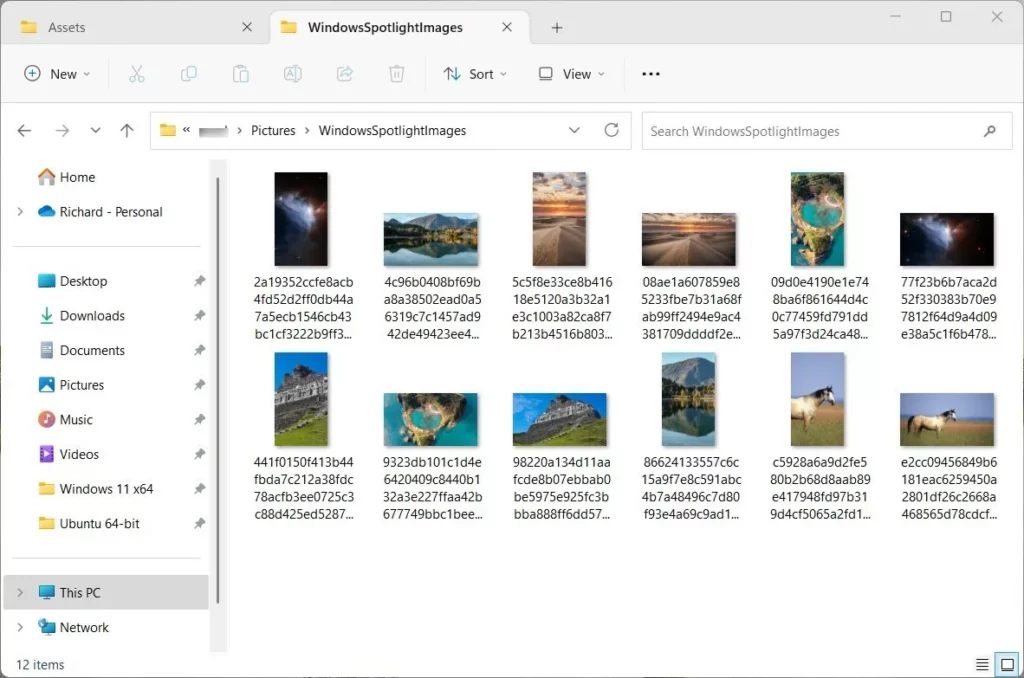
.jpgto the end of the filename. To see what you are doing, turn on extensions first with View Show File name extensions in File Explorer . Select a file, press F2, press End, type the extension, and press Enter. If a warning asks whether you want to change the extension, click Yes. The file icon should change to a picture thumbnail.
Double-click a renamed file to check it. If it opens as a photo, you can right-click it and choose Set as desktop background. To undo any of this, delete the folder on your desktop. Your original Assets folder is unchanged.
Automated Extraction with PowerShell
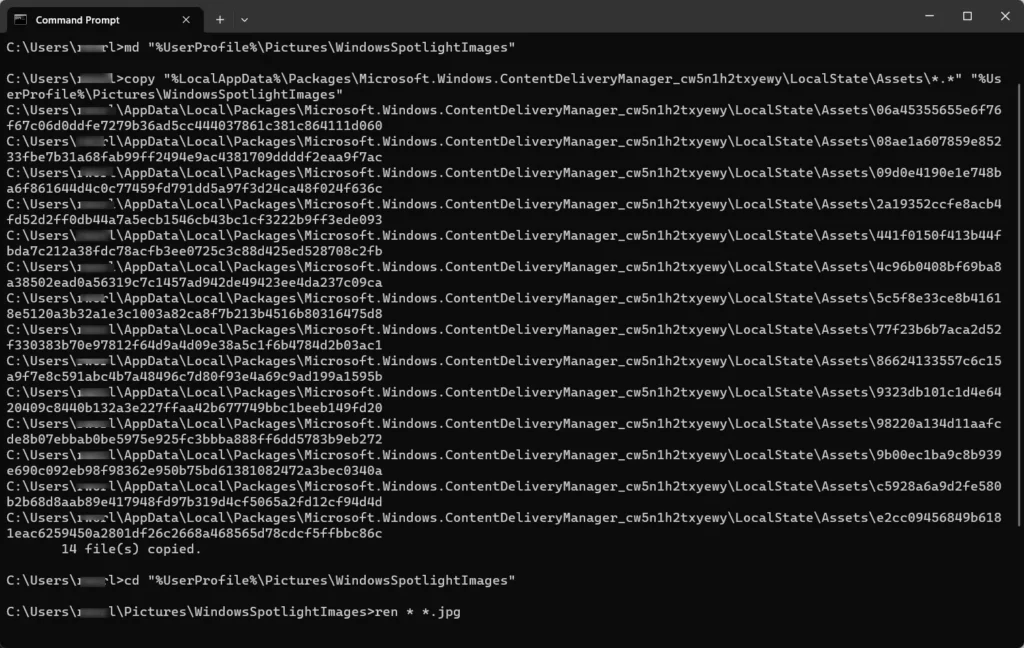
A short command copies the pictures out of the system folder, and a second command adds the file extension to all of them at once. The result is a neat folder in your Pictures directory instead of dozens of files to rename one by one.
- Right-click the Start button and choose Terminal (Admin), or search for PowerShell, right-click it, and choose Run as administrator. Click Yes at the User Account Control prompt. You should see a PowerShell window with an administrator title.
- Run the following command to create a folder and copy the files:
New-Item -Path "$HOME\Pictures\Spotlight" -ItemType Directory; Copy-Item -Path "$env:LOCALAPPDATA\Packages\Microsoft.Windows.ContentDeliveryManager_cw5n1h2txyewy\LocalState\Assets\*" -Destination "$HOME\Pictures\Spotlight"Paste it into the window and press Enter. When it finishes without an error message, the new folder should exist in your Pictures directory. - Run this command to rename them:
Get-ChildItem -Path "$HOME\Pictures\Spotlight" | Rename-Item -NewName { $_.Name + ".jpg" }Press Enter again, then open the new folder in File Explorer . The files should now show picture thumbnails and open normally.
The folder only fills up after Windows has downloaded images. If you run the commands twice, expect some files to be copied again or to produce errors. Delete the new folder and start over if the result looks wrong.
Comparison of Extraction Methods
| Method | Difficulty | Speed |
|---|---|---|
| Manual | Easy | Slow |
| PowerShell | Intermediate | Fast |
| Third-Party Tools | Easy | Fast |
Troubleshooting and Limitations
If a file does not open as an image, delete that file. These files are often small icons or system files, not the Windows Spotlight images you seek. Very small files are almost never wallpaper. Windows updates the cache frequently, so check back every few days for new Spotlight photos. Copy the images you like soon after they appear, because Windows clears older ones from the folder.
Summary
You can save your favorite Windows Spotlight images in two ways. Copy them out of the hidden folder and rename them by hand, or use a quick PowerShell script to do it all at once. Either way, work on copies, check that each file opens as a picture, and repeat every few days to catch new images before Windows replaces them.
Did this guide fix your problem?

About the Author
Richard
Tech Writer, IT Professional
Richard is a writer at Geek Rewind who turns complex IT tasks into clear, step-by-step guides. He draws on years of hands-on experience in system administration and enterprise IT operations, focusing on Windows, Linux and WordPress: the problems people actually run into, and the fixes that work. His server and WordPress guides come from systems he runs himself. Richard builds and maintains the platform behind Geek Rewind, from its Ubuntu servers and Nginx configuration to its custom WordPress plugins. Many new tutorials start with readers' questions, and he's always glad to answer them in the comments.
[…] Windows uses this feature so you can set their desktop background with Spotlight collections, save Spotlight images for use, and see new photos on your […]