How to Turn Touchpad Haptic Feedback on or off in Windows 11

Touchpad haptic feedback in Windows 11 uses subtle vibrations to mimic a physical click on supported laptops. It only works on Precision Touchpads with haptic hardware. On those machines you can turn the feature on or off, and you can change the vibration strength to suit your preference.
You manage all of this from the Windows 11 Settings app . Turning the feature off keeps the touchpad silent and helps save a little battery power. If the option does not appear on your laptop, the touchpad probably does not support haptic feedback. The registry method later in this article is the fallback.
Open Settings , select Bluetooth & devices, click Touchpad, then toggle the Haptic click switch on or off. The change takes effect immediately without restarting. If Haptic click does not appear, your touchpad does not support the feature.
Option 1Taming Your Touchpad with Windows Settings
Use the Settings app if you prefer standard menus and do not want to download extra tools. It is the safer method, and it is the one to try first.
Step 1Open Your Settings
- Press Win+I on your keyboard at the same time.
The Settings app opens. You can also reach it from the Start menu if you prefer.
Step 2Go to Touchpad Settings
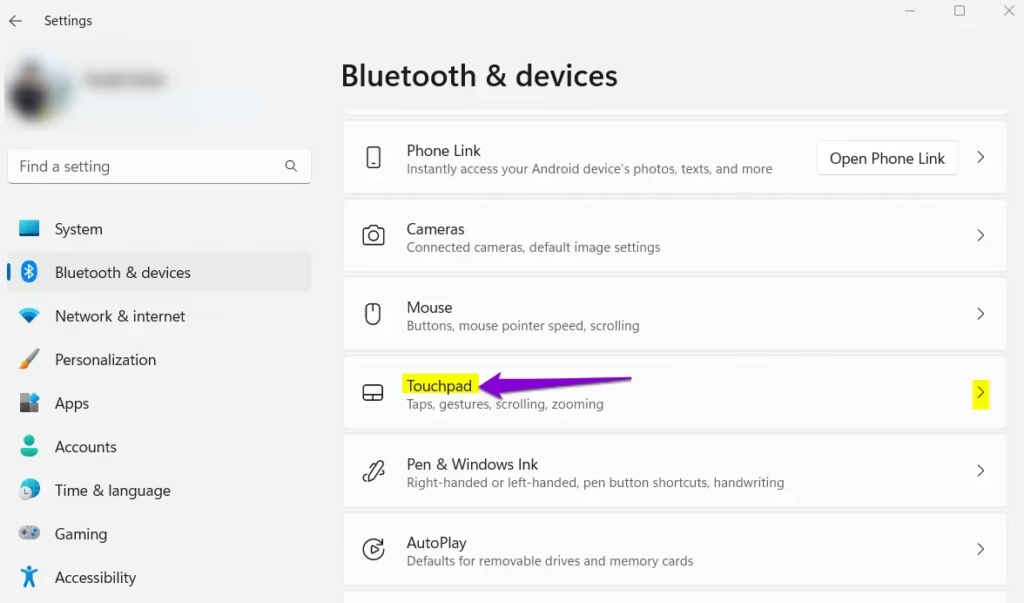
- Click Bluetooth & devices in the left-hand list.
- Click Touchpad on the right side of the window.
If Touchpad is missing from the list, Windows does not see a touchpad. Check that it is not disabled and that the touchpad driver is installed.
Step 3Turn the Haptic Click On or Off
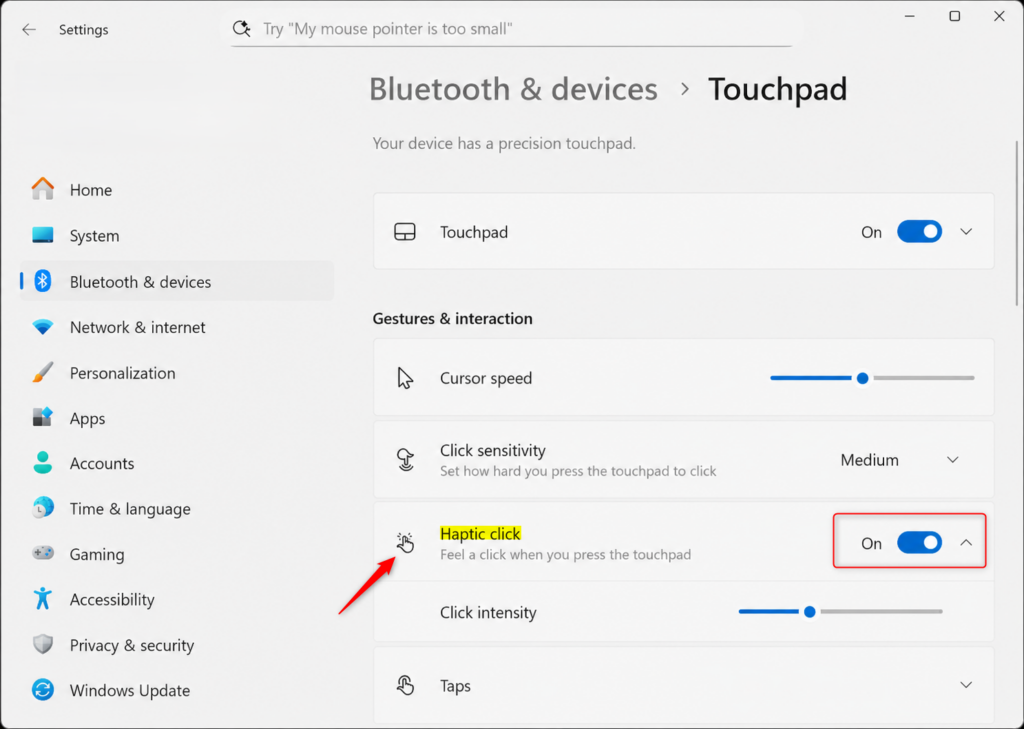
- Find the Haptic click option.
- Click the switch next to it to turn the simulated click feeling on or off.
Most touchpads that support this feature have haptic click enabled by default. If you do not see Haptic click, your touchpad hardware does not offer it. To undo the change at any time, return to this page and flip the switch back. There is no restart involved.
Step 4Close Settings and Test
- Close Settings.
- Tap and press the touchpad a few times to test your changes.
You should feel the difference right away between a firm click and a muted tap. If nothing seems to have changed, reopen the Touchpad page and check that the switch is where you left it.
Option 2Using the Registry Editor for More Control
Open Registry Editor (a database for low-level system settings) if the standard menu options are missing. Be very careful here, because mistakes can cause system problems. This method lets you manage your touchpad feedback directly through system settings.
Back up your Registry before starting, or follow these steps exactly. In Registry Editor, you can make a backup with File Export. If you are not comfortable with registry editing, stick to Option One.
Step 1Open the Registry Editor
- Press the Windows key + R to open the Run box.
- Type regedit into the Open field and press Enter.
- Click Yes if a User Account Control prompt asks for your permission.
Registry Editor opens, with a folder tree on the left and values on the right. If you are on a work or school PC, an administrator may have blocked Registry Editor, and you will see a message saying so.
Step 2Go to the Correct Registry Location
- In the left pane, expand the folders one at a time until you reach HKEY_CURRENT_USER\SOFTWARE\Microsoft\Windows\CurrentVersion\PrecisionTouchPad.
- Click the PrecisionTouchPad folder to select it.
This folder holds the keys that control touchpad haptic feedback in Windows 11. The full path is:
HKEY_CURRENT_USER\SOFTWARE\Microsoft\Windows\CurrentVersion\PrecisionTouchPad
Click each folder name to open it and work down the path. If you do not see the PrecisionTouchPad folder, your system does not have this setting and this method will not work. Check that you followed the path correctly. If it is still missing, your computer likely does not support the feature. This key is under HKEY_CURRENT_USER, so it only affects the account you are signed in to.
Step 3Change the 'FeedbackEnabled' Setting
- With PrecisionTouchPad selected, double-click the FeedbackEnabled item in the right pane.
- In the Value data box, type the number for the state you want.
- Click OK to save the change.
The Value data box tells Windows whether to play the click sensation when you press the pad.
To turn haptic click feedback on, type 1 in the Value data box.
To turn haptic click feedback off, type 0 in the Value data box.
Use 1 for on and 0 for off. To undo the change later, open the same item and enter the other number.
Step 4Apply the Changes
Registry changes may not apply to the running session. Sign out and back in, or restart, to make sure they take effect.
- Sign Out and Sign In: This is usually the quickest way. Sign out of your Windows account, then sign back in.
- Restart Your PC: To make sure the change is fully applied, restart your computer.
After you sign back in or restart, test your touchpad right away. Press it a few times to confirm that haptic feedback is now on or off as you intended. If it is not, reopen Registry Editor and check the FeedbackEnabled value.
Summary
To manage your Windows 11 touchpad haptic preferences in the Settings app, go to Bluetooth & devices Touchpad and toggle the Haptic click switch. If that menu option is missing, you can change the FeedbackEnabled value in Registry Editor instead. It is inside HKEY_CURRENT_USER\SOFTWARE\Microsoft\Windows\CurrentVersion\PrecisionTouchPad. Use 1 for on and 0 for off, then sign out and back in.
Have a question about this guide?
Answered by AI from this guide. Good questions may be added to this page — please don't include personal details.
Did this guide fix your problem?

About the Author
Richard
Tech Writer, IT Professional
Richard is a writer at Geek Rewind who turns complex IT tasks into clear, step-by-step guides. He draws on years of hands-on experience in system administration and enterprise IT operations, focusing on Windows, Linux and WordPress: the problems people actually run into, and the fixes that work. His server and WordPress guides come from systems he runs himself. Richard builds and maintains the platform behind Geek Rewind, from its Ubuntu servers and Nginx configuration to its custom WordPress plugins. Many new tutorials start with readers' questions, and he's always glad to answer them in the comments.
No comments yet — be the first to share your thoughts!