What breaks when you disable automatic time zone detection in Windows 11 Date and Time Settings
Turning off automatic time zone detection in Windows 11 means your PC no longer changes its time zone when you travel. It also won’t pick up a different zone if your location changes. Windows uses location data, Wi-Fi 📶 information and internet time servers to keep both the time zone and the clock right. When the time zone setting is switched off, you become the one responsible for keeping it correct.
Advertisement
Your PC runs on two clocks. The hardware clock (the real-time clock) sits on the motherboard and keeps running on a small battery when the PC is off. The software clock is managed by Windows while it runs. Windows keeps its internal time in UTC and applies your time zone on top to show local time. Set time automatically controls whether the clock syncs with an internet time server. Set time zone automatically controls only the zone. The two are separate switches, and it helps to know which one you changed.
A wrong time zone on its own mostly shifts the time you see on screen. The serious failures start when the clock itself ends up wrong. This usually happens in one of two ways. You turn off automatic time as well and the clock drifts. Or you notice the displayed time is off after travelling and fix it by editing the hour instead of changing the time zone. That leaves the underlying UTC time wrong. From then on, secure websites, updates, sign-ins and calendars can all misbehave, and the drift gets worse until you correct it by hand.
⚡ Quick Answer
Disabling automatic time zone detection in Windows 11 breaks secure websites (SSL certificate errors), Windows Update 🔃 and Microsoft Store downloads, email and calendar synchronization, and multiplayer games if you also let your system clock drift. The time zone itself only shifts displayed time, but a wrong underlying clock causes sign-ins to fail and data to sort incorrectly.
Advertisement
Core Features That Break When Automatic Time Zone Detection Fails
When the clock or time zone does not match reality, several core Windows features and everyday applications stop working correctly. Modern software relies on precise timestamps for security and for sorting data. Even a small gap can cause failures, and the symptoms often look unrelated to time. The sections below cover the most common ones.
Secure Web Browsing and SSL Certificates
Secure web browsing and SSL certificates break because a mismatched system clock makes valid security certificates look invalid. Every certificate has a start date and an expiry date. Your browser checks them against your PC’s clock to verify the server’s identity. If your clock is far enough off, a good certificate looks expired or not yet valid. The browser then blocks the page and shows a security warning, often with an error about the certificate or the date and time.
If you see these warnings on many different sites at once, check the clock before anything else. Compare it with a phone or a trusted time website.
Advertisement
Microsoft Store and Windows Updates
The Microsoft Store and Windows Update can fail to download when the clock is wrong, because Microsoft's servers use secure connections that depend on accurate time. If your clock is off, your PC may not be able to establish that connection. Security patches and app updates then fail to install, often with a generic error code. Fix the time first, then retry the update.
Email Synchronization and Calendar App Failures
Email and calendar apps run into trouble because mail servers sort messages by timestamp. If your PC stamps messages with the wrong time, they can appear out of order. Some servers may refuse them or flag them. Calendar invites can also land on the wrong day or at the wrong hour. A meeting you set for 9:00 can show up at a different time for everyone else. This is most visible when you travel, or when you work with people in other time zones.
Hidden Impacts on Third-Party Applications and Games
Third-party software also suffers when the time zone or clock is wrong. Many desktop programs and games depend on accurate timing for licensing, logins, scheduling and data handling.
Multiplayer Online Games and Anti-Cheat Software
Multiplayer games and anti-cheat software can block your connection when your clock is wrong, because they compare your PC's clock with the game server's. Anti-cheat tools may read a time difference as an attempt to tamper with game speed. The result can be sudden disconnections, login errors, or in the worst case an unfair ban. If a game starts rejecting you right after you travel or change time settings, correct the clock before you contact support.
Advertisement
Cloud Storage and File Synchronization Services
⚠️WarningCloud storage and file sync services rely on file modification dates to work out which copy of a file is newest.
If your clock is wrong, edited files get incorrect timestamps. The sync service may then create unwanted duplicate files, or treat an older version as the newer one and overwrite your recent work. If you suspect this has happened, check the version history in your cloud service before you make more edits.
Unique Angle: The Ripple Effect on Local Network Authentication
Local network authentication is where a wrong clock can lock you out completely. Workplace security protocols such as Kerberos are very sensitive to time differences. They reject login attempts if your PC's clock differs from the server's by even a few minutes. That can cut you off from shared office files and work servers.
Kerberos in Windows 11 rejects a request if your clock differs from the domain controller's by more than five minutes, which is the default tolerance. If your clock ends up that far out (for example, a time zone that was never changed and then "fixed" by editing the hour), you can lose access to shared network folders, network printers and company servers. Access usually returns once the time is corrected. If your PC is joined to a work domain, it normally gets its time from the domain, and the time settings may be locked by your organization. In that case, ask your IT department rather than changing things yourself.
How to Manage Date and Time Settings in 🪟 Windows 11 Safely
If you keep automatic detection turned off, you need to check and adjust the settings yourself. Open the Settings app and make sure the time zone matches where you physically are. These steps apply to current versions of Windows 11, and the layout can differ slightly between builds.
Advertisement
Click the Start button and select Settings (the gear icon), or press the Windows key + I. The Settings window opens.
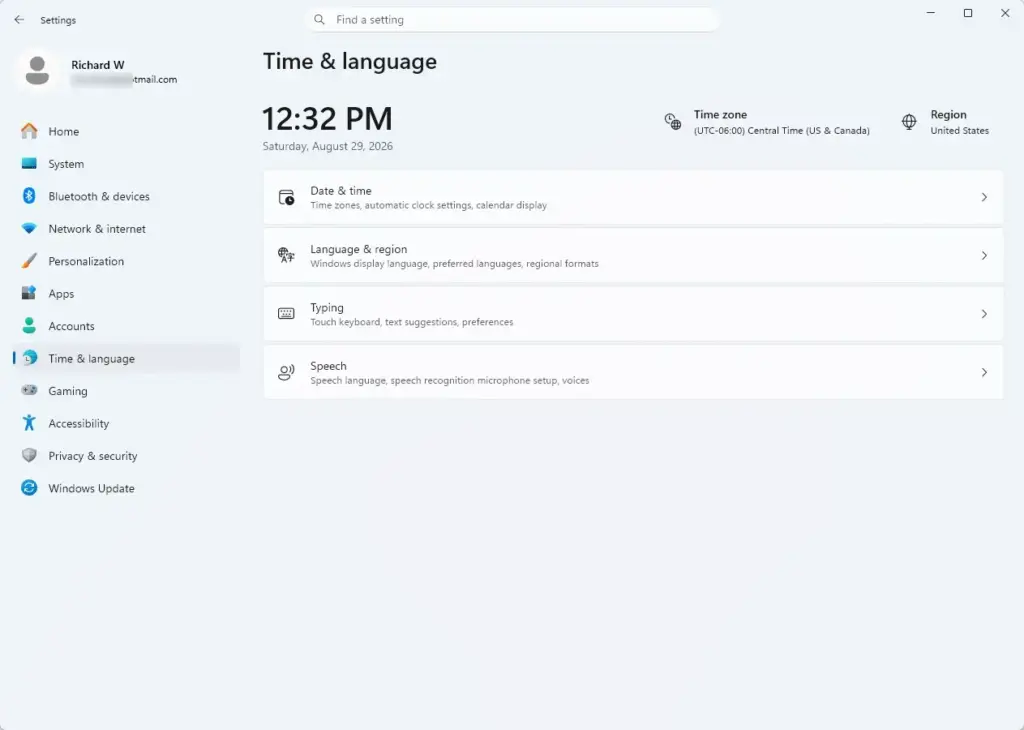
Click Time & language in the left-hand menu. Settings › Time & language
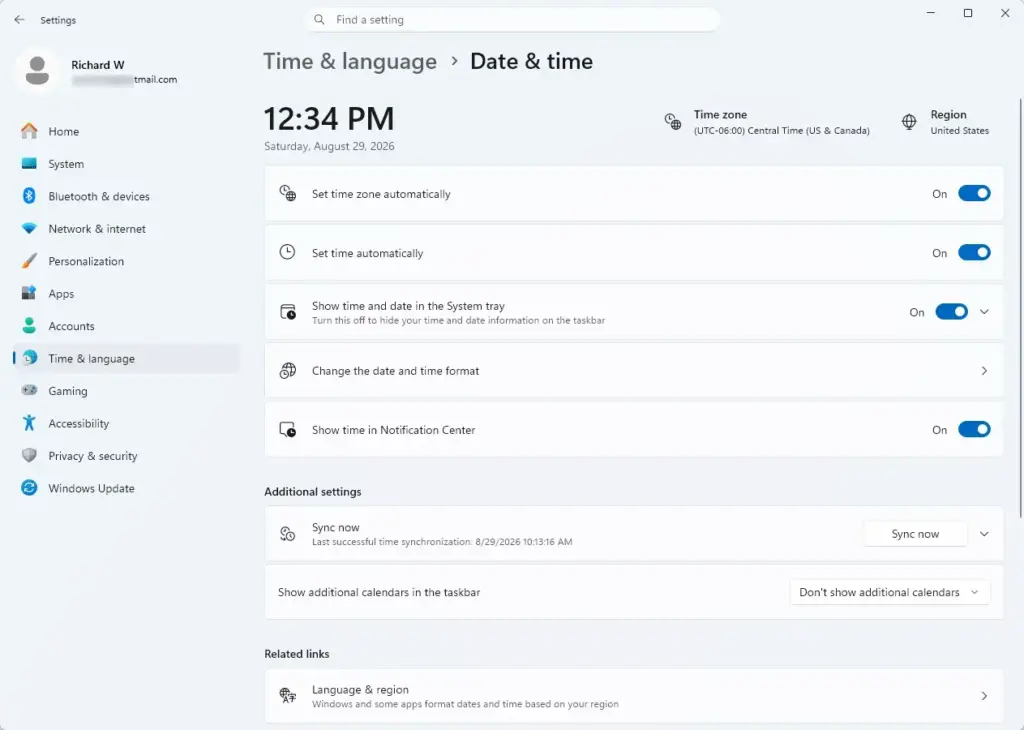
Click Date & time on the right side of the screen. You should now see the time switches, the time zone drop-down and the date and time options.
To let Windows handle everything, turn on Set time automatically and Set time zone automatically. Settings › Time & language › Date & time The time zone shown should then update to match your location. If Set time zone automatically is greyed out or will not stay on, location services are probably turned off. Turn them on under Privacy & security›Location, then return here. On a work PC, a policy may also be controlling this setting.
If you prefer to keep Set time zone automatically turned off, open the Time zone drop-down and select your correct local zone. Check that the displayed time matches your actual local time.
Whenever you travel to a different time zone, come back to this screen and change Time zone yourself. Change the zone, not the hour. That way the underlying clock stays accurate.
If your clock drifts even though the zone is correct, make sure Set time automatically is on. Then scroll to the Additional settings section and click Sync now. Windows contacts an internet time server and updates the clock straight away. The last successful sync time shown should update. If the button fails, check that you are online.
To undo your changes, turn the two automatic switches back on. This returns the PC to the default behavior, and no restart is needed.
📝NoteChanging system time settings and forcing a sync can require administrative privileges.
If you are signed in with a standard user account, Windows may ask for an administrator password before it applies the change. On Windows 11 Home and Pro the Settings screens look the same. PCs managed by an organization may have these options locked.
Summary
Disabling automatic time zone detection in Windows 11 puts you in charge of keeping your clock in step with real-world servers. If the time zone or the clock goes wrong, you can see broken secure websites, failed Windows and Store updates, mixed-up email and calendars, game disconnections, cloud sync conflicts, and lost access to work networks. Keep the automatic switches turned on unless you have a reason not to. If you turn them off, check the time zone each time you travel and after each daylight saving change.
📬 Get new Windows tips in your inbox
One email when we publish something worth your time. No spam, unsubscribe anytime.
Have a question about this guide?
Answered by AI from this guide. Good questions may be added to this page — please don't include personal details.
Richard is a writer at Geek Rewind who turns complex IT tasks into clear, step-by-step guides. He draws on years of hands-on experience in system administration and enterprise IT operations, focusing on Windows, Linux and WordPress: the problems people actually run into, and the fixes that work.
His server and WordPress guides come from systems he runs himself. Richard builds and maintains the platform behind Geek Rewind, from its Ubuntu servers and Nginx configuration to its custom WordPress plugins.
Many new tutorials start with readers' questions, and he's always glad to answer them in the comments.
One email when we publish a guide worth your time — new Windows features, the fixes that actually
work, and a heads-up when Microsoft breaks something. Unsubscribe in one click.
📬 Get new Windows tips in your inbox
One email when we publish something worth your time. No spam, unsubscribe anytime.


No comments yet — be the first to share your thoughts!