How to Enable or Disable Windows 11 Search Indexing


Windows 11 search indexing is a background service that scans your drive and builds a catalog of your files, so results appear almost instantly when you search. SearchIndexer.exe does this work quietly while you use your PC. It indexes file names, file contents and some file properties, depending on the location and the search mode you use.
Turning off indexing stops Windows from constantly reading your drive. That saves some battery life on laptops and cuts background disk activity, which helps most on older PCs with a hard drive. The cost is slower searching. Without a catalog, Windows has to look through every folder from scratch each time you type a query. Apps that rely on the Windows Search service, such as Outlook, can also become slower or less reliable.
To disable Windows 11 search indexing, open Services, find “Windows Search,” click Stop, and set Startup type to Disabled. To enable it, set Startup type to Automatic (Delayed Start) and click Start .
Pros and Cons of Disabling Indexing
| Pros | Cons |
|---|---|
| Slightly lower CPU and disk usage | Search results become very slow |
| Less background disk activity | Some files may not show up in search |
| Reduced wear on older hard drives | Outlook PST files may not be searchable |
How to Rebuild the Index
Rebuilding the index fixes missing files and slow or wrong results. Windows throws away the old catalog and builds a new list of everything in your indexed locations. Try this before you disable indexing, because a damaged index is often the real cause of the problem.
The rebuild is done from Indexing Options in the Control Panel : open it, click Advanced, and choose the rebuild option. The steps below walk through it. The same steps work on Windows 11 Home and Pro.
- Open the Control Panel and select Indexing Options. If you don’t see it, change View by in the top-right corner from Category to Large icons or Small icons. You can also type “Indexing Options” in the Start menu search box . The Indexing Options window opens and shows how many items are indexed.
- Click the Advanced button. If a User Account Control prompt appears, approve it. The Advanced Options window opens. Note: Changing these settings requires administrator privileges.
- Under the Troubleshooting section, click the Rebuild button. A warning tells you that rebuilding can take a long time and that search results may be incomplete until it finishes.
- Click OK. Your computer now re-scans your files. This can take anywhere from a few minutes to several hours, depending on how many files you have and how fast your drive is. You can keep using the PC, but searches may miss files until the rebuild finishes. The Indexing Options window shows progress, and the status changes to Indexing complete when it is done.
Troubleshooting Indexing Issues
If indexing shows as paused, the cause is usually one of these:
- The computer is busy, so Windows holds indexing back until you stop working.
- The computer is running on battery power. Windows often pauses indexing to save energy, especially when Battery Saver is on. Plug the laptop in and see whether indexing resumes.
- The Windows Search service is not set to start automatically. Open the Services console, find Windows Search, and check that its Startup type is Automatic (Delayed Start) and that the service is running. The steps for this are further down.
Managing Indexed Locations
Adding or removing folders in Indexing Options cuts the workload by leaving out files you never search for, such as game libraries, backup copies or big download folders. A smaller index builds faster and uses less disk and CPU time.
- Open Indexing Options in the Control Panel , as in the rebuild steps above.
- Click the Modify button. The Indexed Locations window opens.
- Tick the folders you want indexed and clear the ones you don’t, then click OK.
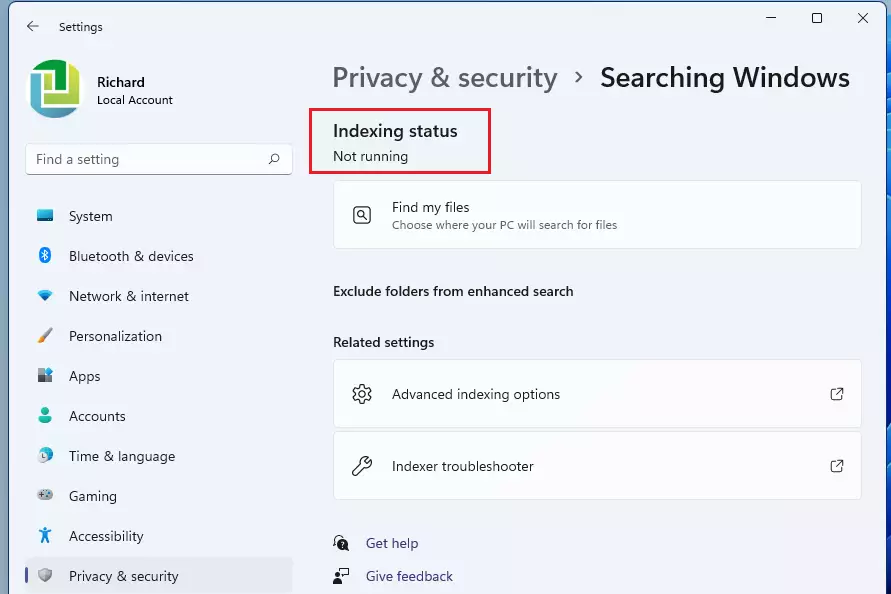
Windows 11 also has a Classic and Enhanced choice under Settings Privacy & security Searching Windows. Classic indexes only your Documents, Pictures, Music and Desktop folders. Enhanced indexes the entire PC. Enhanced gives more complete results but uses more resources. In the same Settings page you can exclude specific folders from Enhanced search.
Disable Windows Search Indexing
Disabling search indexing stops the background scanning, which frees a little memory and CPU. The simplest way is to open the Services console, find the Windows Search entry, stop it, and set its startup type to Disabled. This works on Home and Pro. You need an administrator account.
Try the lighter options first if your goal is only less disk activity. Rebuilding the index or trimming the indexed folders may be enough, and search stays fast.
- Open the Services console on your PC. A list of services opens, sorted by name.
- Scroll down and find the service named Windows Search. Its description mentions content indexing and property caching for files, email and other content.
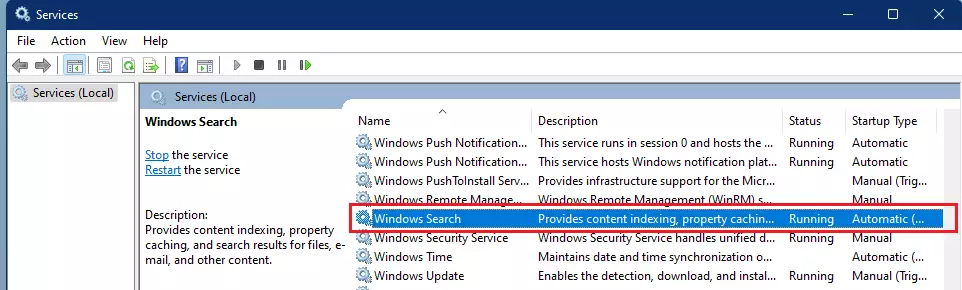
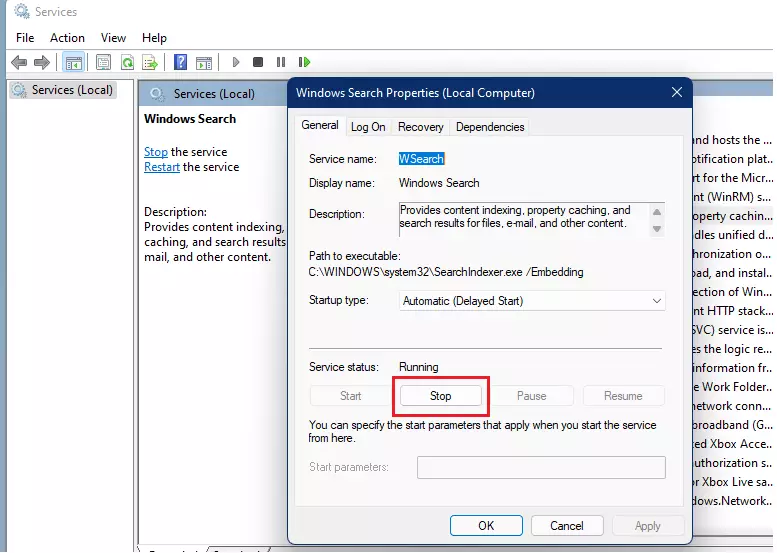
- Double-click Windows Search to open its Properties window. If the options are greyed out, you are not running as an administrator. Sign in with an admin account and try again.
- Click Stop under Service status to turn off the service immediately. After a moment, the status changes to Stopped.
- In the Startup type menu, select Disabled. This keeps the service from starting again the next time you boot.
- Click Apply to save, then click OK to close the window. You don’t need to restart the PC.
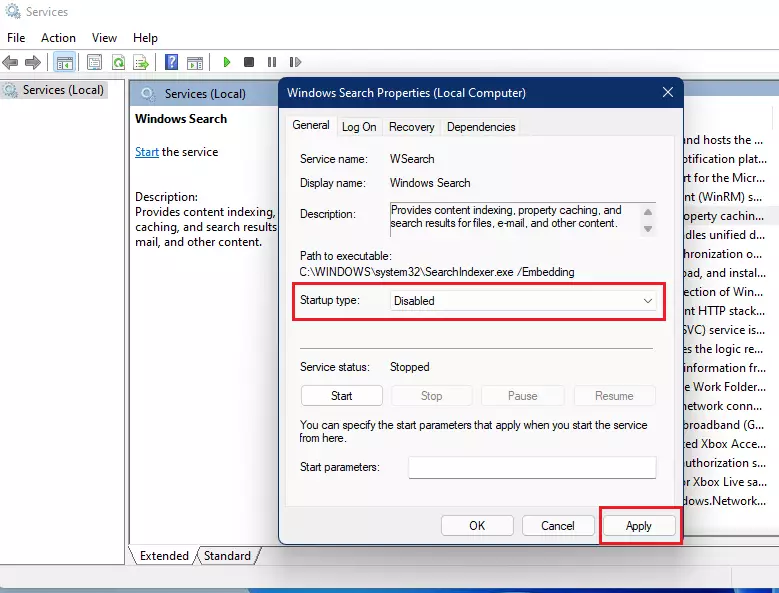
Windows 11 search indexing is now turned off. To confirm, look at the Windows Search row in the Services list. The Status column is empty and Startup Type reads Disabled. In the Properties window, the service status shows as stopped. The service is not running, so the computer no longer spends resources scanning files for search.
Searches in the Start menu and File Explorer still work, but they are slower and may skip some content.
Enable Windows Search Indexing
To turn indexing back on, make these changes in the Services console. The original setting for this service is Automatic (Delayed Start), so that is the one to restore.
- Open the Services console and double-click Windows Search.
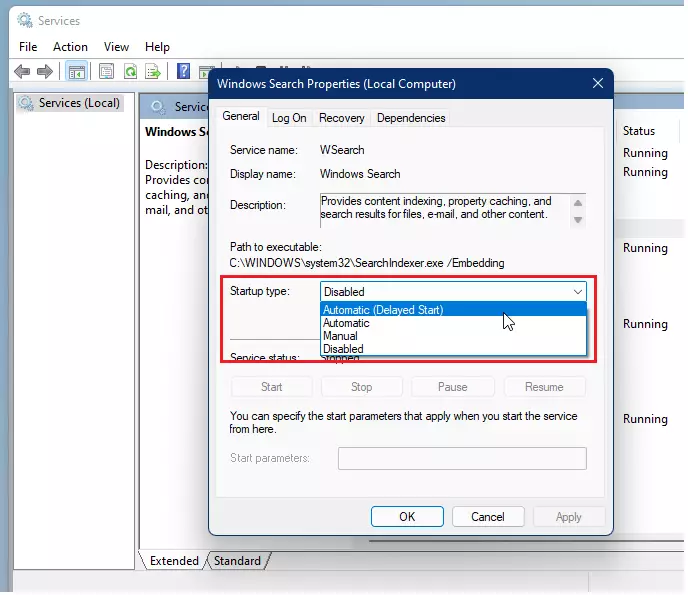
- Set the Startup type to Automatic (Delayed Start). With this setting, Windows starts the service shortly after boot, so it doesn’t slow down sign-in.
- Click Apply. The Start button, which was greyed out while the service was disabled, becomes available.
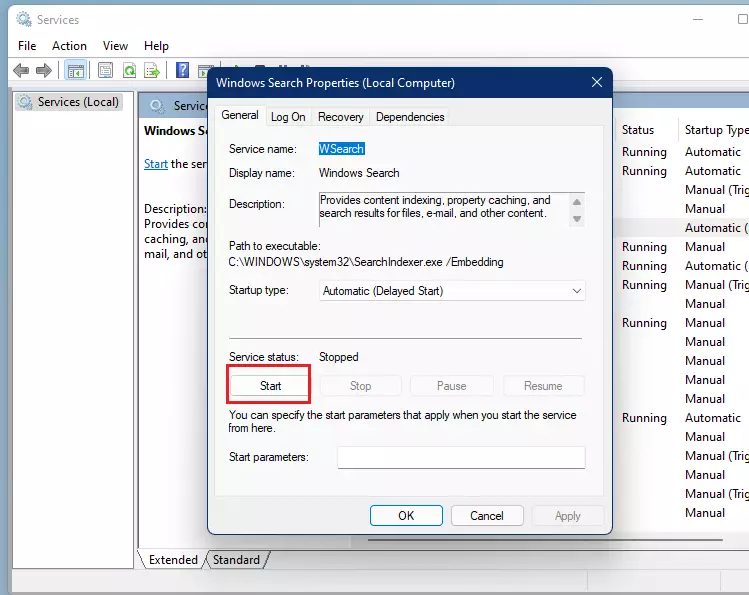
- Click the Start button to begin the service. The status changes to Running. Click OK to close the window. Windows then picks up indexing again, and it may need some time to catch up on files that changed while it was off. If results still look wrong after that, use the rebuild steps earlier in this guide.
Use Command Prompt
Command Prompt turns Windows 11 search indexing on or off with a couple of short text commands. It does the same job as the Services console and is faster if you already have a terminal open, or if you want to script the change. You need to open the terminal with administrator rights, then run the command for the state you want.
To open an elevated Command Prompt, type “cmd” in the Start menu search box , right-click Command Prompt and select Run as administrator. Approve the User Account Control prompt. The title bar should read “Administrator: Command Prompt”. Without that, the commands fail with an access denied message.
To enable indexing: run the command below. It sets the service back to start automatically and then starts it.
sc config "wsearch" start=delayed-auto && sc start "wsearch"To disable indexing: run the command below. It stops the service and keeps it from starting at the next boot. You can check the result in the Services console. No restart is needed in either case.
sc stop "wsearch" && sc config "wsearch" start=disabledSummary
Windows 11 search indexing builds a background catalog of your files so you can find what you need quickly when you search from the Start menu or File Explorer. You can manage it in three ways. You can choose which folders to scan, rebuild the index when results go wrong, or turn the service off completely. Which one fits depends on whether you want faster searches or lower background activity.
- Indexing creates a catalog of your files to make searching faster.
- You can choose between Classic (limited folders) or Enhanced (entire PC) modes. Settings Privacy & security Searching Windows is where you switch.
- Disabling the indexer stops the background search process but slows down future search results.
- You can control this feature through the Services menu or the Command Prompt. Both need administrator rights and neither needs a restart.
- For more information, visit the official Microsoft Support page.
Frequently asked questions
Should I disable search indexing on 🪟 Windows 11?
Usually not. Keep indexing on if you search often, since results appear almost instantly. Turn it off only if your PC has an older hard drive or you want to save battery and rarely search. Expect slower results and possible Outlook search problems.
How do I turn search indexing back on 🪟 Windows 11?
Open Start, type Indexing Options, and press Enter. Select Modify, then tick the folders you want searched. If the feature stays off, open Services, double-click Windows Search, set Startup type to Automatic, and click Start. Then click OK. Indexing starts again in the background.
How do I turn off Windows Search indexing?
Open Start, type services.msc, and press Enter. Double-click Windows Search, click Stop, set Startup type to Disabled, and click OK. Searches get slower right away. To keep indexing but shrink it, open Indexing Options and clear the folders you don't need searched.
How to fix search indexing was turned off?
Open Services by typing services.msc in Start and pressing Enter. Double-click Windows Search, set Startup type to Automatic, click Start, then click OK. If it won't start, restart your PC and check again. Indexing will restart, and the message should disappear.
Still have a question?
Answered by AI from this guide. Good questions may be added to this page — please don't include personal details.
Did this guide fix your problem?

About the Author
Richard
Tech Writer, IT Professional
Richard is a writer at Geek Rewind who turns complex IT tasks into clear, step-by-step guides. He draws on years of hands-on experience in system administration and enterprise IT operations, focusing on Windows, Linux and WordPress: the problems people actually run into, and the fixes that work. His server and WordPress guides come from systems he runs himself. Richard builds and maintains the platform behind Geek Rewind, from its Ubuntu servers and Nginx configuration to its custom WordPress plugins. Many new tutorials start with readers' questions, and he's always glad to answer them in the comments.
I would break this into two articles.
Also, there are countless typos and grammatical errors which need to be corrected.