Manage OneDrive Upload and Download Rates in Windows 11


OneDrive upload and download speed limits let you control how much internet bandwidth Microsoft’s cloud storage app uses on your Windows 11 PC. By default, OneDrive syncs your Desktop, Documents, and Pictures folders automatically with no speed restrictions. A large sync can slow down web browsing and video streaming for everything else you do online.
A fixed download or upload cap stops OneDrive from taking over your connection, so you can work or play online without lag. You can also pause syncing for a while when you are on slow Wi-Fi or mobile data.
Open OneDrive settings, go to Sync and backup, then Advanced settings. Use the “Limit download rate” and “Limit upload rate” options to set your desired speeds. Choose “Adjust automatically” for uploads if preferred.
Control the OneDrive app upload and download rate in 🪟 Windows 11
The limits are in the OneDrive settings, which you open from the taskbar . In current Windows 11 builds they sit under Sync and backup Advanced settings. Older OneDrive versions kept them on a Network tab. You type your speed limits in kilobytes per second (KB/s) for downloading and uploading.
The limits only apply to OneDrive. Other apps and downloads are not affected. As a rough guide, 1 Mbps is about 125 KB/s, so a 20 Mbps connection tops out near 2,500 KB/s. If you want OneDrive to use about a quarter of that, enter around 600.
The steps below set the limits inside the app preferences.
Before you start, set up OneDrive in Windows 11. Then identify any large files and folders you do not need on this PC, because they are the ones that eat bandwidth during a sync. Once that is done, open the OneDrive app.
You can start OneDrive in either of these ways:
- Open the Start menu, type OneDrive, and select the app.
- Browse to the installed location, usually C:\Program Files\Microsoft OneDrive\OneDrive.exe. The exact folder can differ depending on how OneDrive was installed on your PC.
The OneDrive cloud icon is also quick to reach from the Taskbar overflow area. If you don't see it, click the small arrow to show hidden icons. If the icon is missing altogether, OneDrive is probably not running, so start it from the Start menu first.

- Click the OneDrive icon, and wait for the app window to appear.
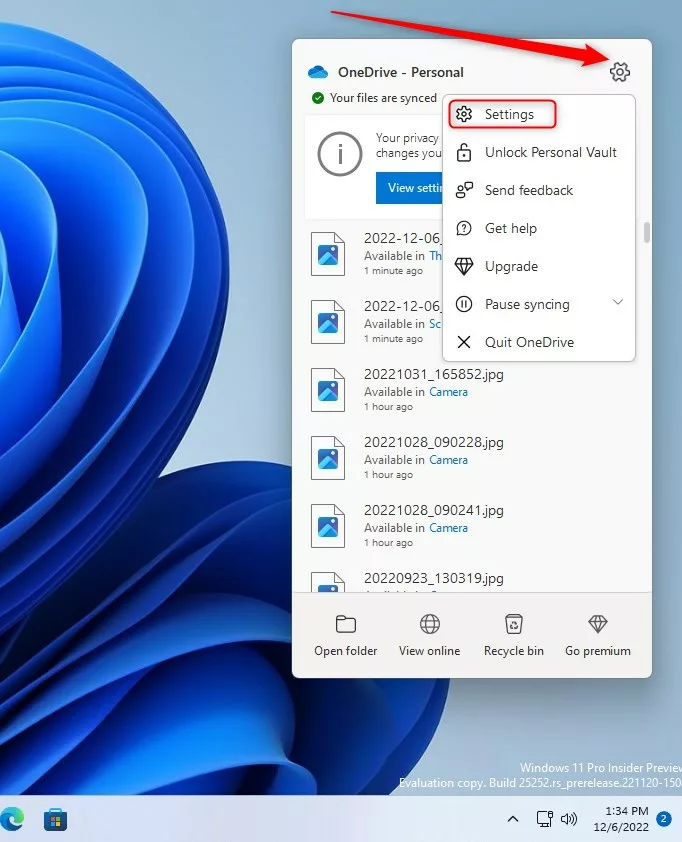
- Click the Help & Settings (gear) icon in the top corner of that window.
- Select Settings from the menu.
The OneDrive Settings window opens.
- In the Settings pane, select Sync and backup.
- Click the Advanced settings link to expand that section.
You should now see the extra options, including Limit download rate and Limit upload rate.

Open the Limit download rate and Limit upload rate sections to set your preferences.
- Limit download rate:
- If you turned on Limit download rate, enter the speed in the Limit to box. The value is in KB/s.
- Limit upload rate:
- If you turned on Limit upload rate, choose one of these:
- Adjust automatically
- Limit to: Enter the rate in KB/s.
- If you turned on Limit upload rate, choose one of these:
Adjust automatically: This setting lets the OneDrive sync client (OneDrive.exe) upload in the background using only unused bandwidth, so it won't interfere with other network activity. It is a good choice if you don't want to work out a number. Use Limit to if you want a firm ceiling. The automatic option is offered for uploads only. Downloads use a fixed limit or no limit.
To undo a limit later, come back to this page and turn the option off.

Save your changes. If the window has an OK button, click it, then close the OneDrive window. The new limits apply to the next sync. To check they work, copy a large file into your OneDrive folder and watch your network use in Task Manager.
If you only need a short break from syncing, you don't have to set a limit. Click the OneDrive icon, open Help & Settings, and choose Pause syncing, then pick how long. Syncing resumes after that time, or when you choose to resume it.
Reference:
Conclusion:
- This article covered how to control the OneDrive upload and download rate in Windows 11, so you can manage your network bandwidth.
- You can limit upload and download throughput to a fixed rate, let uploads adjust automatically, and pause OneDrive syncing for a while when you are on a slow network.
- The OneDrive sync client settings are easy to change later, so you can adjust them to suit your connection.
- For more detail, the official Microsoft support page is linked above.
- Use the comment section for feedback, error reports, or extra information about this article.
Frequently asked questions
How do I disable auto upload on OneDrive?
Open the OneDrive icon in the taskbar, select Help & Settings, then select Settings. On the Sync and backup tab, select Manage backup, then select Stop backup next to Desktop, Documents, or Pictures. Your files stay on your PC and in OneDrive. Only the automatic backup stops.
What is a good upload and download speed?
For most homes, a download speed of at least 25 Mbps handles browsing, streaming, and video calls for several people. The FCC's minimum upload benchmark is 3 Mbps, but 10 Mbps or more makes large OneDrive uploads and video calls much smoother. Check your plan's listed speeds to see what you get.
Why is OneDrive taking so long to upload?
Most slow uploads come from a low upload speed, since many home connections send far less data than they receive. Large files, many small files, weak Wi-Fi, or a set upload limit also slow things down. Check the OneDrive icon for a paused status, and check the upload limit under Sync and backup, then Advanced settings.
Why is my Documents folder in OneDrive 🪟 Windows 11?
OneDrive syncs your Documents folder when folder backup is turned on. Windows often turns this on automatically when you sign in with a Microsoft account during setup. To check, open OneDrive settings, select Sync and backup, then Manage backup. To stop it, select Stop backup for the Documents folder.
Still have a question?
Answered by AI from this guide. Good questions may be added to this page — please don't include personal details.
Did this guide fix your problem?

About the Author
Richard
Tech Writer, IT Professional
Richard is a writer at Geek Rewind who turns complex IT tasks into clear, step-by-step guides. He draws on years of hands-on experience in system administration and enterprise IT operations, focusing on Windows, Linux and WordPress: the problems people actually run into, and the fixes that work. His server and WordPress guides come from systems he runs himself. Richard builds and maintains the platform behind Geek Rewind, from its Ubuntu servers and Nginx configuration to its custom WordPress plugins. Many new tutorials start with readers' questions, and he's always glad to answer them in the comments.
No comments yet — be the first to share your thoughts!