How to Change Drive Letters in Windows 11

Drive letters are the single letters like C:, D: or E: that Windows assigns to your storage drives. They decide how hard drives, SSDs and USB sticks show up in File Explorer . Changing a letter keeps your storage organized and stops shortcuts from breaking when you plug in extra drives.
You can change any drive letter in a few clicks with the built-in Disk Management tool, so you don’t need extra software. You need administrator privileges. If you’re on a standard account, Windows will ask for an admin password. Nothing here is permanent: to undo a change, repeat the same steps and pick the old letter again, as long as nothing else has taken it in the meantime.
Open Disk Management by pressing Win+X and selecting Disk Management. Right-click the volume, choose Change Drive Letter and Paths, click Change, then pick a new letter from the drop-down and click OK. The change applies right away, with no restart needed, and you need administrator rights. Close any open File Explorer windows showing the drive first.
How to Change a Drive Letter in 🪟 Windows 11
This guide covers four methods: Disk Management, the Settings app, Command Prompt with a command-line disk tool, and PowerShell. All four do the same job and work on both Windows 11 Home and Pro. Pick whichever you’re most comfortable with.
Whichever method you use, close any program that is using the drive first, including File Explorer windows showing it. Windows can refuse the change if files on the drive are open.
Method 1Using Disk Management
Disk Management is the most common way to change a drive letter. It is the Windows tool for managing all your storage devices: internal drives, external drives and USB sticks. It shows every disk and volume, including ones that don’t have a letter yet.
Open Disk Management
- Press Win+X on your keyboard. The Power User menu opens above the Start button .
- Click Disk Management in the list. The Disk Management window opens, with a list of volumes at the top and a graphical view of your disks below it.
If you don’t see it in the menu, type “Disk Management” in the Windows search bar and select Create and format hard disk partitions. That is the same tool under a different name.
Find Your Drive
Before you change anything, find the exact drive you want to work with. Look at the volume list at the top of the window, or the disk map at the bottom. Each volume shows its letter, name, file system and size.
Check the size and any names you've given your drives to be sure. Two drives can have similar sizes, so the name is often the safest way to tell them apart.
Change the Drive Letter
Power users can also use a quick PowerShell command. Open PowerShell as an administrator and use the Set-Partition cmdlet. Type Get-Partition -DriveLetter | Set-Partition -NewDriveLetter and replace the blank placeholders with your actual drive letters. Put the current letter after -DriveLetter and the new one after -NewDriveLetter. The PowerShell section further down walks through this in more detail.
Assign a New Letter
- Right-click the Start button and choose Disk Management.
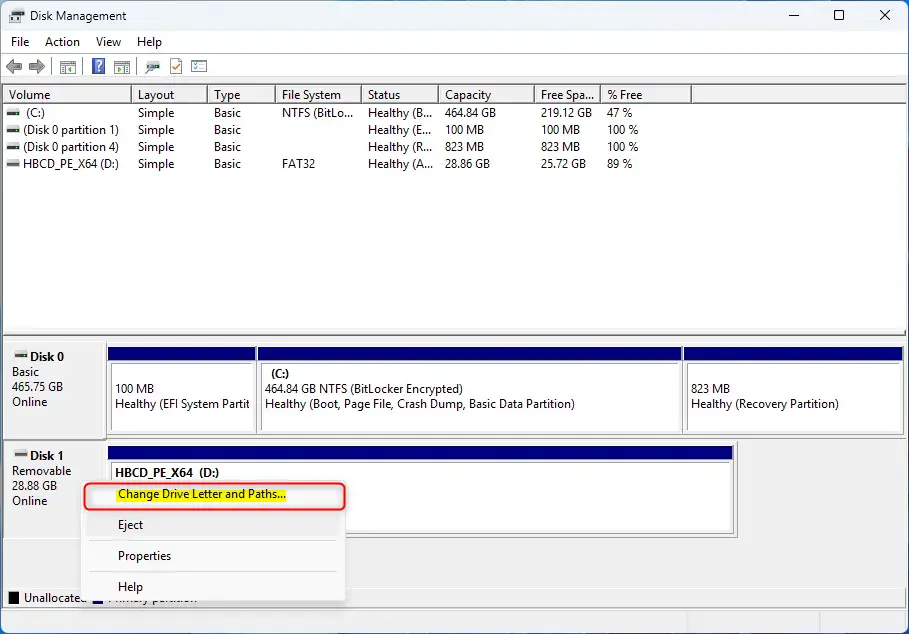
- Right-click the volume you want to change, either in the list at the top or in the graphical view at the bottom.
- Click Change Drive Letter and Paths. A small window opens showing the drive's current letter.
- Click Change. The Drive Letter Assignment window opens. (Add and Remove are next to it. Use Change to swap the letter.)
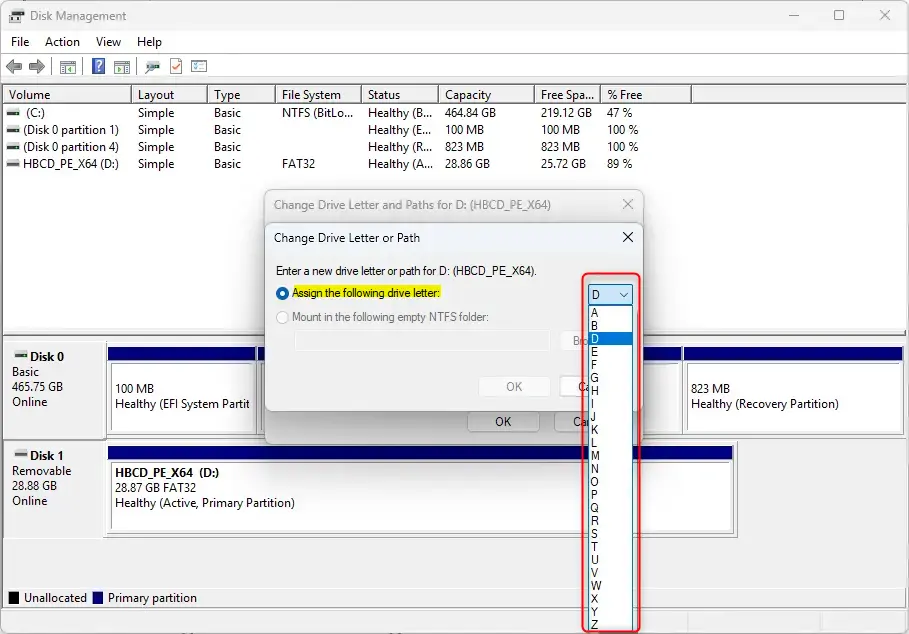
- Make sure Assign the following drive letter is selected.
The Drive Letter Assignment window shows a drop-down list. Click the current drive letter to open the list of available letters, then select the new letter you want for this drive. The list only offers letters that aren't already in use, so you can't pick a clashing one by accident.
If Change Drive Letter and Paths is greyed out, the volume is probably the system or boot volume (usually C:). Windows doesn't let you change those from here. It can also be greyed out for a volume that has no recognized file system.
Confirm Your Choice
- Click OK after choosing the new letter. Windows shows a warning that some programs that rely on drive letters might not run correctly.
- If you're sure, click Yes to apply the new letter. The volume list updates right away.
Be careful with this prompt. Changing the letter of your main C drive, or of any partition with installed apps, can stop those programs from working until you reinstall them or repair their paths. Programs, shortcuts and scheduled tasks that point to the old letter will not find their files.
Changing the drive letter of your main Windows installation, typically C:, or of any drive holding installed programs can cause problems. Programs may fail to start, and shortcuts and backup jobs may stop working. This advice applies to Windows 11 and earlier versions of Windows.
The safe cases are data drives, external drives and USB sticks that don't hold installed software. If a drive does hold programs, move it to a new letter only if you're prepared to fix the programs afterwards. Otherwise, leave it alone.
Done!
That's it! The drive letter should now be updated. You don't need to restart. Close Disk Management and open File Explorer to check that the drive appears under the new letter.
If you still see the old letter, press F5 in File Explorer to refresh. If any shortcuts or apps stop working, change the letter back using the same steps.
Method 2Using 🪟 Windows 11 Settings
Windows 11 also lets you change drive letters from the Settings app. It does the same job as Disk Management, with a cleaner layout. It depends on your Windows 11 version: older builds have fewer options on the storage pages, so if a page below doesn't match what you see, use Disk Management instead.
Open Settings
- Press Windows key + I on your keyboard to open Settings. Alternatively, click the Start button and choose the gear icon for Settings.
- Wait for the Settings window to open, with the list of categories on the left.
Navigate to Storage Settings
- In the Settings window, click System in the left menu.
- Click Storage on the right side. You'll see a bar showing how much space is used, followed by a list of storage categories.
Access Advanced Storage Settings
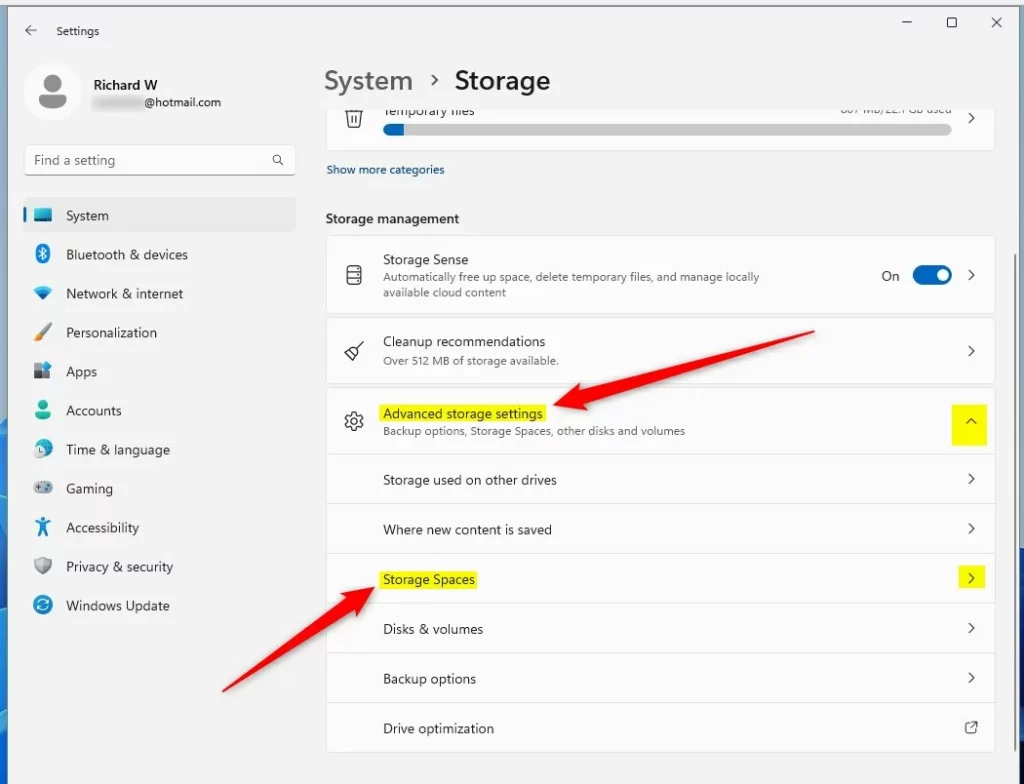
The Settings app is an alternative to Disk Management, and you reach the drive settings by this path: System Storage Advanced storage settings Disks & volumes
- Scroll down on the Storage page and click Advanced storage settings to expand it.
- Click Disks & volumes. You'll see a list of every disk connected to the PC.
Click Yes if you see this prompt. If you're on a standard account, you'll need to enter an administrator password.
Select Your Drive
You will see a list of all your disks and their volumes (sections). Disks are the physical drives. Volumes are the partitions on them, and these are what carry the letters. Find the volume for the drive you want to change and click its name. If a disk's volumes aren't visible, click the disk to expand it first. Check the name and size to be sure you've got the right one.
Change the Drive Letter
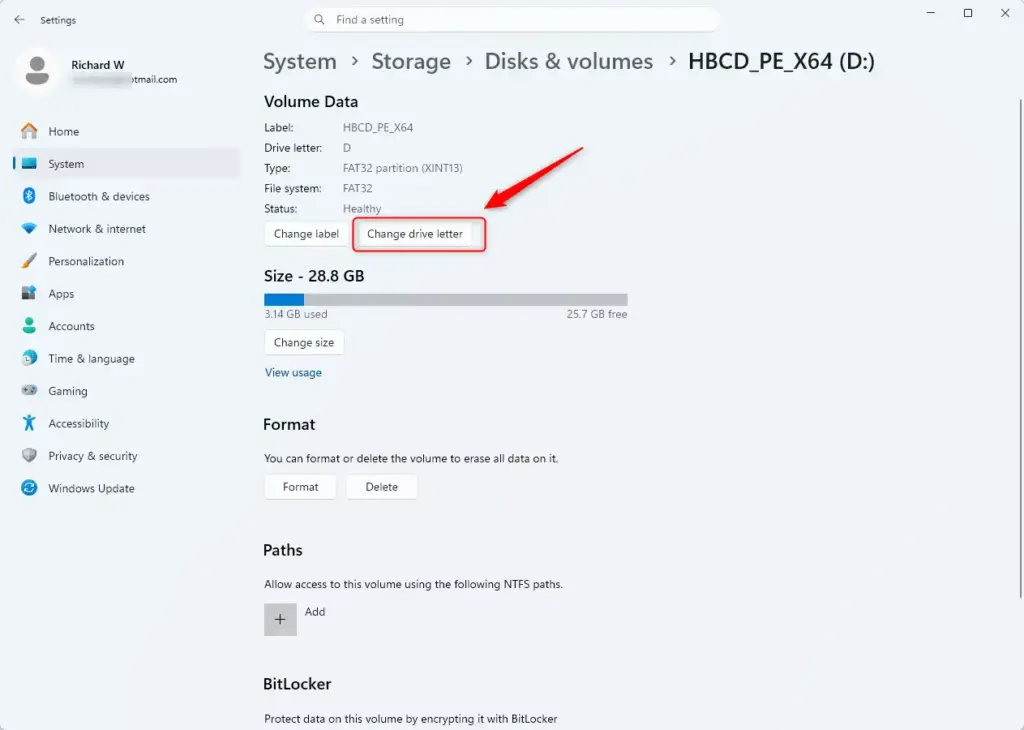
- Click Properties on the volume's page if the details aren't already showing.
- Find the Change drive letter button on the properties page and click it to begin assigning a new letter to the selected drive.
If the button is missing or greyed out, the volume is probably your system drive or another volume Windows is using. Use a different drive, or leave that one as it is.
Assign a New Letter
Similar to Disk Management, a small window will pop up. Click the current drive letter in the list. A drop-down opens with the letters that are free. Choose the new letter you want to use from those options.
Confirm and Finish
- Click OK after choosing the new letter. A warning appears about possible issues with programs that rely on the old letter.
- If you are sure, click Yes to confirm.
- Close the Settings window.
Your drive letter should now be updated, with no restart needed. Open File Explorer to confirm. To undo the change, repeat the same steps and pick the original letter.
Method 3Using the Command Prompt (diskpart)
Command Prompt gives you a more powerful way to manage disks and partitions directly, using a disk tool that runs inside the terminal window. It's useful when you prefer typing over clicking, or when the graphical tools don't behave. You can run the same commands in Windows Terminal, which hosts Command Prompt and PowerShell.
Open Windows Terminal as Administrator
- Press Windows key + X.
- Choose Windows Terminal (Admin). On some newer builds the entry is called Terminal (Admin).
- Click Yes if User Account Control asks for permission.
Administrator rights are required to make changes with diskpart. Without them, the commands will fail with an access error.
Start diskpart
- In the Windows Terminal window, type
diskpartand press Enter. - Look at the prompt. It will change, indicating you are now in the
diskparttool.
List Volumes
- Type `list volume` and press Enter. This command shows all drives and their partitions.
- Read the list. It includes the volume number, the current drive letter, the label and the size of each volume.
Tip: Carefully note the "Volume ###" number for the drive you want to change. For example, your D: drive might be Volume 2. Use the label and size columns to confirm you have the right one. Volume numbers can change after you plug in or remove drives, so don't rely on an old list.
Select the Volume
- Tell
diskpartwhich volume to work with. Typeselect volume <volume number>, and replace<volume number>with the number you noted earlier. - For example, if your drive was Volume 2, type
select volume 2and press Enter. - Check the response. The tool should confirm that the volume you chose is now the selected volume.
Assign the New Letter
With your volume selected, the Diskpart tool can assign the new letter.
- Type assign letter= followed by your chosen letter and press Enter.
- Look for a message saying the drive letter was assigned successfully.
If the letter you chose is already being used, diskpart will give you an error. In that case, list the volumes again to see which letters are taken, pick a different available letter, and run the assign command again.
Exit diskpart
- Once the letter is assigned correctly, type
exitand press Enter to leave thediskparttool. - Close Windows Terminal.
Open File Explorer to confirm the drive shows up with its new letter. No restart is needed.
Method 4Using PowerShell (Set-Partition)
PowerShell has a built-in command that changes a partition's drive letter in one line. It's a more advanced method, but once you've used it a couple of times it's the quickest of the four.
Open Windows Terminal (Admin)
- Press Windows key + X and choose Windows Terminal (Admin).
- Click Yes if User Account Control asks for permission.
- Check which shell is running. If the terminal opened Command Prompt, use the drop-down arrow in the tab bar and select Windows PowerShell.
Administrator rights are required, much like with diskpart. Without them the commands will fail with an access error.
Identify the Current Drive Letter
- Before making changes, you need to know the current letter. Type
Get-Partitionand press Enter. - Look through the list for the drive you want to change and note its current "DriveLetter". Use the size column to make sure you've got the right partition.
Change the Drive Letter
Now, use the Set-Partition command. The format is like this:
Get-Partition -DriveLetter <current drive letter> | Set-Partition -NewDriveLetter <new drive letter>Replace <current drive letter> with the letter the drive currently has (like D) and <new drive letter> with the letter you want to assign (like F). Type only the letter itself, without a colon.
For example, to change drive D to drive F, type the following:
Get-Partition -DriveLetter D | Set-Partition -NewDriveLetter F- Press Enter after typing the command.
- Wait for the prompt to come back. If PowerShell prints nothing and returns to the prompt, the command worked.
Tip: If the new drive letter is already in use, PowerShell will show an error. You will need to try again with a different, available letter.
Close Windows Terminal
If the command runs without any errors, you can close Windows Terminal. Open File Explorer to check that the drive now has the new letter. To undo the change, run the same command with the two letters swapped.
Summary
Windows 11 gives you several ways to change drive letters. You can use the graphical tools, Disk Management or the Settings app, or the command-line tools, Command Prompt and PowerShell. All of them need administrator rights and none needs a restart. Always avoid changing your main Windows drive letter, and be careful with any drive that holds installed programs.
Have a question about this guide?
Answered by AI from this guide. Good questions may be added to this page — please don't include personal details.
Did this guide fix your problem?

About the Author
Richard
Tech Writer, IT Professional
Richard is a writer at Geek Rewind who turns complex IT tasks into clear, step-by-step guides. He draws on years of hands-on experience in system administration and enterprise IT operations, focusing on Windows, Linux and WordPress: the problems people actually run into, and the fixes that work. His server and WordPress guides come from systems he runs himself. Richard builds and maintains the platform behind Geek Rewind, from its Ubuntu servers and Nginx configuration to its custom WordPress plugins. Many new tutorials start with readers' questions, and he's always glad to answer them in the comments.
[…] post describes changing a drive or volume letter in Windows […]
[…] post describes the steps to mount a drive in a folder rather than a drive letter in Windows […]
[…] example, if you have an external drive attached to your Windows 11 computer using the drive letter F: you can mount it in WSL using the commands […]
[…] the next screen, enter the Label or name. Select a Drive Letter to assign to the Dev Drive, type in the drive size (at least 50GB), and click […]
[…] service will not index content from any drive or partition with the A and B drive letters, even when included in the index location, because A and B drive letters are reserved for floppy […]
[…] you boot the virtual machine and log in, you should see a mapped folder with the G: drive letter in the Windows virtual […]
[…] find it on your computer? If your new drive does not show up in File Explorer, you may need to add a drive letter or initialize it. This process prepares a blank drive so Windows can recognize […]