How to Change Mouse Double-Click Speed In Windows 11

Double-click speed is the longest gap Windows allows between two presses of the mouse button before it treats them as two separate clicks instead of one double-click. Changing it lets you match the setting to how you actually click.
If the window is too short, you have to click faster than feels natural, and double-clicks get missed. If it is too long, two deliberate single clicks can be read as a double-click. That is how you end up opening a file when you only meant to select it.
For example, if Windows registers a double-click too quickly, you might open a file just by trying to select it. If it is too slow, you may have to click with unusual speed before the computer notices.
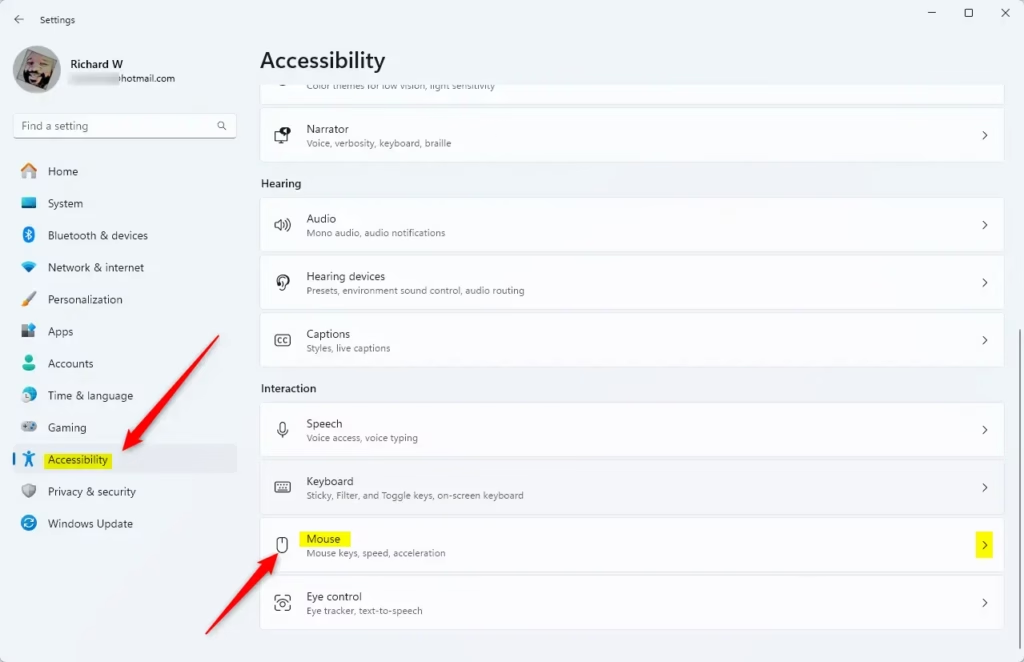
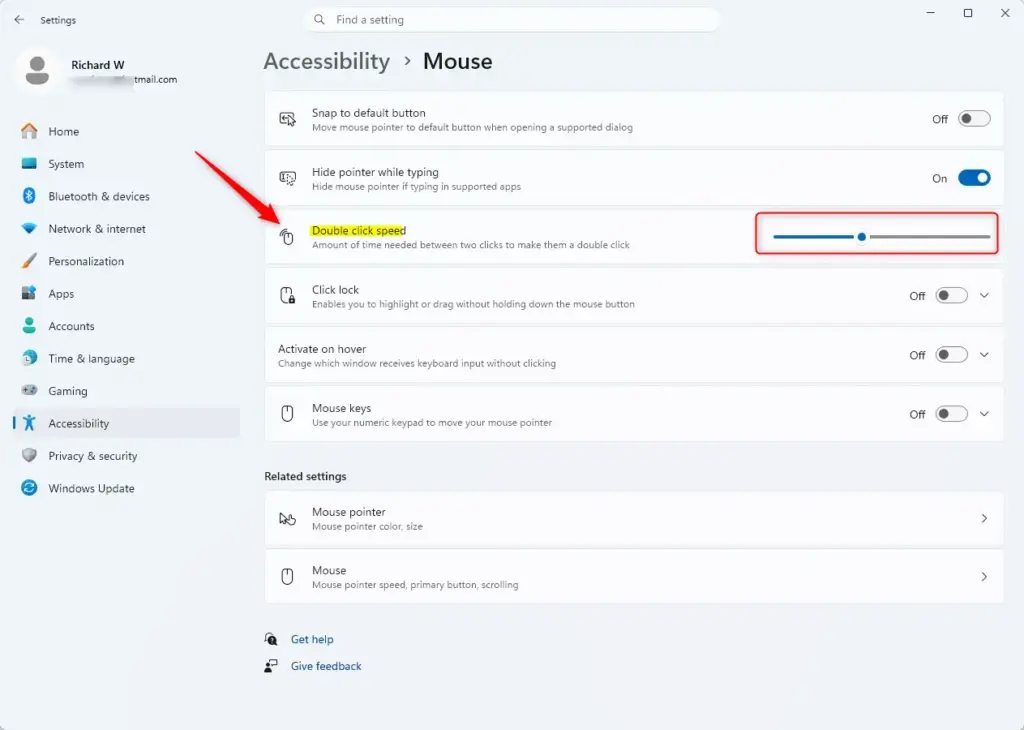
In Windows 11 the slider is in the classic Mouse Properties window, which you can reach from the Settings app or from the Control Panel . You can also set the exact value in the Registry. Some guides say the slider is under the Accessibility pages. It is not. Accessibility Mouse covers things like Mouse keys, not double-click speed. This guide covers all three working methods, from easiest to most manual.
Open Settings Bluetooth & devices Mouse, click Additional mouse settings, then drag the Double-click speed slider on the Buttons tab toward Slow or Fast to adjust the time allowed between clicks. Test with the folder icon, then click OK.
Method 1Using the Settings App (For newer 🪟 Windows 11 builds)
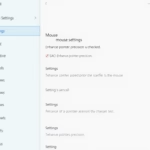
The Settings app works on any current Windows 11 build, Home or Pro. It does not have its own double-click slider. Instead it opens the classic Mouse Properties window, where the slider lives. Open Settings, go to Bluetooth & devices > Mouse, and use the additional mouse settings link to reach the slider.
- Press Win+I to open Settings . You should see the Settings window with a list of categories on the left.
- Click Bluetooth & devices in the left-hand menu.
- Click Mouse in the list on the right. You should see options such as the primary mouse button, pointer speed and scrolling.
- Scroll down to the Related settings section and click Additional mouse settings. A separate window called Mouse Properties opens.
- Click the Buttons tab if it is not already selected.
- Under Double-click speed, drag the slider. Move it toward Slow (left) to allow more time between clicks, which is more forgiving. Move it toward Fast (right) to allow less time, so you must click faster.
- Double-click the folder icon next to the slider to test it. The folder opens or closes (it shows an open folder) when Windows counts your clicks as a double-click. If nothing happens, move the slider a notch toward Slow and try again.
- Click Apply, then OK. The change takes effect straight away. You do not need to restart.
If you do not see a Buttons tab, or the window looks different, your mouse maker’s driver software may have replaced the standard dialog. In that case, use the vendor’s own settings app or one of the other methods below.
To undo the change, open the same window and move the slider back to the middle, which is close to the Windows default.
Method 2Using the Control Panel (Works on all 🪟 Windows 11 versions)
The Control Panel gets you to the same Mouse Properties window and works on every edition of Windows 11, Home and Pro. It is useful if the Settings link is missing or you simply prefer the classic route. Open the Start menu, type Control Panel, open the app, go to Hardware and Sound Mouse, and use the slider on the Buttons tab.
- Click the Start button, type Control Panel, and click the result. The Control Panel window opens.
- Check the View by setting in the top right corner. Set it to Category or Large icons, whichever you find easier to read.
- Open the Mouse settings. In Category view, click Hardware and Sound, then click Mouse under Devices and Printers. In Large icons view, click Mouse directly in the list. The Mouse Properties window opens.
- Click the Buttons tab across the top. This tab holds the settings for your mouse buttons.
- Under Double-click speed, drag the slider. As in the Settings method, left (Slow) allows more time between clicks and is less sensitive. Right (Fast) allows less time and is more sensitive.
- Double-click the folder icon next to the slider to test the speed. Adjust until it opens and closes reliably without you rushing.
- Click OK at the bottom of the window to save the new setting. The change applies immediately.
- Close the Control Panel window.
Ticking it swaps your left and right buttons.
Method 3Using the Registry Editor (For advanced users)
The Registry Editor lets you set the double-click time directly in milliseconds, which the slider cannot do. It works on all editions of Windows 11. Press Windows key + R, type regedit, and go to HKEY_CURRENT_USER\Control Panel\Mouse. There you edit the DoubleClickSpeed value. This is a per-user setting, so it only affects the account you are signed in to.
Back up the Registry before you change anything. Open Registry Editor, click File Export, choose All as the export range, and save the file somewhere safe. To restore it later, use File Import
- Press Windows key + R to open the Run dialog box. Type regedit and press Enter, or click OK.
- If User Account Control asks for permission, click Yes. The Registry Editor opens, with a tree of keys in the left pane.
- Go to the correct key. Click the address bar at the top of Registry Editor, paste the path below, and press Enter:
HKEY_CURRENT_USER\Control Panel\MouseOr browse there by hand in the left pane: expand HKEY_CURRENT_USER, then Control Panel, then click Mouse. The right pane now lists the mouse values.
- In the right pane, find the value named DoubleClickSpeed. Its Type is normally REG_SZ, which means it is stored as text.
- Double-click DoubleClickSpeed. A small Edit String window opens.
- Type your chosen number in the Value data field. The range is 200 (very fast) to 900 (very slow). The Windows default is usually around 500, and some systems show 480. For a faster double-click, enter a lower number such as 300. For a slower one, enter a higher number such as 700.
- Click OK. The new number appears next to the value in the right pane.
- Close Registry Editor.
- Sign out and sign back in, or restart the computer. The value is read when you sign in, so the change usually does not apply until then. A restart is the most reliable option.
Important Note: The value is in milliseconds. A value of 480 means Windows waits up to 480 milliseconds between clicks and still counts them as a double-click. A lower number gives you less time, so you must click faster. A higher number is more forgiving.
To undo the change, edit DoubleClickSpeed again and enter your old number (500 is a safe default), or import the backup you made. You can also set the slider in Mouse Properties back to the middle, and Windows will rewrite the value for you.
Summary
You can change mouse double-click speed in Windows 11 through the Settings app, the classic Control Panel, or the Registry Editor. The first two lead to the same slider in Mouse Properties and apply immediately. The Registry method sets an exact millisecond value and needs a sign-out or restart. Whichever you use, the aim is the same: set a speed that stops accidental opens and missed double-clicks.
Was this guide helpful?

About the Author
Richard
Tech Writer, IT Professional
Richard is a writer at Geek Rewind who turns complex IT tasks into clear, step-by-step guides. He draws on years of hands-on experience in system administration and enterprise IT operations, focusing on Windows, Linux and WordPress: the problems people actually run into, and the fixes that work. His server and WordPress guides come from systems he runs himself. Richard builds and maintains the platform behind Geek Rewind, from its Ubuntu servers and Nginx configuration to its custom WordPress plugins. Many new tutorials start with readers' questions, and he's always glad to answer them in the comments.

No comments yet — be the first to share your thoughts!