How to Enable or Disable System Restore in Windows 11

This tutorial shows you how to turn System Restore on or off in Windows 11.
What is System Restore?
System Restore watches for changes on your computer and saves snapshots of your system. These snapshots are called restore points. If something goes wrong with your computer after you make a change, you can use a restore point to go back to how your system worked before.
Restore points are created before important changes happen to your system. Each restore point saves all the information needed to bring your computer back to that earlier state.
How Long Are Restore Points Kept?
After the June 2025 KB5060842 Windows security update, Windows 11 version 24H2 will keep restore points for up to 60 days. Any restore points older than 60 days will be deleted. This same 60-day limit will apply to all future versions of Windows 11 version 24H2.
System Restore automatically manages the disk space used for restore points. When space runs low, it deletes the oldest restore points to make room for new ones. The amount of disk space used depends on your hard drive size and which version of Windows you have.
What Gets Restored and What Doesn’t?
System Restore creates restore points when you install new apps, drivers, or Windows updates. You can also create restore points manually.
Important: System Restore does NOT restore your files, documents, email, browsing history, or favorites. Your personal files stay safe. However, any apps, drivers, or updates installed after the restore point was made will be removed.
System Restore works in the Windows Recovery Environment and safe mode too. This makes it easier to fix your computer when problems happen.
Default Setting and Disabling
System Restore is turned on by default in Windows. You can turn it off if you want. When disabled, you cannot access the System Restore Wizard or change System Restore settings.
Good to know: Disabling System Restore will NOT delete your existing restore points. You can still use restore points at startup or in PowerShell even after disabling System Restore.
You must be signed in as an administrator to enable or disable System Restore.
Option One: Use Local Group Policy Editor
Note: Local Group Policy Editor only works on Windows Pro, Enterprise, and Education editions. Use Option Two if you have Windows Home edition.
- Open the Local Group Policy Editor by typing
gpedit.mscin your search bar and pressing Enter. - In the left pane, navigate to this location:
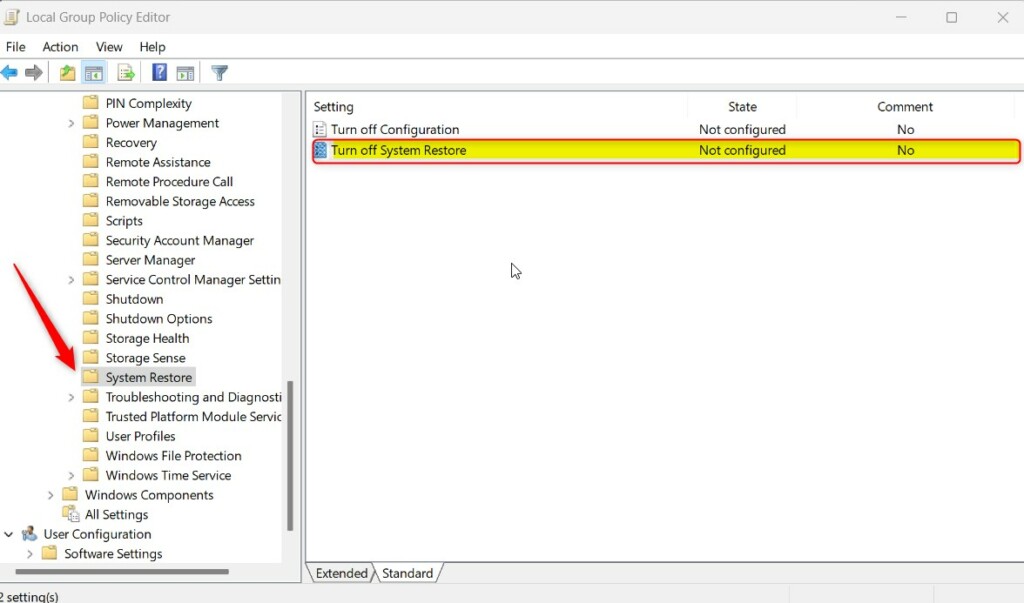
Computer Configuration > Administrative Templates > System > System Restore - In the right pane, find the policy called
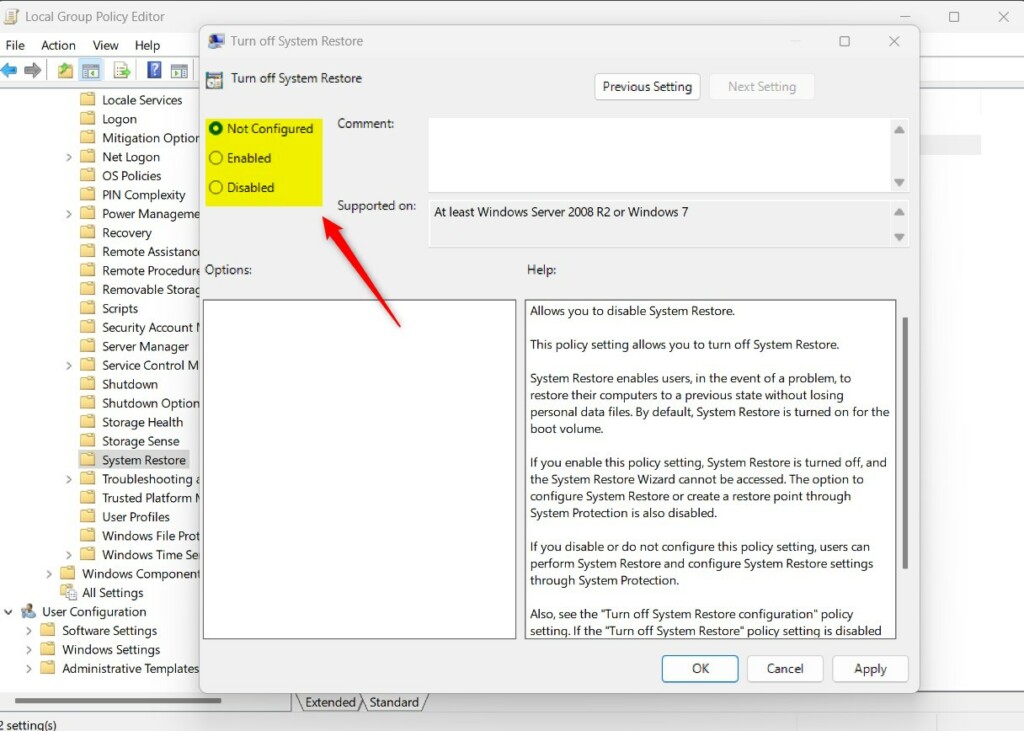
Turn off System Restore. Double-click it to open it. - To Enable System Restore (Default Setting):
- A) Select the dot next to
Not Configured. - B) Click
OK.
- A) Select the dot next to
- To Disable System Restore:
- A) Select the dot next to
Enabled. - B) Click
OK.
- A) Select the dot next to
- [REQUIRES ADMIN] After making your choice, you can close the Local Group Policy Editor.
Option Two: Use Registry Editor (Works on All Editions)
This method works on all Windows editions, including Home.
- [REQUIRES ADMIN] Open Windows Terminal as administrator.
- To Enable System Restore (Default Setting):
Run this command:
reg delete "HKLM\SOFTWARE\Policies\Microsoft\Windows NT\SystemRestore" /v DisableSR /f
- To Disable System Restore:
Run this command:
reg add "HKLM\SOFTWARE\Policies\Microsoft\Windows NT\SystemRestore" /v DisableSR /t REG_DWORD /d 1 /f
Summary
System Restore is a helpful Windows feature that saves snapshots of your system. If problems occur, you can roll back to an earlier state. Windows 11 version 24H2 keeps restore points for 60 days. Your personal files are safe—System Restore only removes apps and updates added after the restore point. You can enable or disable System Restore using the Local Group Policy Editor (Pro/Enterprise/Education editions) or Registry Editor (all editions). Remember that disabling System Restore does not delete existing restore points.
Was this guide helpful?

About the Author
Richard
Tech Writer, IT Professional
Richard, a writer for Geek Rewind, is a tech enthusiast who loves breaking down complex IT topics into simple, easy-to-understand ideas. With years of hands-on experience in system administration and enterprise IT operations, he’s developed a knack for offering practical tips and solutions. Richard aims to make technology more accessible and actionable. He's deeply committed to the Geek Rewind community, always ready to answer questions and engage in discussions.




No comments yet — be the first to share your thoughts!