How to Access Phone Link Notifications in Windows 11

Phone Link connects your Android phone to your Windows 11 PC and shows your phone’s alerts on the PC screen. The app keeps up to 40 of your most recent notifications at once, so you can read text messages and check app updates without picking up your phone.
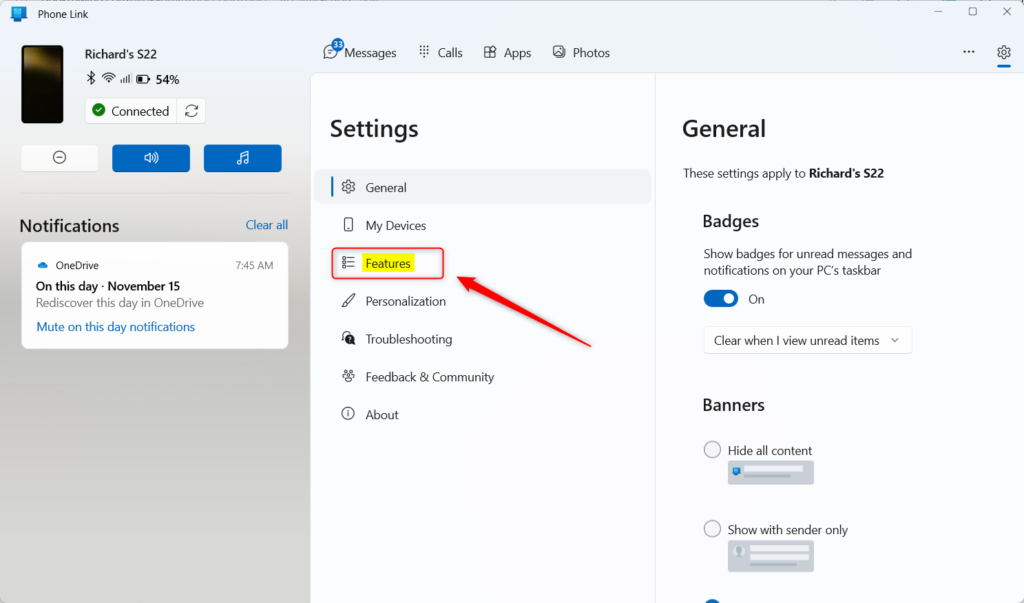
Open Phone Link on your Windows 11 PC, click the Settings gear icon, select Features, and choose your preferred notification display method under Notifications. Alerts from your Android phone then appear in the Action Center or as pop-up banners without requiring a restart.
What Happens When You Enable Notifications?
Once notifications are enabled, your PC mirrors the alerts from your Android device. They show up in the Windows notification panel (the Action Center , where alerts are collected) or as pop-up banners in the corner of the screen.
If you have not done that yet, open Phone Link on the PC, choose Android, and follow the pairing prompts. You will scan a QR code with your phone and sign in with your Microsoft account. The setup below assumes pairing is finished.
Supported Devices
Make sure the Link to Windows app is installed on your phone. On many phones it comes preinstalled, but if yours does not have it, get it from the Google Play Store.
Connect both your phone and your PC to the same Wi-Fi network, which gives the best experience. Also make sure you are signed in to the same Microsoft account on both devices. A mismatch there is a common reason pairing succeeds but nothing shows up on the PC.
Step-by-Step: Enabling Permissions on Android
Android will not share your alerts with the PC until you grant permission inside the Link to Windows app. You open the app settings, find the notifications toggle, and tap allow when prompted. After that, your phone can pass alerts to your Windows 11 computer. The wording of menus can differ a little between phone makers and app versions, but the steps are the same.
- Open the Link to Windows app on your phone. You should see the app's main screen showing that your PC is connected.
- Tap Settings. The list of app options opens.
- Find Notifications and toggle it to On. Android should now ask for permission.
- When prompted, tap Allow to grant access to your notifications. On some phones this opens Android's notification access list. If so, switch Link to Windows on there and confirm any warning, then go back to the app.
To undo this, turn the same Notifications toggle off, or remove the app's notification access in your Android settings. No restart is needed on the phone.
How to Access Phone Link Notifications in 🪟 Windows 11
On the PC, everything is controlled inside the Phone Link app. You open the app, click the gear icon to open settings, go to Features, and choose how you want your phone alerts to appear on the desktop.
- Open the Phone Link app on your PC. You can find it by typing Phone Link in the Start menu search. The app window should show your phone's name and its connection status.
- Click the Settings (gear icon) button. It sits in the top-right corner of the app window. The settings page opens.
- Select Features. You should see a list of Phone Link features, including notifications.
- Under Notifications, choose how you want to see your alerts. If the option is greyed out or missing, check that you completed the permission steps on your phone and that the phone shows as connected in Phone Link.
These settings apply to your own account and work the same on Windows 11 Home and Pro. To switch notifications off, return to the same page and turn the option off. You do not need to restart the PC for any of this.
Heads up: You might need administrator privileges to change system-wide notification settings in folders like C:\Windows\System32 if your user account has restrictions.
Phone Link's own settings normally do not need administrator rights. The note above applies only if your PC is managed by a work or school account, or if your account has been restricted by an administrator.
Troubleshooting Common Sync Issues
Sync problems usually come down to a few settings on the phone or the PC. Turn off Do Not Disturb on the PC, make sure battery saving is not blocking the app on your phone, and restart both devices. Work through the checks below in order, and test with a new notification after each one.
- Check that Focus Assist or Do Not Disturb mode is turned off on your PC. In current Windows 11 versions, Focus Assist was renamed Do Not Disturb. You can find it in Settings System Notifications While it is on, alerts go quietly to the notification panel instead of appearing as banners.
- Ensure Battery Optimization is disabled for the Link to Windows app on your phone. Android often puts background apps to sleep to save power, and that stops alerts from being passed along. The menu name differs by phone maker. Look in your phone's battery settings, or in the app's info page, for an option such as unrestricted or no battery optimization.
- Restart both your PC and your phone. This clears a stalled connection and is often all it takes.
- Verify that your PC and phone are connected to the same network. If one of them is on a guest network or a VPN, switch it to the same network as the other and check again.
If none of that helps, confirm that the notification permission on the phone is still granted. Android sometimes removes it after a system update or after the app has been force-stopped.
Customizing Your Experience
You can control which apps send alerts to your PC. In the Phone Link settings, look for the list of apps, which you will usually find with the notification options. Toggle the switch to Off for any app you want to silence. The change takes effect right away, and you can turn the app back on the same way.
You can also pin your favorite conversations to the top of the feed for faster access. This helps if you get a lot of alerts and only need to catch the important ones.
Summary
Phone Link notifications keep you updated on your PC without needing your phone in hand. Once you grant permission on your Android and adjust the settings in the Windows app, you can mirror alerts, reply to messages, and silence unwanted notifications. If notifications stop syncing, check your network connection, the notification permission on your phone, Do Not Disturb on your PC, and battery optimization for the Link to Windows app.
Have a question about this guide?
Answered by AI from this guide. Good questions may be added to this page — please don't include personal details.
Did this guide fix your problem?

About the Author
Richard
Tech Writer, IT Professional
Richard is a writer at Geek Rewind who turns complex IT tasks into clear, step-by-step guides. He draws on years of hands-on experience in system administration and enterprise IT operations, focusing on Windows, Linux and WordPress: the problems people actually run into, and the fixes that work. His server and WordPress guides come from systems he runs himself. Richard builds and maintains the platform behind Geek Rewind, from its Ubuntu servers and Nginx configuration to its custom WordPress plugins. Many new tutorials start with readers' questions, and he's always glad to answer them in the comments.
It is not clear what the difference is between “opening notifications banners in the Phone Link vs the mobile app”.
[…] in the Phone Link feature feed, enable or disable using Phone Link with Windows suggestions, open Phone Link notification banners in the mobile app or Phone Link, enable or disable Phone Link to show text messages, enable or disable Phone Link to make calls […]