

Moodle is a free learning management system that lets you build online classes, create quizzes, and share study materials on your PC without paying for web hosting. Running this setup on Windows 10 or Windows 11 gives you a local testing space that works like a real internet server.
Enable WSL and Virtual Machine Platform via PowerShell, then install Ubuntu from the Microsoft Store. Set WSL 2 as default and install the Apache web server and MariaDB database within Ubuntu.
The Windows Subsystem for Linux (WSL), a compatibility layer that lets you run Linux natively in Windows, speeds up file access so Moodle runs smoothly.
- Turn on the Windows Subsystem for Linux (WSL) and the Virtual Machine Platform. You’ll need to restart your computer after this.
- Set WSL 2 as the default version by opening PowerShell as an administrator and running the command
wsl --set-default-version 2. - Install Ubuntu from the Microsoft Store. Launch it and create a new UNIX username and password.
- Install the Apache web server by running
sudo apt updateand thensudo apt install apache2in your Ubuntu terminal. - Install MariaDB (a database server) by running
sudo apt install mariadb-server mariadb-clientand then securing it withsudo mysql_secure_installation. - Install PHP and its required modules using the command
sudo apt install php libapache2-mod-php php-imagick php-imap php-json php-ldap php-common php-pgsql php-ssh2 php-sqlite3 php-xml php-soap php-mysql php-gmp php-curl php-intl php7.4-mbstring php-xmlrpc php-gd php-xml php-cli php-zip. - Create a database and user for Moodle within MariaDB.
- Download the latest Moodle files using Git and set the correct permissions.
- Configure Apache to recognize Moodle and then restart the Apache service.
- Open your web browser and go to
http://localhostto run the Moodle installation wizard and complete the setup.
Enable WSL in Windows
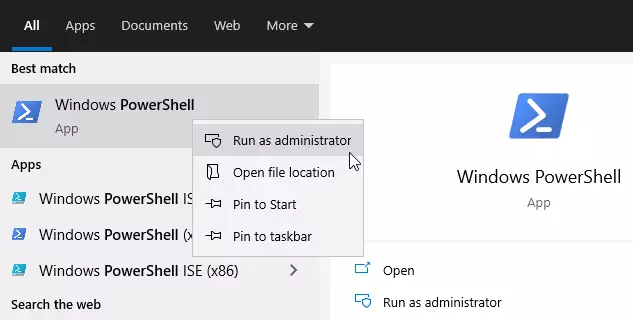
Windows Subsystem for Linux (WSL) lets your Windows computer run Linux programs directly, setting up the foundation for your Moodle environment. To enable this feature and install Moodle WSL Windows, open PowerShell as an administrator by clicking Start, typing PowerShell, right-clicking Windows PowerShell, and selecting Run as administrator.
What to do: Open PowerShell as an administrator. Click Start , then type PowerShell. Right-click Windows PowerShell and select “Run as administrator.”
Now run this command:
dism.exe /online /enable-feature /featurename:Microsoft-Windows-Subsystem-Linux /all /norestart
You should see a success message like this:
Deployment Image Servicing and Management tool

Version: 10.0.19041.844
Image Version: 10.0.19042.844
Enabling feature(s)

[==========================100.0%==========================]

The operation completed successfully.
Enable Virtual Machine Platform
Virtual Machine Platform is an essential feature that allows WSL 2 to manage the virtual environment needed for Linux applications, ensuring Moodle functions correctly. To enable this, run the DISM command from your open PowerShell window to configure the system components properly.
Run this command from the same PowerShell window:
dism.exe /online /enable-feature /featurename:VirtualMachinePlatform /all /norestart
If you're using Windows 10 version 2004 or older, use this command instead:
Enable-WindowsOptionalFeature -Online -FeatureName VirtualMachinePlatform -NoRestart
This lets all the changes take effect. If you don't restart, the next command won't work.
After restarting your computer, open PowerShell as administrator again. Run the command `wsl --set-default-version 2` to set the Windows Subsystem for Linux (WSL) 2 as the default version. This step ensures that Moodle installations utilize the newer, more capable WSL 2 architecture, which offers better performance and compatibility for Linux environments.
wsl --set-default-version 2
Install Ubuntu on 🪟 Windows 10
Ubuntu on Windows 10 creates the Linux environment required to install Moodle WSL Windows. Ubuntu provides the necessary Linux terminal and command-line tools for running Moodle and its associated software, and you can download it directly from the Microsoft Store.
Open this link to download Ubuntu 20.04 from the Windows Store:
Get Ubuntu 20.04 LTS - Microsoft Store
Ubuntu provides a Linux terminal with command-line tools such as bash, ssh, git, apt, and more.
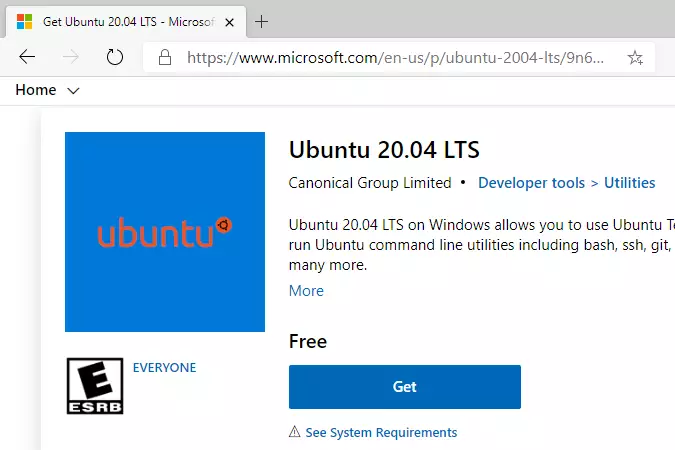
Click the Get button and install it. After installing, launch Ubuntu from WSL.
Ubuntu will ask you to create an account. Follow the prompts:
Installing, this may take a few minutes.

Please create a default UNIX user account. The username does not need to match your Windows username.

For more information visit: https://aka.ms/wslusers

Enter new UNIX username: user

New password:

Retype new password:

passwd: password updated successfully

Installation successful!

To run a command as administrator (user "root"), use "sudo <command>".

See "man sudo_root" for details.
Welcome to Ubuntu 20.04.2 LTS (GNU/Linux 4.4.0-19041-Microsoft x86_64)
 * Documentation:  https://help.ubuntu.com

 * Management:     https://landscape.canonical.com

 * Support:        https://ubuntu.com/advantage
  System information as of Mon Apr 12 17:57:37 CDT 2021
  System load:    0.52      Processes:             7

  Usage of /home: unknown   Users logged in:       0

  Memory usage:   26%       IPv4 address for eth0: 192.168.1.100

  Swap usage:     0%
1 update can be installed immediately.

0 of these updates are security updates.

To see these additional updates run: apt list --upgradable
Great! Ubuntu is now installed.
If you run into problems, try these commands:
wsl --set-default-version 1

bcdedit /set hypervisorlaunchtype auto start
Install Apache HTTP Server
Apache HTTP Server acts as a web server on your Ubuntu WSL, handling requests from browsers so they can display your Moodle site and its content. You install and manage this web server using standard apt package manager commands in your Linux terminal.
Run these commands:
sudo apt update

sudo apt install apache2
You can use these commands to control Apache:
sudo service apache2 stop

sudo service apache2 start

sudo service apache2 restart
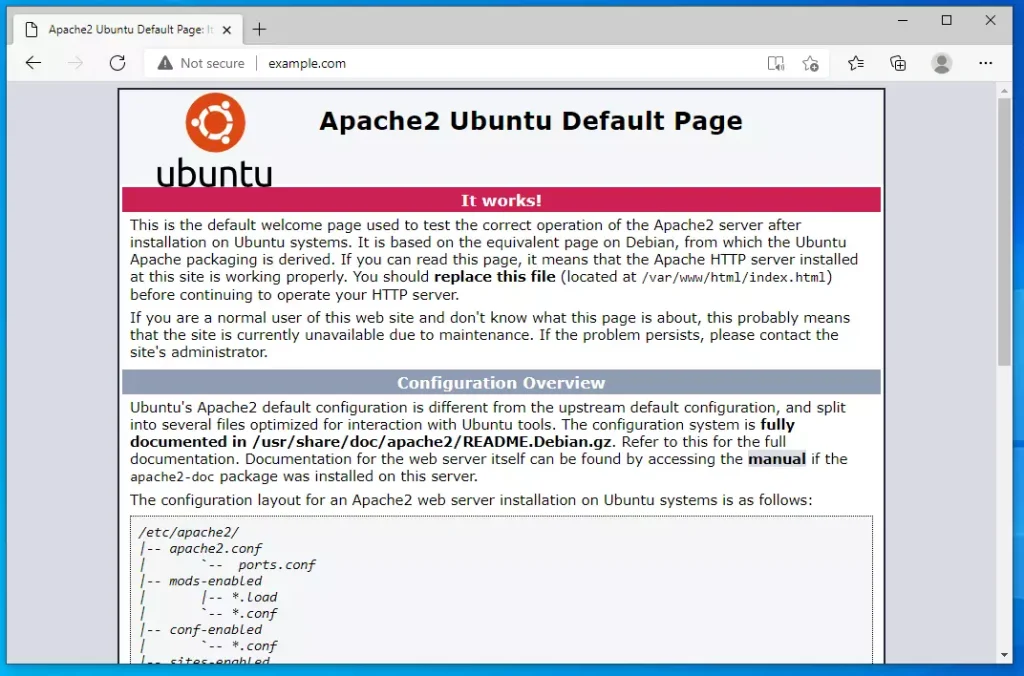
To check if Apache is working, open your browser and go to:
http://localhost
You should see an Apache test page.
Install MariaDB Database Server
MariaDB Server stores all important Moodle data, such as course details and user accounts, within your WSL setup. MariaDB is open-source, fast, and secure, making it the standard database choice for most Linux systems hosting Moodle.
MariaDB is open-source, fast, and secure. Most Linux systems use it.
Run this command:
sudo apt install mariadb-server mariadb-client
You can use these commands to control MariaDB:
sudo service mysql stop

sudo service mysql start

sudo service mysql restart
Run this command:
sudo mysql_secure_installation
Answer the questions like this:
Enter current password for root (enter for none): Press the Enter key
Set root password? [Y/n]: Y
New password: Enter a password
Re-enter new password: Repeat the password
Remove anonymous users? [Y/n]: Y
Disallow root login remotely? [Y/n]: Y
Remove test database and access to it? [Y/n]: Y
Reload privilege tables now? [Y/n]: Y
To verify MariaDB is working, log in with this command:
sudo mysql -u root -p
Type your root password when asked. You should see:
Welcome to the MariaDB monitor.  Commands end with ; or g.

Your MariaDB connection id is 46

Server version: 10.3.29-MariaDB-0ubuntu0.20.04.1 Ubuntu 20.04

Copyright (c) 2000, 2018, Oracle, MariaDB Corporation Ab and others.

Type 'help;' or 'h' for help. Type 'c' to clear the current input statement.

MariaDB [(none)]>
Great! MariaDB is installed.
Install PHP and Related Modules
PHP and all its required modules are essential for Moodle to function correctly and process its web pages on your WSL system. You install these software packages using the terminal to give Moodle the backend scripting language it needs.
Run this command to install PHP and all required modules:
sudo apt install php libapache2-mod-php php-imagick php-imap php-json php-ldap php-common php-pgsql php-ssh2 php-sqlite3 php-xml php-soap php-mysql php-gmp php-curl php-intl php7.4-mbstring php-xmlrpc php-gd php-xml php-cli php-zip
To check if PHP is installed correctly, run:
php -v
You should see something like:
PHP 7.4.3 (cli) (built: Oct  6 2020 15:47:56) ( NTS )

Copyright (c) The PHP Group

Zend Engine v3.4.0, Copyright (c) Zend Technologies

with Zend OPcache v7.4.3, Copyright (c), by Zend Technologies
You can also test PHP by creating a test file. Run this command:
sudo nano /var/www/html/phpinfo.php
Type this content:
<?php phpinfo( ); ?>
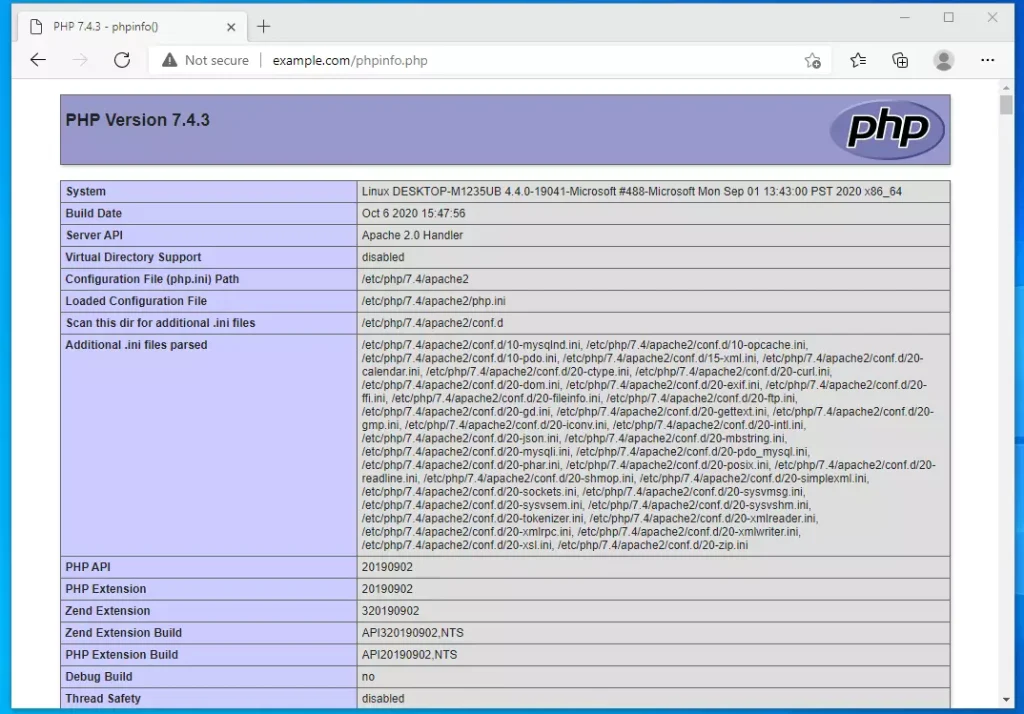
Save the file. Restart Apache, then open your browser and go to:
http://example.com/phpinfo.php
You should see a PHP information page.
Create Moodle Database
A dedicated database securely stores all your course and user information within MariaDB on WSL. You create this specific database and a corresponding user account using the MySQL command-line interface to hold your Moodle content and settings.
Log into MariaDB with this command:
sudo mysql -u root -p
Create a database called moodle:
CREATE DATABASE moodle;
Create a database user called moodleuser:
CREATE USER 'moodleuser'@'localhost' IDENTIFIED BY 'new_password_here';
Give the user full access to the moodle database:
GRANT ALL ON moodle.* TO 'moodleuser'@'localhost' WITH GRANT OPTION;
Save your changes and exit:
FLUSH PRIVILEGES;

EXIT;
Download Moodle
Moodle files are downloaded using Git to get the platform running on your Windows WSL setup. This method fetches the files directly from Moodle's official source to ensure you have the most current version for your installation.
First, install git and curl:
sudo apt install git curl
Go to the Apache directory and download the latest Moodle version:
cd /var/www/

sudo git clone -b MOODLE_39_STABLE git://git.moodle.org/moodle.git moodle
To see the latest Moodle versions, check this link:
Now set the correct permissions so Moodle can work:
sudo mkdir -p /var/www/moodledata

sudo chown -R www-data:www-data /var/www/

sudo chmod -R 755 /var/www/

sudo chown www-data:www-data /var/www/moodledata
Configure Apache
Apache configuration files direct the web server to find Moodle's files and serve your website correctly. You create this special configuration file on your WSL server to tell Apache how to handle incoming browser requests.
Create a new Apache configuration file:
sudo nano /etc/apache2/sites-available/moodle.conf
Copy and paste this configuration:
<VirtualHost *:80>

  ServerName example.com

  ServerAlias www.example.com

  ServerAdmin admin@example.com

  DocumentRoot /var/www/moodle
  <Directory /var/www/moodle/>

       Options FollowSymlinks

       AllowOverride All

       Require all granted

  </Directory>
     ErrorLog ${APACHE_LOG_DIR}/error.log

     CustomLog ${APACHE_LOG_DIR}/access.log combined
</VirtualHost>
Save the file. Then enable the new site and restart Apache:
sudo a2ensite moodle.conf

sudo a2enmod rewrite

sudo service apache2 restart
Launch Moodle
Moodle launches on your Windows WSL installation when you visit the configured web address in your browser after setup is complete. This action starts the Moodle setup wizard, guiding you through the final language selection and directory confirmation steps.
Open your browser and go to:
http://example.com
The Moodle installation wizard should open.
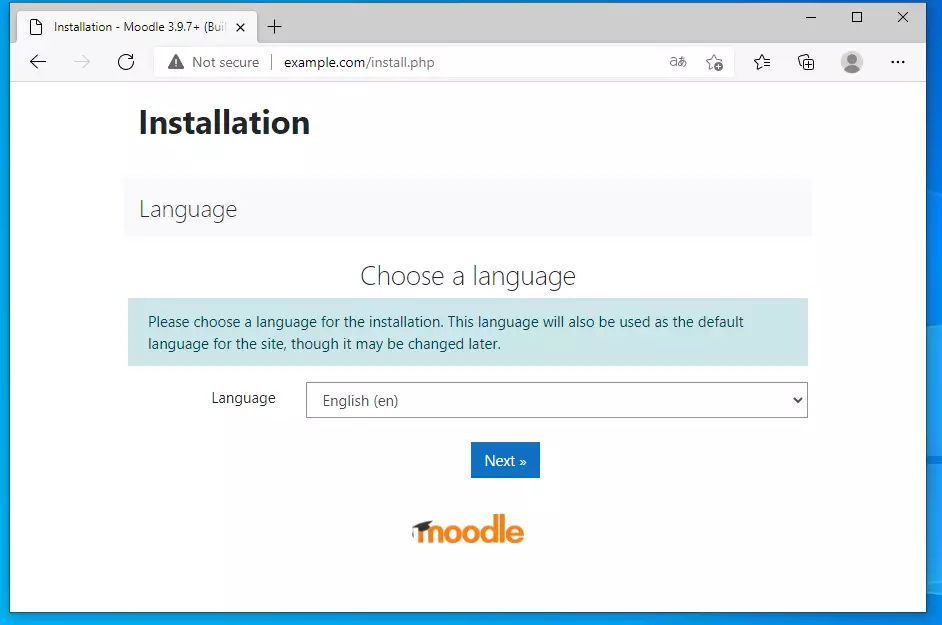
First, choose your language:
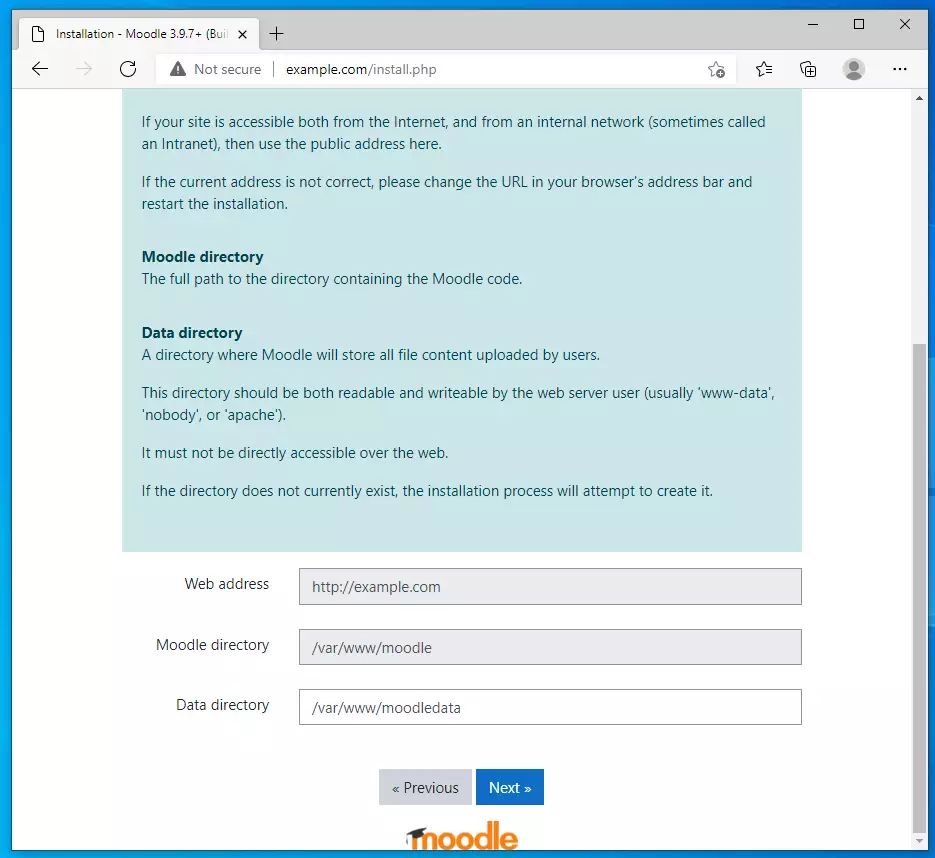
Next, confirm the Moodle directories:
- Moodle directory: The folder with Moodle's code
- Data directory: Where Moodle stores files users upload
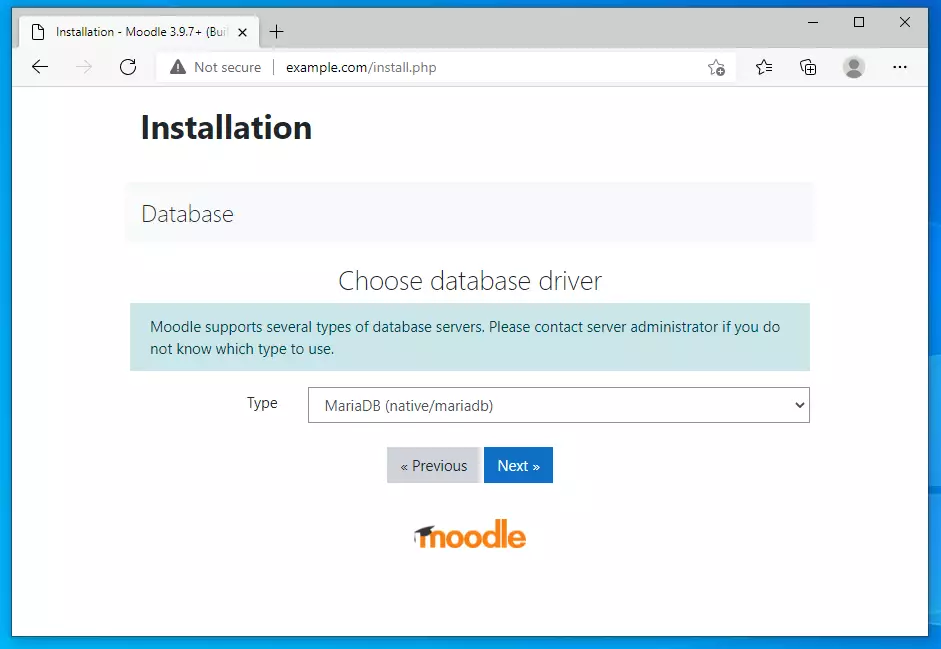
Choose your database type. MariaDB is what we installed:
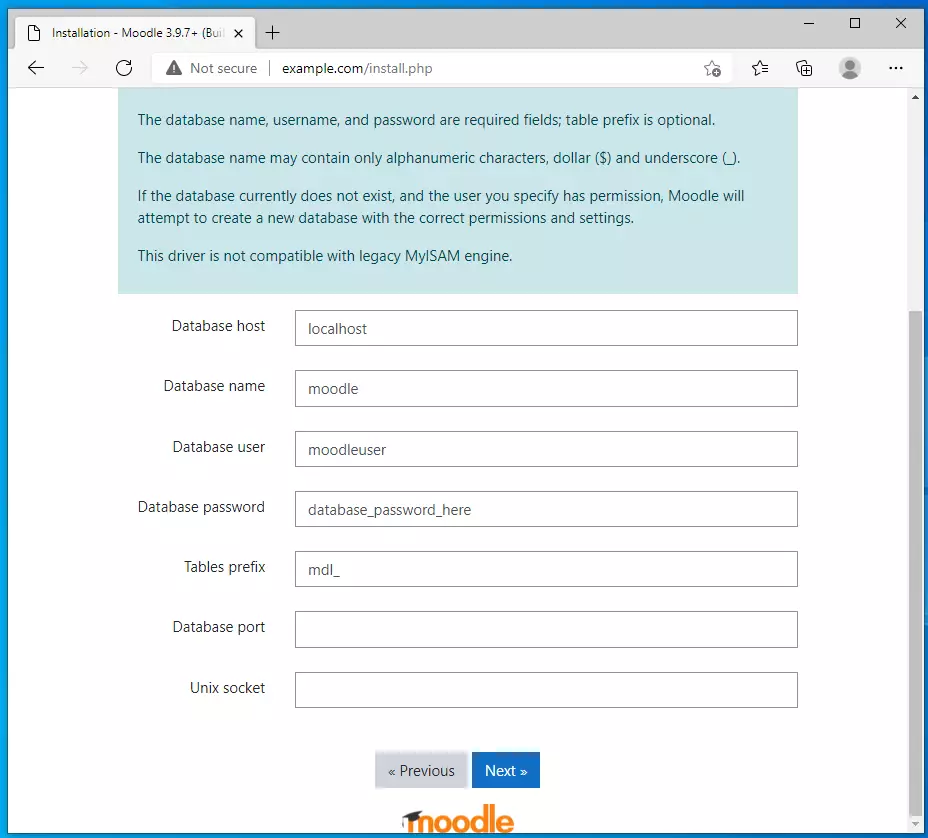
Enter your database details:
- Database name: moodle
- Username: moodleuser
- Password: The password you created
Continue through the installer. Check that everything meets the requirements.
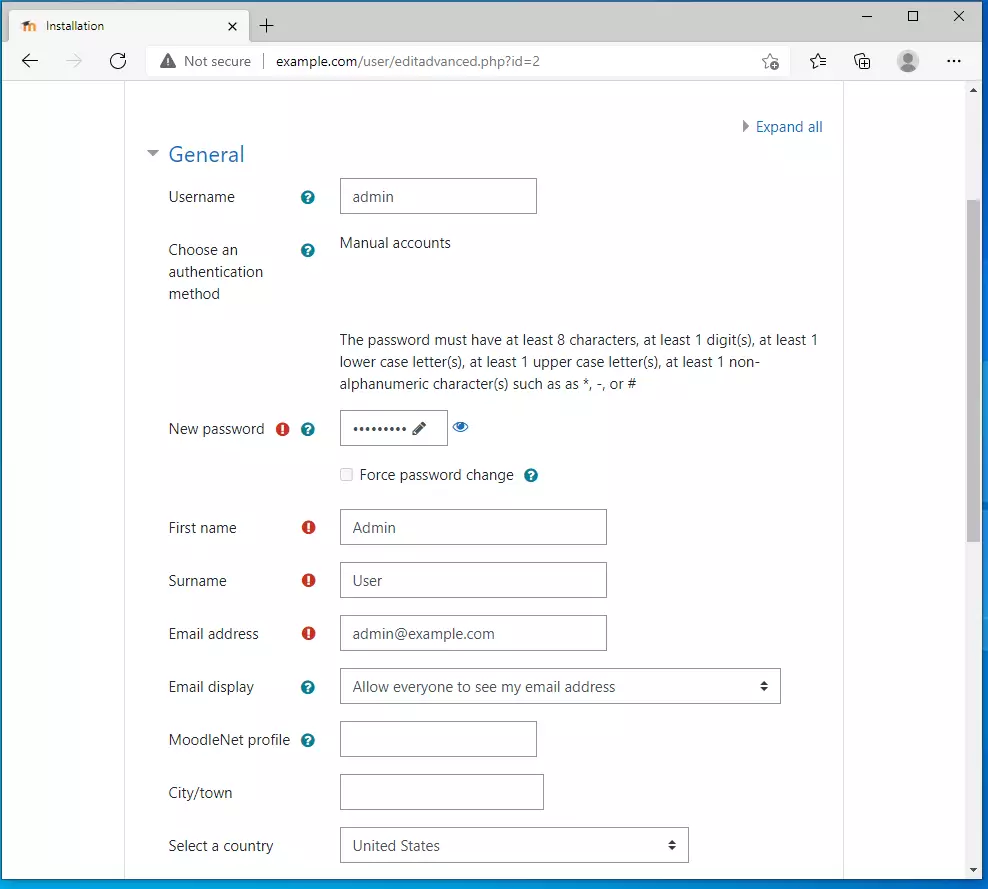
Create your main admin account. This person will control the entire site. Use a strong password and a real email address:
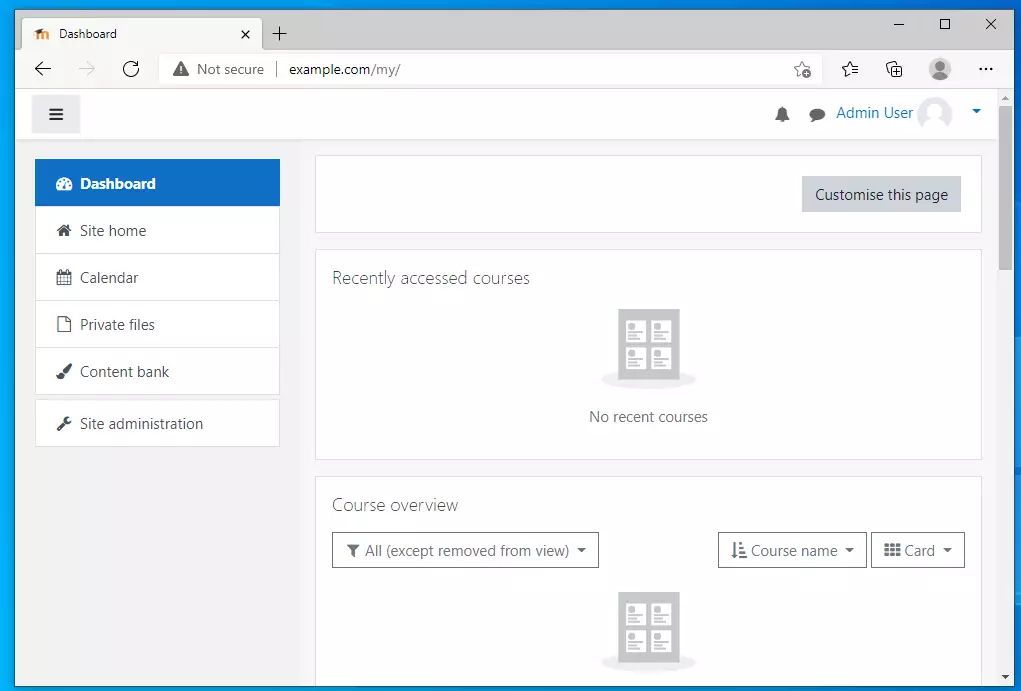
Once done, Moodle is ready to use:
Summary
Install Moodle WSL Windows process is now successfully completed after enabling WSL, installing Ubuntu, Apache, MariaDB, PHP, and setting up Moodle. This configuration gets the learning platform ready for use on your local machine.
- Enabled WSL 2 on Windows
- Installed Ubuntu Linux on your Windows machine
- Installed Apache web server
- Installed MariaDB database
- Installed PHP and required modules
- Created a Moodle database and user
- Downloaded Moodle from GitHub
- Configured Apache for Moodle
- Ran the Moodle installation wizard
Moodle is now running on your Windows computer. You can use it to create courses, manage students, and deliver online education.
Was this guide helpful?

About the Author
Richard
Tech Writer, IT Professional
Richard is a writer at Geek Rewind who turns complex IT tasks into clear, step-by-step guides. He draws on years of hands-on experience in system administration and enterprise IT operations, focusing on Windows, Linux and WordPress: the problems people actually run into, and the fixes that work. His server and WordPress guides come from systems he runs himself. Richard builds and maintains the platform behind Geek Rewind, from its Ubuntu servers and Nginx configuration to its custom WordPress plugins. Many new tutorials start with readers' questions, and he's always glad to answer them in the comments.


This is a great article. Are there any differences when doing this on Windows 11? If so, please can you upgrade or create a new article for Windows 11.