How to Change How Often Windows 11 Makes Restore Points


System Restore creation frequency in Windows 11 controls how often your PC saves snapshots of its settings and important files. By default, Windows 11 creates a new restore point only once every 24 hours, but you can adjust this time limit to make restore points more or less often. These saved points let you roll back your computer to an earlier time if a problem pops up. This guide shows the one registry change that does it, and how to undo it.
Change the SystemRestorePointCreationFrequency value in the Registry Editor. Navigate to 🗝️HKEY_LOCAL_MACHINESOFTWAREMicrosoftWindows NTCurrentVersionSystemRestore, create a new DWORD value, and set its data to the desired minutes between restore points. Restart your PC for the change to take effect.
What is a Restore Point?
A restore point is like taking a snapshot of your computer’s important files and settings at a certain time. If something goes wrong later, such as after installing a new program or driver, you can use a restore point to put your computer back to that earlier, working condition. A restore point does not back up your documents, photos or other personal files. It covers system files, drivers, installed programs and registry settings.
How Often Does Windows Create Restore Points?
Windows 11 usually makes a new restore point every 24 hours automatically if system protection is turned on for your drive. However, you can change the Windows 11 restore points frequency using the Registry Editor if you want backups to happen more or less often. Knowing this schedule helps you decide if you need to adjust the timing to better protect your files.
Check one thing first: system protection is switched off by default on some Windows 11 installs. If it is off for your system drive, Windows creates no restore points at all, and the setting in this guide will do nothing. To check, type Create a restore point in the Start menu search and open the result. Then look at the Protection column in the System Properties window. If your system drive says Off, select it, click Configure, choose Turn on system protection, and click OK.
You can change this time to make Windows create restore points more often. Or you can set it so Windows creates one every time something changes on your computer.
The limit applies to the automatic restore points that Windows and installers request, for example before a Windows update or a program install. A restore point you create by hand from the System Protection window is not held back by this limit. This works on both Windows 11 Home and Pro, because the Registry Editor is included in both.
How to Change How Often 🪟 Windows 11 Makes Restore Points
This is a part of Windows that controls important settings. Please follow these steps carefully. It's a good idea to back up your registry first, just in case.
To make a quick backup, open the Registry Editor as described below, click File Export, set Export range to All, give the file a name and save it somewhere safe. If anything goes wrong later, double-click that file to restore it. You will need to be signed in with an administrator account for all of this.
Step 1Open the Registry Editor
- Press
Win + Ron your keyboard. This opens the Run box, a small window with a single text field in the lower-left corner of the screen. - Type
regeditand press Enter. - [ADMIN REQUIRED] If Windows asks for permission, click Yes. The Registry Editor window should now open, with a folder tree on the left.
Need help? See this guide: How to Open Registry Editor in Windows 11.
Step 2Find the SystemRestore Folder
In the Registry Editor window, go to this path. You can expand the folders on the left one by one, or paste the path into the address bar under the menu bar and press Enter:
HKEY_LOCAL_MACHINE\SOFTWARE\Microsoft\Windows NT\CurrentVersion\SystemRestore
If you don't see the SystemRestore folder (called a key in the registry) under that path, create it with these steps:
- Right-click on the CurrentVersion folder in the left pane.
- Select New Key A new folder appears under CurrentVersion with its name highlighted for editing.
- Name the new folder:
SystemRestore. Press Enter to confirm. The name should now appear in the tree on the left.

With the SystemRestore folder in place, you can add the value that sets the time between restore points. The next steps create that value and give it a number of minutes.
Step 3Create or Change the Frequency Setting
- Click on the SystemRestore folder. The right pane shows its contents, which may be empty apart from a (Default) entry.
- On the right side, right-click in the empty space and choose New DWORD (32-bit) Value. A new entry appears with its name highlighted.
- Name the new value:
SystemRestorePointCreationFrequency. Press Enter to confirm. If the name is wrong, right-click the entry, choose Rename and fix it. - Double-click the new value you just made. The Edit DWORD (32-bit) Value box opens.
- Under Base, select Decimal. Then, in the box for Value data, enter how many minutes you want between restore points. Choose Decimal first, because the box defaults to Hexadecimal and the number would otherwise be read in the wrong base.
Registry Editor (a tool for advanced Windows settings) lets you adjust the exact time delay between automatic backups. Changing this setting requires adding a specific numeric value in minutes to control when Windows 11 restore points frequency updates. Be careful here, because making a mistake in the registry can cause system issues.
- 0 means Windows will try to create a restore point every time it can (never skip). On a busy machine this can mean many restore points, and they use disk space.
- 1440 means Windows will make one restore point every 24 hours (this is the default). Setting this value has the same effect as not having the entry at all.
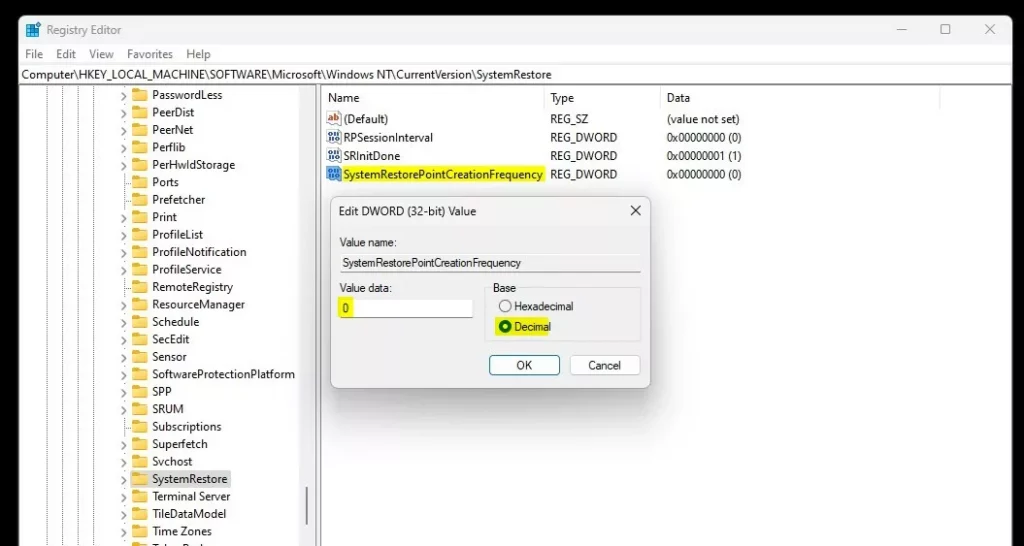
Other values work the same way: the number is minutes. For example, 720 gives you roughly one restore point every 12 hours, and 60 gives you one per hour at most. Before you move on, check that the Value data box shows the number you meant and that Decimal is still selected.
Step 4Save and Restart Your PC
- Click OK to save your changes. The box closes, and the new number shows in the Data column next to the value name.
- Close the Registry Editor.
- Restart your computer to make the new setting take effect.
Summary
Managing Windows 11 restore points frequency gives you exact control over how often your computer saves backup states. You can set a custom time limit in minutes or use zero to capture changes constantly. This setup ensures your computer always has a fresh restore point ready when you need to fix a problem.
To undo the change, go back to the same SystemRestore folder. Either set the value back to 1440 or right-click the value, choose Delete and confirm. Then restart. Windows goes back to its 24-hour default.
- Setting the value to 0 means Windows will create restore points every time it tries, without skipping.
- You can choose any number of minutes that works best for you. Shorter gaps give you more recovery points to pick from, but they also use more of the disk space set aside for system protection, so older points get deleted sooner.
Want to learn more? Check out the official Microsoft info here: Microsoft Restore Point Info.
Need Help or Want to Share?
If you have questions or want to share your experience, leave a comment below — we're here to help!
Was this guide helpful?
100% of readers found this helpful (1 votes)

About the Author
Richard
Tech Writer, IT Professional
Richard is a writer at Geek Rewind who turns complex IT tasks into clear, step-by-step guides. He draws on years of hands-on experience in system administration and enterprise IT operations, focusing on Windows, Linux and WordPress: the problems people actually run into, and the fixes that work. His server and WordPress guides come from systems he runs himself. Richard builds and maintains the platform behind Geek Rewind, from its Ubuntu servers and Nginx configuration to its custom WordPress plugins. Many new tutorials start with readers' questions, and he's always glad to answer them in the comments.




Good guide ! But MS keeps Restore Points for only 3 days. They have made retention settings inaccessible, and updates may wipe them out. Is there any way to fix this in the registry, to keep restore points for longer?
BR
…Ghia..