How to Enable USB Battery Saver in Windows 11

USB Battery Saver in Windows 11 cuts power to plugged-in USB devices like mice and flash drives the moment your screen turns off. This power-saving feature stops idle accessories from draining your laptop battery in the background.
Turning it on takes a few clicks in Settings, and it helps your battery last longer through the day. This guide covers the main toggle, the older USB selective suspend option in Power Options, and what to do if a device keeps disconnecting. None of these changes needs a restart, and each one can be reversed the same way you set it.
Open Settings , go to Bluetooth & devices, click the USB tile, and toggle USB battery saver On. The change takes effect immediately with no restart needed. If you don’t see this option, press Win+R, type powercfg.cpl, and adjust USB selective suspend in Power Options instead.
Is USB battery saver enabled by default in 🪟 Windows 11?
Sometimes. Windows 11 often enables basic power management features by default to optimize system latency and battery life. Your laptop manufacturer’s power delivery profiles can change that, though, so the setting on your machine may differ from the default.
Open the USB page in Settings (covered below) and look at the toggle. If it is off and you want longer battery life, turn it on. If you rely on a device that must stay powered, you may need to adjust the settings manually to balance performance with longevity.
How to change USB battery saver settings
You change USB battery saver settings in the main Settings app , under Bluetooth & devices. This built-in feature helps your laptop battery last longer by reducing the power sent to connected USB accessories when you are not plugged into a wall outlet.
The steps are the same on Windows 11 Home and Pro. The USB page and its battery saver option appear on some PCs and not on others, depending on your hardware and Windows 11 version. If you cannot find it, see the notes after the steps and use the Power Options method in the next section instead.
- Open Settings by pressing the Windows key + I on your keyboard. The Settings window opens with a list of categories on the left.
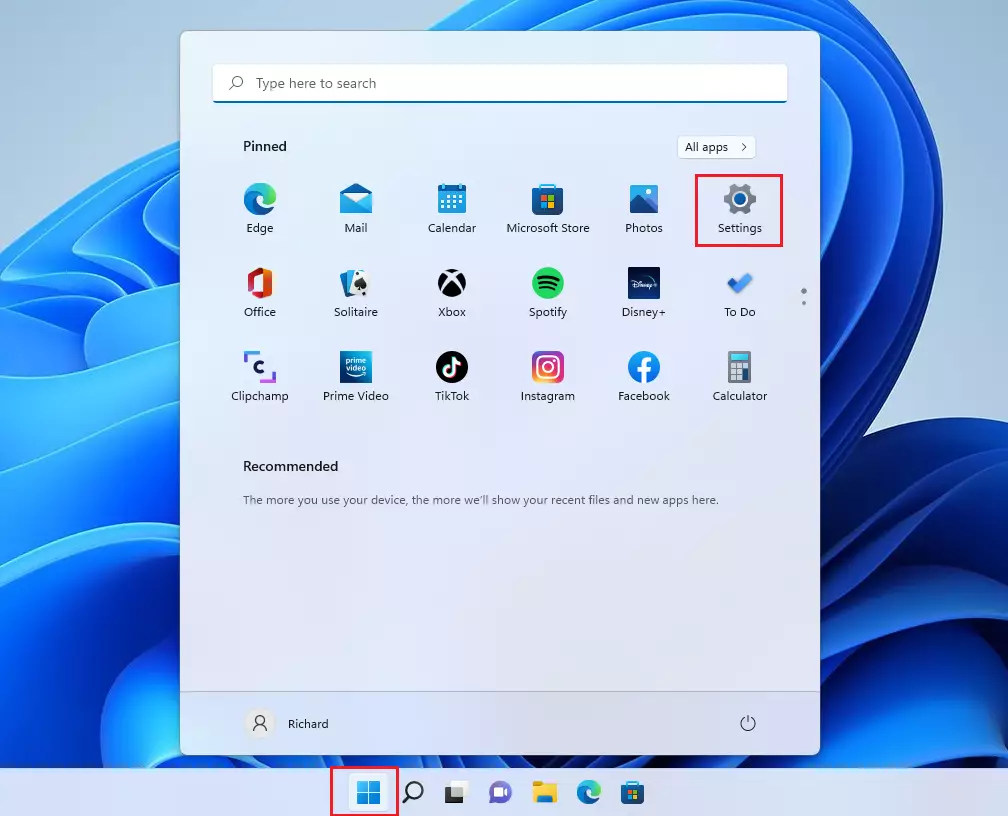
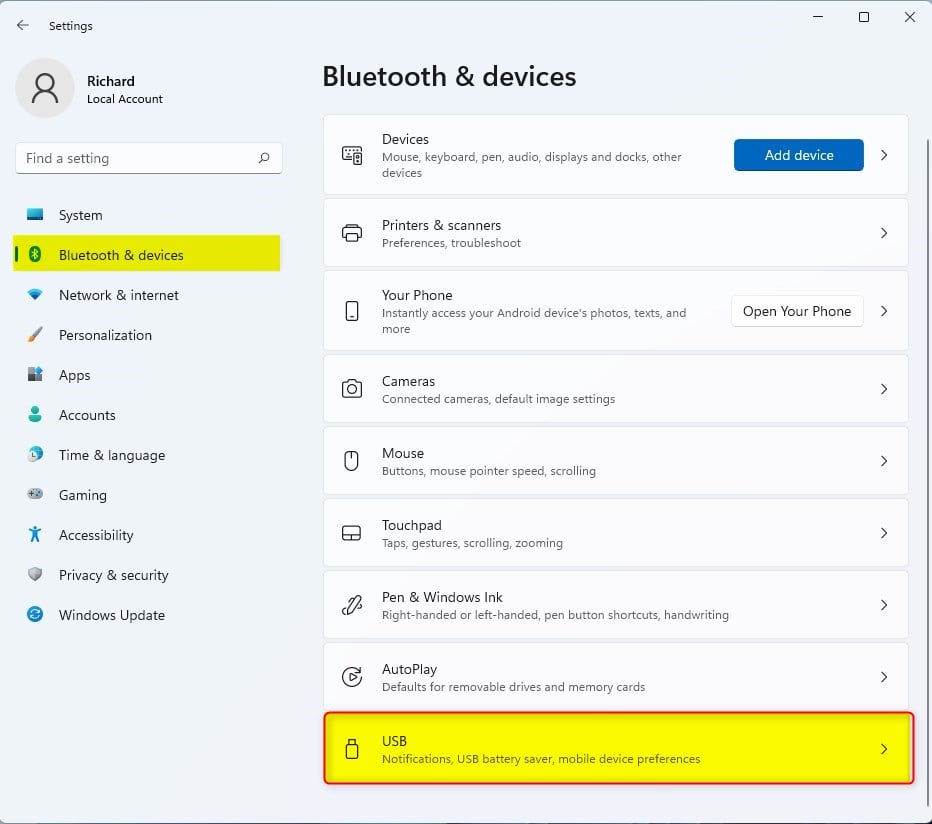
windows 11 start menu settings updated - In the menu on the left, click Bluetooth & devices. The right side now lists your paired devices and related options.
- On the right side of the screen, click the USB tile. You may need to scroll down to see it. A page with USB options opens.
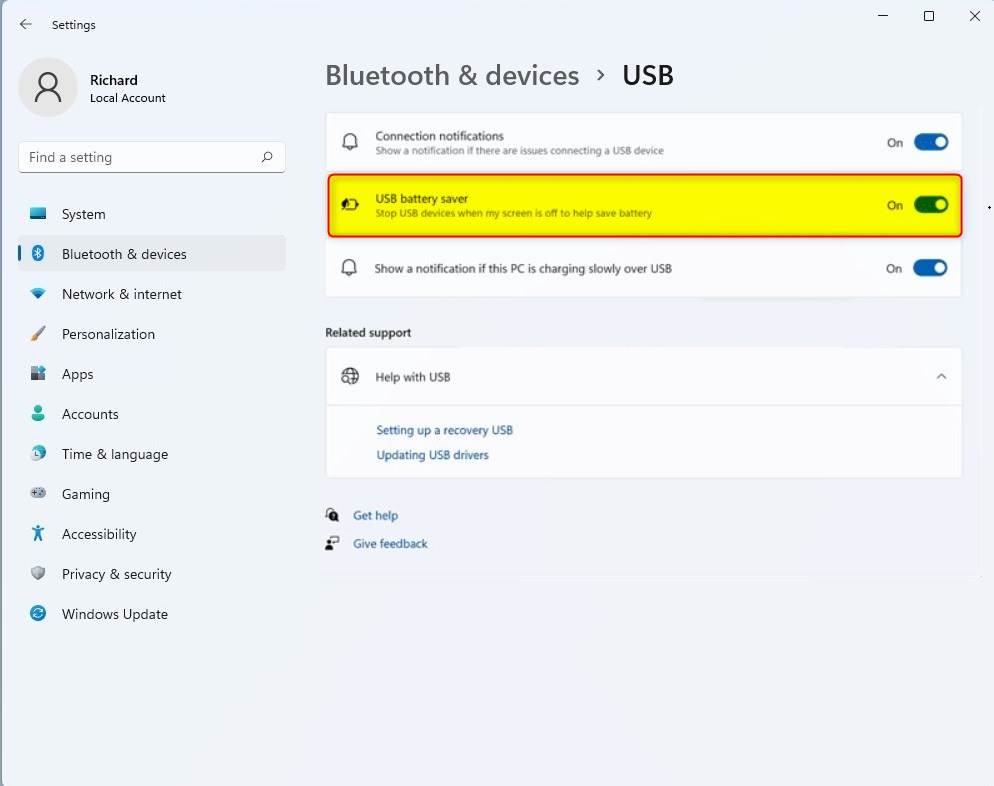
windows 11 bluetooth and devices usb - Find the USB battery saver option and toggle it On or Off. The switch changes right away. There is no Save button and you do not need to restart.
windows 11 usb battery saver on off
Advanced Power Management: USB Selective Suspend
USB Selective Suspend is a power management feature in Windows 11 that helps conserve your laptop battery. It works by putting unused USB ports into a low-power state so they stop draining energy when your devices are plugged in but not actively being used.
This setting lives in the older Power Options window, and it is set per power plan. It is also the place to look if the USB page in Settings does not show a battery saver option on your PC. Changing it needs an administrator account. If you are on a standard account, Windows will ask for admin credentials.
Steps to access legacy Power Options (Requires Admin Privileges):
- Press Windows key + R, type powercfg.cpl, and press Enter. The Power Options window opens in Control Panel.
- Click Change plan settings next to your active power plan. This is the plan with the filled-in selection circle.
- Click Change advanced power settings. A small Power Options dialog opens with a list of settings you can expand.
- Expand USB settings and then USB selective suspend setting. You will see entries for On battery and Plugged in.
- Set each entry to Enabled to let Windows suspend idle USB ports and save power, or to Disabled to keep them powered all the time.
- Click Apply, then click OK. The change takes effect immediately, so you do not need to restart.
To undo the change, repeat the steps and set the value back. If you use more than one power plan, check each plan, because the setting does not carry over between them.
Troubleshooting USB Connectivity Issues
USB devices frequently disconnect in Windows 11 when the operating system cuts power to save battery. You can fix this common connectivity problem by changing your device power management settings in Device Manager to stop Windows from turning off your hardware automatically.
The usual signs are a mouse that stops responding after a pause, a drive that vanishes from File Explorer, or a headset that drops out and comes back. If you see these after turning on USB battery saver or selective suspend, this fix is the next thing to try.
Steps to disable power management for a specific device (Requires Admin Privileges):
- Right-click the Start button and select Device Manager. The Device Manager window opens with a list of hardware categories.
- Expand Universal Serial Bus controllers. You will see a list of USB controllers and hubs.
- Right-click your USB Root Hub and select Properties. Many PCs list more than one root hub, so you may need to repeat these steps for each one.
- Go to the Power Management tab and uncheck Allow the computer to turn off this device to save power.
- Click OK to save the change. No restart is needed.
The trade-off is a little more battery use, because that hub stays powered. To undo it, open the same tab and tick the box again. If a device's Properties window has no Power Management tab, Windows does not let you control power for that item, and you can skip it.
USB4 and Power Delivery
While USB battery saver is great for basic peripherals like mice and keyboards, high-performance docks and external GPUs may require consistent power. If one of these keeps dropping out, turn the battery saver and selective suspend settings off and test again. Always check the official Microsoft USB documentation for compatibility details.
Pro-Tip: Prevent Windows from turning off USB ports
If you have a single device that keeps disconnecting, you can stop Windows from powering it down without changing the setting for every USB port. Follow these steps:
- Open Device Manager and navigate to Human Interface Devices. Mice, keyboards and similar devices are listed here.
- Double-click the device that keeps dropping out to open its properties.
- Go to the Power Management tab and uncheck the power saving box to keep the device active at all times.
- Click OK. The device should now stay connected when idle.
Some devices appear under a different category, such as Universal Serial Bus controllers or Disk drives, so look there if you do not see yours. To undo the change, tick the box again.
Summary
The USB battery saver in Windows 11 is a straightforward way to help your laptop battery last longer by stopping power to USB devices when not needed. Turn it on in Settings Bluetooth & devices USB, or use USB selective suspend in Power Options if the toggle is missing.
If a device starts disconnecting, turn off power management for that device in Device Manager. You can reverse any of these changes at any time.
Have a question about this guide?
Answered by AI from this guide. Good questions may be added to this page — please don't include personal details.
Did this guide fix your problem?

About the Author
Richard
Tech Writer, IT Professional
Richard is a writer at Geek Rewind who turns complex IT tasks into clear, step-by-step guides. He draws on years of hands-on experience in system administration and enterprise IT operations, focusing on Windows, Linux and WordPress: the problems people actually run into, and the fixes that work. His server and WordPress guides come from systems he runs himself. Richard builds and maintains the platform behind Geek Rewind, from its Ubuntu servers and Nginx configuration to its custom WordPress plugins. Many new tutorials start with readers' questions, and he's always glad to answer them in the comments.
No comments yet — be the first to share your thoughts!