How to Copy File and Folder Paths in Windows 11


The “Copy path” option in Windows 11 lets you grab the exact address of any file or folder in File Explorer without typing it out by hand. A file path is a text-based address that tells Windows exactly where an item sits on your drive, for example a folder inside Documents on the C: drive.
You can use paths to share a file location with a coworker, to describe a problem to support, or to run commands in Command Prompt, PowerShell or Windows Terminal. This guide covers four ways to copy a path: a keyboard shortcut, the right-click menu , the command bar, and the address bar. They work on every edition of Windows 11, Home and Pro included, and none of them needs a restart.
Press Ctrl+Shift+C with a file or folder selected in File Explorer to copy its full path to the clipboard. Windows 11 wraps the path in quotation marks, so you can paste it straight into Notepad, Command Prompt, PowerShell or Windows Terminal. Nothing appears on screen when the path is copied, and no restart is needed.
Why do this?
Typing long file paths is slow and easy to get wrong. One missing backslash or a misspelled folder name and the command fails or the link goes nowhere. Copying the path puts the exact address on your clipboard, so you only have to paste it. This matters most with deep folders such as 📁C:\
Copied paths are also handy when a file name has spaces or unusual characters, which are the easiest things to mistype.
What happens when done?
The copied path is saved to your clipboard, which is the temporary memory Windows uses for anything you copy. To use it, click where you want the text and press Ctrl+V. You can paste the path into a text document, an email, a chat window or Windows Terminal.
The clipboard holds one item at a time unless you turn on clipboard history (see below). If you copy something else before you paste, the path is replaced.
Using the Keyboard Shortcut: Ctrl + Shift + C
Select any file or folder in File Explorer, press those three keys together, and the full path is on your clipboard. It is ready to paste into documents, command prompts or chat windows, and you never touch the mouse.
- Open File Explorer. The quickest way is to press the Windows key + E. You should see your folders in the window.
- Click the file or folder you want once, so it is highlighted. Make sure the item itself is selected, not an empty area of the window.
- Press Ctrl + Shift + C on your keyboard. Nothing appears on screen, and that is normal. The path is now on your clipboard.
To check the result, open Notepad and press Ctrl + V. You should see the full path, wrapped in quotation marks.
If you press the shortcut again on another item, that path is copied as well. It does not wipe out your earlier clipboard history. To see that history, press the Windows key + V. If clipboard history is off, Windows asks you to turn it on the first time. You can also switch it on in Settings System Clipboard To undo anything, there is nothing to reverse: the shortcut only copies text and never changes your files.
Using the Context Menu
If you prefer the mouse, the right-click menu does the same job.
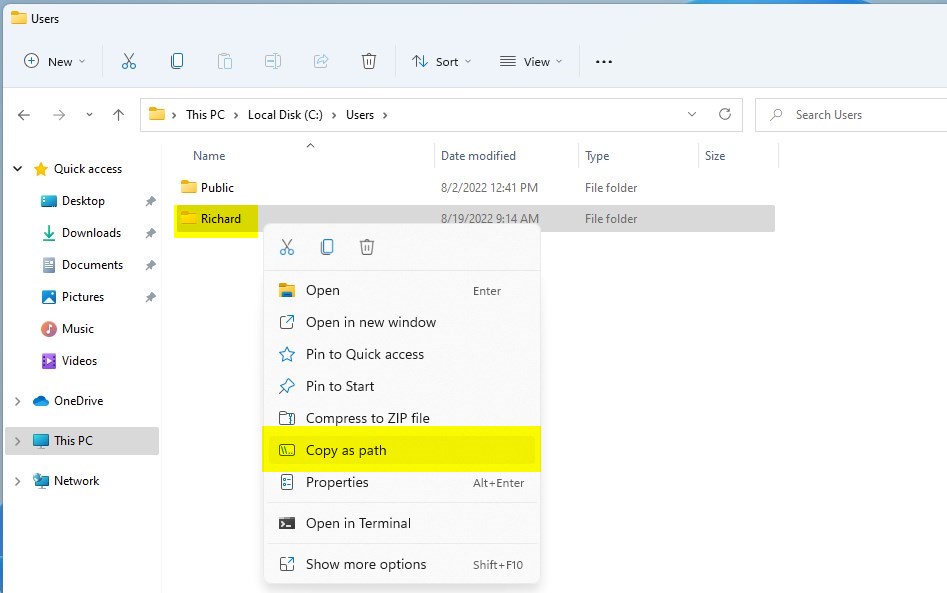
- Right-click the file or folder. A context menu opens.
- Select Copy as path from the menu. The path is now on your clipboard.
If you do not see Copy as path in the short menu, click Show more options at the bottom of the menu, or select the item and press Shift + F10. The full classic menu lists it. The exact layout of the short menu varies between Windows 11 versions.
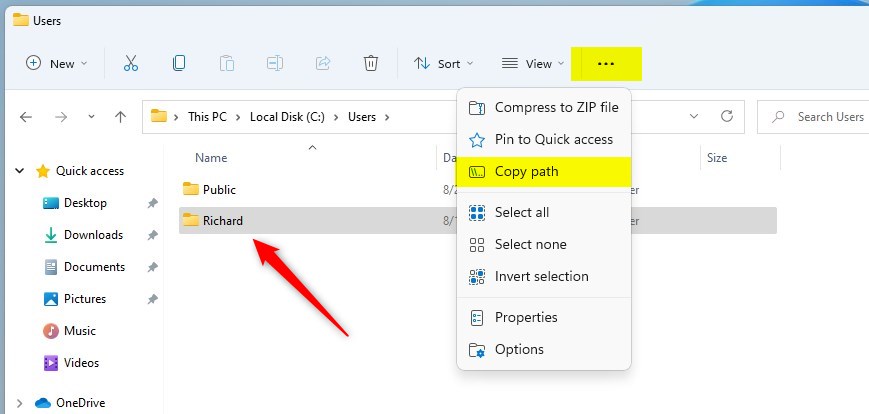
The same option is also available from the command bar at the top of the File Explorer window.
- Select the file or folder.
- Click the ellipsis (...) icon in the command bar. A menu drops down.
- Choose Copy as path.
How to Remove Quotation Marks
Paths copied with Copy as path or Ctrl + Shift + C come wrapped in quotation marks. This matters most when folder names include spaces, because commands need the quotes to read the path as one piece. If you need the path without quotes, paste it into Notepad first. Click just after the opening quote and press Backspace, then click just before the closing quote and press Delete. Alternatively, use the address bar method below, which copies the path without quotes.
Copying Multiple File Paths
You can also copy the paths of many files at once. This is useful when you need a list of file locations for a script or a support ticket.
- Highlight all the files you want. Hold Ctrl and click to pick individual files, hold Shift and click to select a range, or press Ctrl + A to select everything in the folder.
- Press Ctrl + Shift + C.
- Paste with Ctrl + V. Each file path appears on its own line.
Using the Address Bar
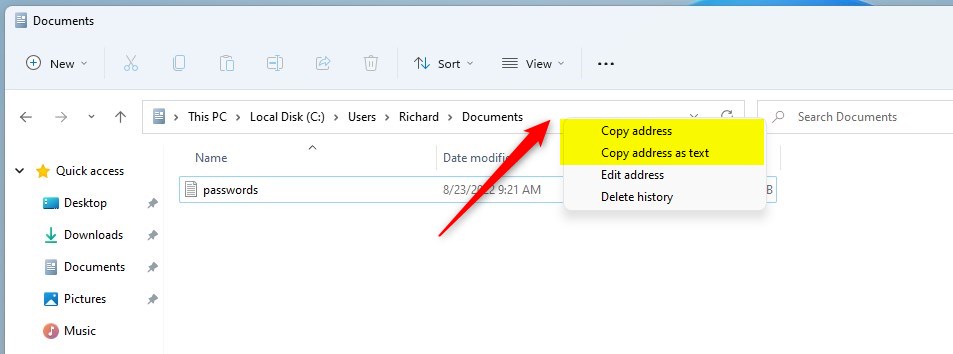
When you want a folder location without quotation marks, use the address bar at the top of the File Explorer window.
- Navigate to the folder in File Explorer.
- Right-click inside the address bar at the top.
- Choose Copy address or Copy address as text. The path of the open folder is now on your clipboard, with no quotes.
Press Ctrl + A to select it, then Ctrl + C to copy it. Note that this copies the folder you are in, not an individual file.
Important Note on Privileges
You do not need administrator permissions to copy the path of a protected system location such as C:\Windows\System32. Windows lets any user read and copy the address of any file or folder on the drive. Only changing or deleting protected system files needs extra approval.
Permissions only come into play when you act on the file. If you plan to run commands against something in C:\Windows\System32, start your terminal with administrator rights. (Requires Admin Privileges)
- Click Start and type "Command Prompt" or "PowerShell" in the search box.
- Right-click the result and select Run as administrator.
- Click Yes if the User Account Control prompt appears. You need to be signed in as an administrator or know an administrator's password.
The window title will show that it is running as Administrator. Paste your copied path with Ctrl + V, or right-click in the window. Close the window when you are finished, so you do not keep elevated rights longer than needed.
Summary
You can copy a file path with the Ctrl + Shift + C shortcut, the right-click menu or command bar, or the address bar. Use the shortcut for speed, Copy as path for single files and groups of files, and the address bar when you want a folder path without quotes. Any of them saves time and avoids typos when you work with file locations in Windows 11.
Have a question about this guide?
Answered by AI from this guide. Good questions may be added to this page — please don't include personal details.
Did this guide fix your problem?

About the Author
Richard
Tech Writer, IT Professional
Richard is a writer at Geek Rewind who turns complex IT tasks into clear, step-by-step guides. He draws on years of hands-on experience in system administration and enterprise IT operations, focusing on Windows, Linux and WordPress: the problems people actually run into, and the fixes that work. His server and WordPress guides come from systems he runs himself. Richard builds and maintains the platform behind Geek Rewind, from its Ubuntu servers and Nginx configuration to its custom WordPress plugins. Many new tutorials start with readers' questions, and he's always glad to answer them in the comments.
No comments yet — be the first to share your thoughts!