How to Find Your IP Address on Windows 11

Your IP address is a unique set of numbers, like 192.0.2.10, that identifies your computer on a home network or the internet. Windows 11 assigns two types of IP addresses to every PC. Your private IP address lets devices talk to each other at home, while your public IP address is what websites see when you go online.
Finding your IP address takes a few quick clicks in the Settings app or a short command in Command Prompt. You can track it down in less than a minute without installing any extra software. This guide covers several ways to find your private address and a few ways to find your public one.
You can find your IP address on Windows 11 through the Settings app by navigating to Network & internet, or via the Command Prompt by typing “ipconfig”. Both methods will display your IPv4 and IPv6 addresses.
Understanding Your IP Addresses
Windows 11 uses an IP address to connect your computer to a network. Addresses come in two versions, IPv4 and IPv6. An IPv4 address is four numbers from 0 to 255 separated by dots, such as 192.168.1.25. An IPv6 address is longer and uses letters and numbers separated by colons. Most home networks still rely mainly on IPv4, so that is usually the address you want.
Every PC also has two kinds of IP address:
- Private IP Address: This is the address your device gets from your router when it connects to your home network (also called your Local Area Network, or LAN). Other devices on your network use this address to see and talk to your computer. It’s like your house number on your street. This address isn’t directly visible from the internet. Private IPv4 addresses usually start with 192.168, 10 or 172.16 through 172.31.
- Public IP Address: This is the address your Internet Service Provider (ISP) assigns to your router. It’s the address the rest of the internet sees when your devices connect. It’s like your neighborhood’s zip code. It identifies your whole network to the outside world, and every device on your network shares it.
Knowing your IP address helps when you troubleshoot network problems, set up port forwarding for games or servers, or just want to understand how your network is set up. For anything inside your home network, you need the private address. For anything that involves the outside world, you need the public one.
Method 1Finding Your Private IP Address in Settings
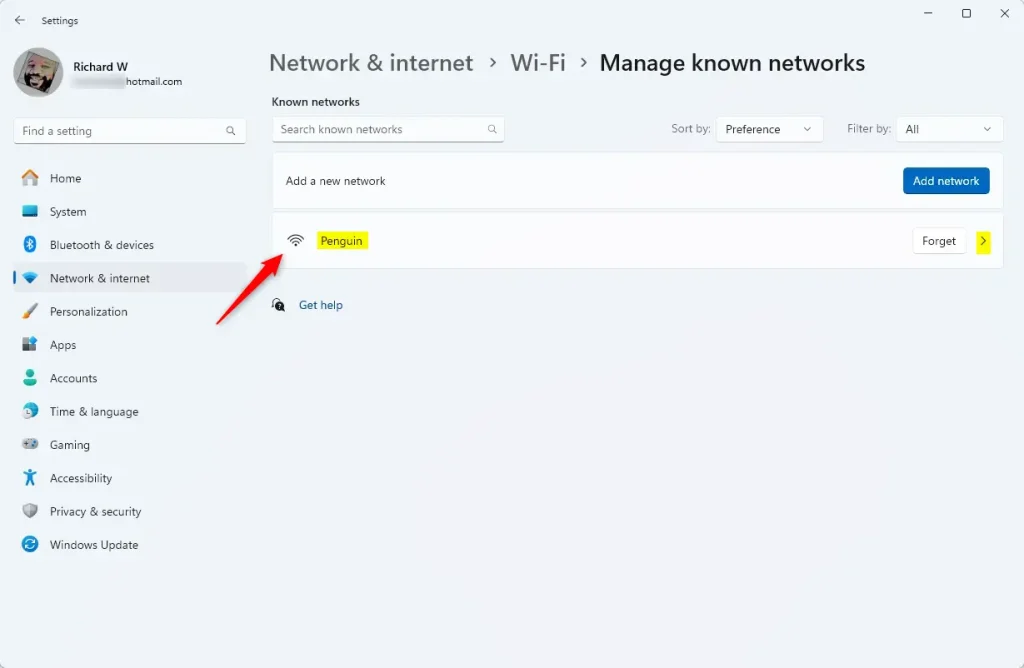
The Windows 11 Settings app lets you find your private IP address in a few clicks. You open Settings, go to Network & internet, and select your Wi-Fi or Ethernet connection to see your active IPv4 address and other network details.
- Press
Win+Ion your keyboard to open Settings. You can also click the Start button and then click the gear icon. The Settings window opens. - Click Network & internet in the left-hand sidebar. The page shows your current connection at the top.
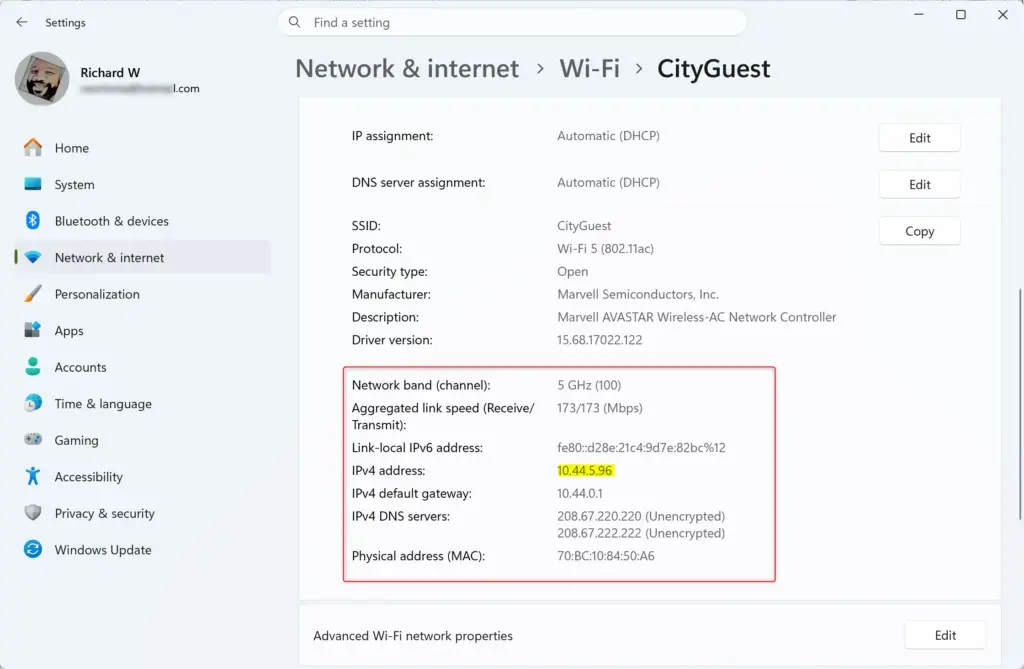
- Click Wi-Fi or Ethernet, whichever one you are using to connect. Then click Properties for the connected network. On some builds the Wi-Fi page also has a Hardware properties option, which shows the same details. The properties page opens.
Tip: If you have more than one network adapter, make sure you open the one that is actually connected and active. - Scroll down the properties page until you see the IPv4 address and IPv6 address entries. These are your private IP addresses for this connection.
- Don't confuse your address with the Default gateway entry, if your build lists one. The default gateway is typically your router's IP address. Your computer uses it to send information outside your local network.
Method 2Finding Your Private IP Address in Control Panel
The classic Control Panel gives you another way to find your private IP address, through your network adapter's status window. You open Control Panel, go to Network and Sharing Center, click your active connection, and read the connection details to see your IPv4 address.
- Click the Start button, type Control Panel in the search box, and open it. The Control Panel window appears.
- Check the View by setting at the top right. If it says Category, change it to Large icons or Small icons. Then click Network and Sharing Center.
- Look for Connections in the Network and Sharing Center. Your active connection is listed next to it. Click the connection name, for example Wi-Fi (NetworkName) or Ethernet. A status window opens for that connection.
- Click the Details... button. The Network Connection Details window opens.
- Find IPv4 Address and IPv6 Address in the list. You'll also see other useful information here, like your default gateway and DNS server addresses.
Method 3Finding Your Private IP Address in Task Manager
Task Manager shows your private IP address on its Performance tab, so you don't have to dig through menus. You press Ctrl+Shift+Esc to open Task Manager, select the Performance tab, click your network adapter, and read the IP address listed at the bottom of the window.
- Press
Ctrl+Shift+Escon your keyboard to open Task Manager. If it opens in a small view, click More details first. - Click the Performance tab. A list of hardware categories appears in the left-hand pane.
- Click the network adapter you are using in the left-hand pane, such as Wi-Fi or Ethernet. A graph of your network activity appears on the right.
- Look at the statistics under the graph for IPv4 address and IPv6 address. They can be a bit further down, so you may need to make the window larger. This view shows your IP address and your real-time network activity together.
Method 4Finding Your Private IP Address Using the Command Prompt (ipconfig)
The ipconfig command in Command Prompt quickly shows your private IP address. You open Command Prompt from the Start menu, type the command, press Enter, and find the IPv4 Address under your active network adapter.
- Click the Start button, search for Command Prompt or Windows Terminal, and open it. You don't need to run it as administrator for this command.
- Type ipconfig /all and press
Enter. The/allswitch tellsipconfigto show much more detailed information about all of your network adapters. If you only want the short version, run ipconfig without the switch. A long list of adapters appears. - Scroll through the output. Each adapter has its own section, such as Ethernet adapter or Wireless LAN adapter. Under the adapter that is connected, look for IPv4 Address and IPv6 Address.
Tip: The output also shows your physical address (MAC address) and whether DHCP is enabled. DHCP is how your router assigns IP addresses automatically. Virtual adapters from VPN software, Hyper-V or WSL may also appear in the list, so make sure you read the one that is actually connected. An address starting with 169.254 usually means the PC didn't get an address from the router.
Method 5Finding Your Private IP Address Using PowerShell (Get-NetIPConfiguration)
The Get-NetIPConfiguration command in Windows PowerShell displays your private IP address and your network configuration details. You open PowerShell, type the command, press Enter, and read the IPv4Address from the output.
- Click the Start button, search for Windows PowerShell, and open it. Running it as administrator isn't required.
- Type Get-NetIPConfiguration and press
Enter. PowerShell lists each network adapter that has a connection. - Find your active connection in the output and read the IPv4Address and IPv6Address lines. The output also shows the adapter name, the default gateway and the DNS servers. PowerShell commands can often be piped and manipulated further if you want to pull out specific pieces of information.
Method 6Finding Your Public IP Address Using Command Prompt (curl)
The curl command in Command Prompt fetches your public IP address from an external service. You open Command Prompt, type the command, press Enter, and your public IP address appears on the next line.
- Click the Start button, search for Command Prompt or Windows Terminal, and open it.
- Type curl -4 ifconfig.me and press
Enter. This command asks an external website for your public IP address. The -4 option asks for your IPv4 address. You can also use curl https://api.ipify.org, which does the same job.
Note: Ifcurlisn't recognized, you might need to enable it in Windows Features or use a different method. It's generally available in recent Windows 11 builds. If you run it inside Windows PowerShell 5.1, type curl.exe instead, because plain curl is an alias for a different PowerShell command there. - Read the line the command prints. It is your public IPv4 address.
Warning: Your public IP address can change over time, especially if your ISP assigns addresses dynamically. Websites and services might also show you a different IP if you're using a VPN.
Method 7Finding Your Public IP Address Using PowerShell (Invoke-WebRequest)
The Invoke-WebRequest command in Windows PowerShell lets you check your public IP address using an online API service. You open PowerShell, run the command below, and your public IP appears in the window.
- Click the Start button, search for Windows PowerShell, and open it.
- Type Invoke-WebRequest -Uri "https://api.ipify.org" | Select-Object -ExpandProperty Content and press
Enter. This command fetches the content from thehttps://api.ipify.orgwebsite, which is just your public IP address. - Read the address PowerShell prints. It is your public IPv4 address. If nothing comes back, check that you are connected to the internet and that a firewall or proxy isn't blocking the request.
Method 8Finding Your Public IP Address Using Websites
IP checker websites are the fastest way to find your public IP address without running any commands or opening system tools. You open any web browser, visit a site like whatismyip.com or ipchicken.com, and your public IP address shows on the page.
- Open your web browser. Any browser will do, such as Chrome, Edge or Firefox.
- Go to one of these IP checker sites:
- https://www.whatismyip.com/
- https://www.ipchicken.com/
- https://www.whatismyip.com.au/
- Read the address shown on the page. The website detects your public IPv4 address automatically and displays it prominently. Many sites will also show your approximate location and your ISP. That location is only a rough guess based on the address.
Tip: These websites are also useful for checking your IPv6 address if you have one configured.
Summary
Finding your IP address in Windows 11 is simple. Use Settings, Control Panel, Task Manager, or commands like ipconfig and Get-NetIPConfiguration for your private network addresses. To check the public IP address that the internet sees, use curl in Command Prompt, Invoke-WebRequest in PowerShell, or visit an online IP checker website.
If the private and public addresses don't match what you expect, check whether a VPN is running. Your private address usually looks like 192.168.x.x or 10.x.x.x, and your public address will be completely different.
Was this guide helpful?

About the Author
Richard
Tech Writer, IT Professional
Richard is a writer at Geek Rewind who turns complex IT tasks into clear, step-by-step guides. He draws on years of hands-on experience in system administration and enterprise IT operations, focusing on Windows, Linux and WordPress: the problems people actually run into, and the fixes that work. His server and WordPress guides come from systems he runs himself. Richard builds and maintains the platform behind Geek Rewind, from its Ubuntu servers and Nginx configuration to its custom WordPress plugins. Many new tutorials start with readers' questions, and he's always glad to answer them in the comments.

No comments yet — be the first to share your thoughts!