How to Enable Efficiency Mode in Windows 11


- 2 steps
- Needs administrator rights
- Includes a restart or sign-out
Efficiency Mode in Windows 11 lowers the processor priority of a background app, so it uses less CPU power. That can make your PC feel faster and stretch your battery life. Windows uses a built-in feature called EcoQoS (a tool that puts heavy background tasks on a lower priority) to do this. Your main apps keep the CPU time they need.
You can turn on Efficiency Mode for an app from inside Task Manager. It stops background programs from slowing down the games, web browsers or work tools you have open right now. You can switch it off again at any time, and nothing is changed permanently.
Open Task Manager, select the desired process on the Processes tab, and click the Efficiency mode button or right-click and choose Efficiency mode. This limits background app resource consumption for better performance.
Why use Efficiency Mode?
Windows 11 Efficiency Mode helps your PC run faster and preserves battery life by throttling apps that use more power than they need. It helps most on laptops running on battery. It also helps on older PCs where a busy background app, such as a browser with many tabs, a sync tool or an updater, competes with the work you are doing.
What happens when you are done?
Once enabled, the chosen app runs at a lower priority and its threads are marked as low importance for the CPU. Windows gives the full attention of the processor to the tasks you are actively using, so the system feels more responsive. The throttled app is not stopped. It still runs, only more slowly, so a heavy job such as an export or a download may take longer to finish.
How to enable or disable Efficiency Mode
You can turn on Windows 11 Efficiency Mode in Task Manager to slow down resource-heavy apps and save battery life. In short, press Ctrl+Shift+Esc, open the Processes page, find the app you want to limit, and click Efficiency mode in the top command bar. The same button turns the feature off again. The full steps are below.
- Open the Task Manager . You can do this by pressing Ctrl+Shift+Esc on your keyboard. The Task Manager window opens. If you see a small window with only a list of app names, click More details at the bottom to expand it.
- Click on the Processes tab on the left side of the window. You should now see a list of your running apps and background processes, with columns showing CPU, memory and other usage. Click the CPU column header to sort the list so the busiest apps appear at the top.

Once you have found the app you want to limit, there are two ways to turn the feature on or off. Both do the same thing, so use whichever you prefer:
- Method 1Select the app or process from the list. Click the Efficiency mode button located in the top command bar. The button has a leaf icon. If it is greyed out, the selected item cannot be limited.
- Method 2Right-click on the specific app or process and select Efficiency mode from the menu that appears. This is quicker if you already have the mouse over the app.
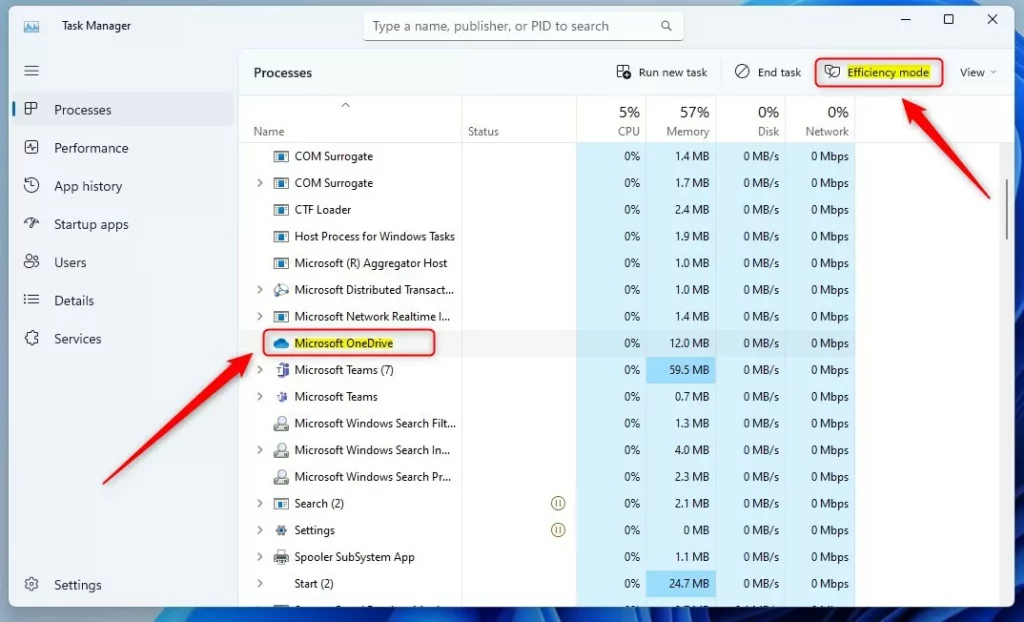
Leave these alone, as limiting them can cause system instability. If you select an app that has several sub-processes, such as a web browser, you can apply the setting to the whole group by selecting the main entry at the top of that group.
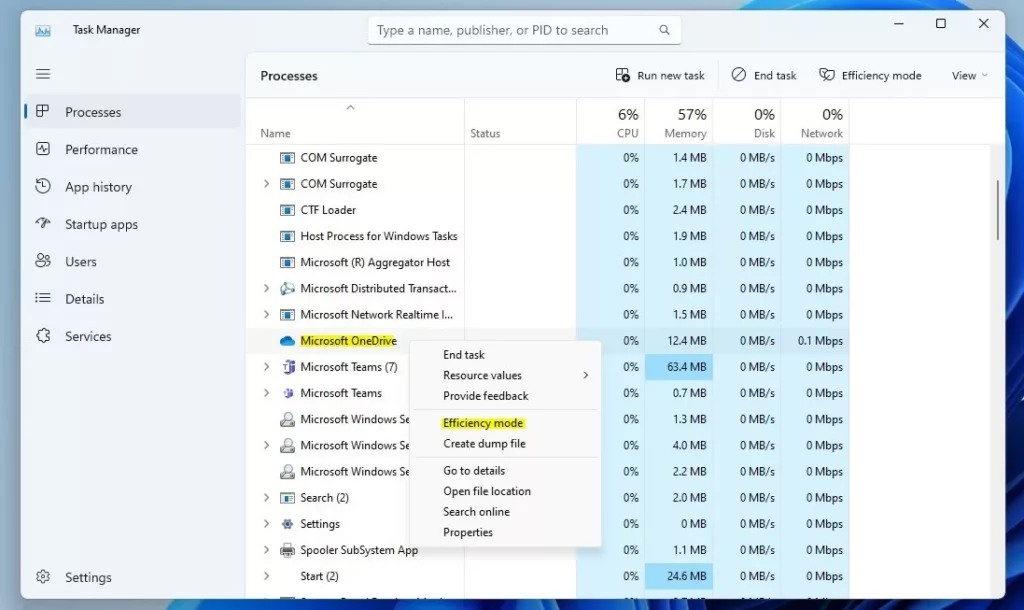
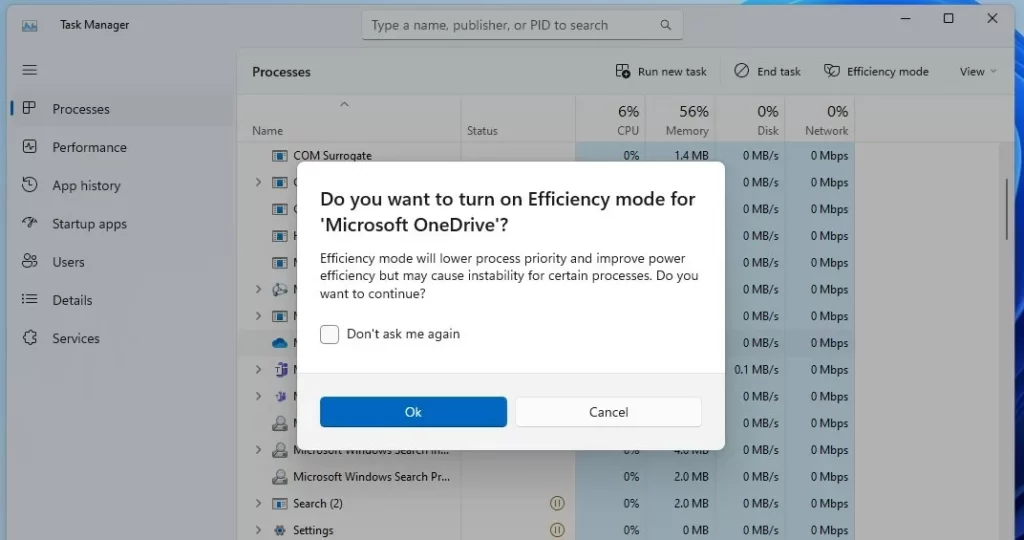
A confirmation window appears when you enable the feature. It warns that limiting an app can make it slower or less responsive. Click Turn on Efficiency mode to confirm the change. After that, the app shows a green leaf icon in the list, and the Status column reads Efficiency mode. To undo the change, select the same app and click Efficiency mode again.
Avoid using this on the app you are working in at the moment, because it will feel slower. The setting also does not carry over. If you close the app and open it again, or restart the PC, you need to turn it on again.
This is most likely when the process belongs to another user or to the system. If the option is unavailable for such a process, close Task Manager, reopen it with administrator rights, and try again.
Technical Deep Dive: EcoQoS and CPU Throttling
EcoQoS (Efficiency Quality of Service, a feature that manages background resource priority) identifies non-urgent background tasks and throttles them slightly to benefit active applications. Efficiency Mode applies two things to the app: a lower priority and the EcoQoS power hint. Together they let Windows run the app on the most power-efficient part of the CPU where possible. This works in Windows 11 Home and Pro alike, and it needs a version of Windows 11 that includes the Efficiency mode button in Task Manager (22H2 or later). If you cannot find the button, run Windows Update first.
Comparison: Efficiency Mode vs. Power Saver
| Feature | Efficiency Mode | Power Saver Mode |
|---|---|---|
| Scope | Per-process | System-wide |
| Goal | Improve responsiveness | Extend battery life |
| Mechanism | EcoQoS / Priority | Voltage / Frequency scaling |
Advanced: Registry Editor Modifications
If Efficiency Mode keeps causing problems, you can look at process settings in the Registry Editor (a powerful tool for managing Windows settings). Take great care here, because a wrong change can stop apps or Windows from working. Back up the registry or create a restore point before you change anything, and only look around unless you know exactly what a value does.
Navigate to HKEY_LOCAL_MACHINE\SOFTWARE\Microsoft\Windows NT\CurrentVersion\Image File Execution Options to check process settings. Administrator privileges are needed for this. The Registry Editor is available on Windows 11 Home as well as Pro. If you find an entry for an app you are having trouble with, note it down before you change or remove anything. In most cases, turning Efficiency Mode off in Task Manager is all you need.
Summary
Windows 11 Efficiency Mode remains a handy feature that limits demanding apps to speed up your PC and conserve battery life. Use it on background apps that you do not need to run at full speed, check the Status column to see which apps are limited, and turn it off again if an app becomes too slow for your needs.
Frequently asked questions
How to activate best performance in 🪟 Windows 11?
To turn on best performance, open Settings, go to System About, and select Advanced system settings. Under Performance, click Settings, choose Adjust for best performance, and click OK. This turns off animations and visual effects to free up resources. For a power-saving change instead, use Power mode in Settings System Power & battery
Is 32GB RAM overkill for 🪟 Windows 11?
For most people, yes. 16GB handles everyday work, web browsing and gaming without trouble. 32GB helps with video editing, virtual machines, large data files or running many heavy apps at once. To check your own needs, open Task Manager, select Performance, then Memory, and see how much is in use during a busy day.
How to remove efficiency mode in 🪟 Windows 11?
Open Task Manager, select the Processes tab, right-click the app, and click Efficiency mode again to turn it off. The app goes back to normal priority right away. Nothing else changes, and you do not need to reinstall anything.
Does 🪟 Windows 11 give a performance boost?
Not automatically. On the same PC, Windows 11 usually runs about as fast as Windows 10, and it needs newer hardware to install. Any gains come from specific features, such as DirectStorage, which speeds up game loading on supported hardware, and better power handling on laptops.
Still have a question?
Answered by AI from this guide. Good questions may be added to this page — please don't include personal details.
Did this guide fix your problem?

About the Author
Richard
Tech Writer, IT Professional
Richard is a writer at Geek Rewind who turns complex IT tasks into clear, step-by-step guides. He draws on years of hands-on experience in system administration and enterprise IT operations, focusing on Windows, Linux and WordPress: the problems people actually run into, and the fixes that work. His server and WordPress guides come from systems he runs himself. Richard builds and maintains the platform behind Geek Rewind, from its Ubuntu servers and Nginx configuration to its custom WordPress plugins. Many new tutorials start with readers' questions, and he's always glad to answer them in the comments.
No it does not ! Doesn’t even work properly ! If i were in charge at MS development i fire all the “moorons” who invented this crap of feature immediately ! It throttles app to background even if not active so settings do not work at all on working foreground app ! No guidance that i found on net is working to user benefit ! Throatless Excel to to the point to choke and freeze, so basically MS throttles its own flagship Office App on performance power hardware ! Completely useless and robing my nerves sky high ! Its a MS cluster fuck to all the users out there coz cant be disabled neither removed from the system completely ! U re better of with Win10 or go-to Linux. I have newer heard Linux to throttle app.
[…] How to Enable Efficiency Mode in Windows 11 […]