Guide to Managing Columns in Windows 11 Task Manager


Task Manager in Windows 11 lets you choose which data columns appear on your screen so you can track resource usage like CPU, memory, and disk speed. This built-in system monitor shows every open app, background task, and hardware resource running on your PC in real time.
Customizing these columns helps you spot slow apps or hardware issues right away. Right-click the header row at the top of the process list to turn specific columns on or off. The steps are the same on Windows 11 Home and Pro. Changes only affect what you see in Task Manager. They do not change how your PC runs.
To open Task Manager, press Ctrl+Shift+Esc, or right-click the Start button and choose Task Manager. The page names below refer to the redesigned Task Manager that comes with current Windows 11 releases (version 22H2 and later). On older builds, the layout may differ slightly.
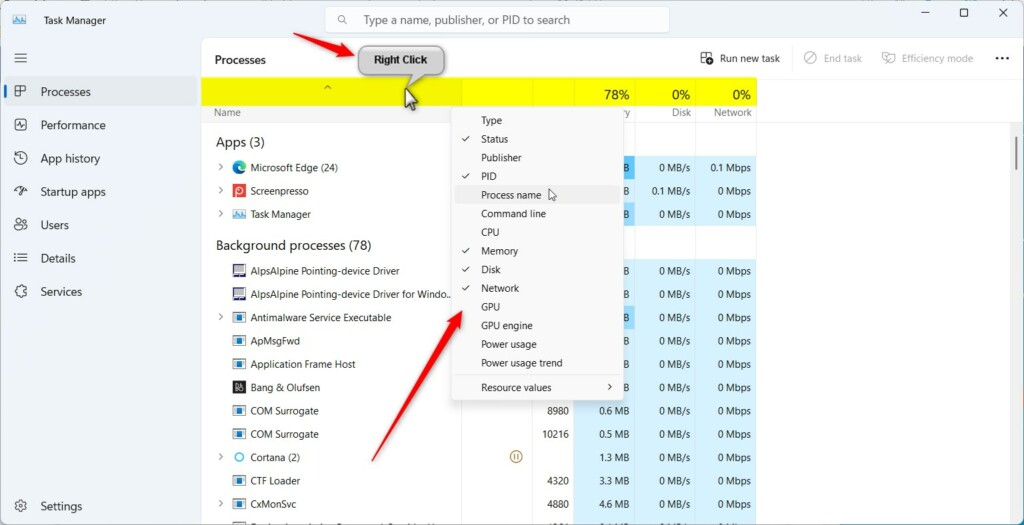
To customize Windows 11 Task Manager columns, right-click any column header at the top of the Processes, App history, Startup apps, or Users pages and check or uncheck the columns you want to display. On the Details page, right-click a column header, click Select columns, then check or uncheck items in the pop-up window and click OK.
Add or remove columns in the Task Manager app
You can add or remove Windows 11 Task Manager columns by right-clicking any existing column header at the top of the Processes, App history, Startup apps, or Users pages and checking or unchecking the items you want to see. This lets you hide data you do not need and display important details like publisher names, process IDs, or disk usage.
Navigation happens through the menu on the left side of the window. If you only see icons, click the menu (hamburger) button at the top left to expand it and show the page names. It contains Processes, Performance, App history, Startup apps, Users, Details, and Services.
Adding and removing columns works the same way on most of these pages. The exceptions are the Performance, Details, and Services pages. Performance shows live graphs instead of a column list. Details has its own method, covered in the next section.
Follow these steps for the Processes, App history, Startup apps, and Users pages:
- Open Task Manager and click the page you want in the left menu. You should see a table with column titles across the top.
- Right-click any column title. A menu appears listing the columns available for that page, with a check mark next to each one currently shown.
- Click an unchecked item to add it as a column. The menu may close after each click, so right-click the header again to change another column. The new column appears in the table right away.
- Click a checked item to remove that column from the page.
- To change the order, click a column title and drag it left or right, then release it in the position you want. The first column, which holds the item names, usually stays in place.
Repeat these steps on each page where you want a custom layout. Each page keeps its own set of columns. If you hide a column by mistake, right-click the header again and check it to bring it back.
Add and remove columns on the Details page
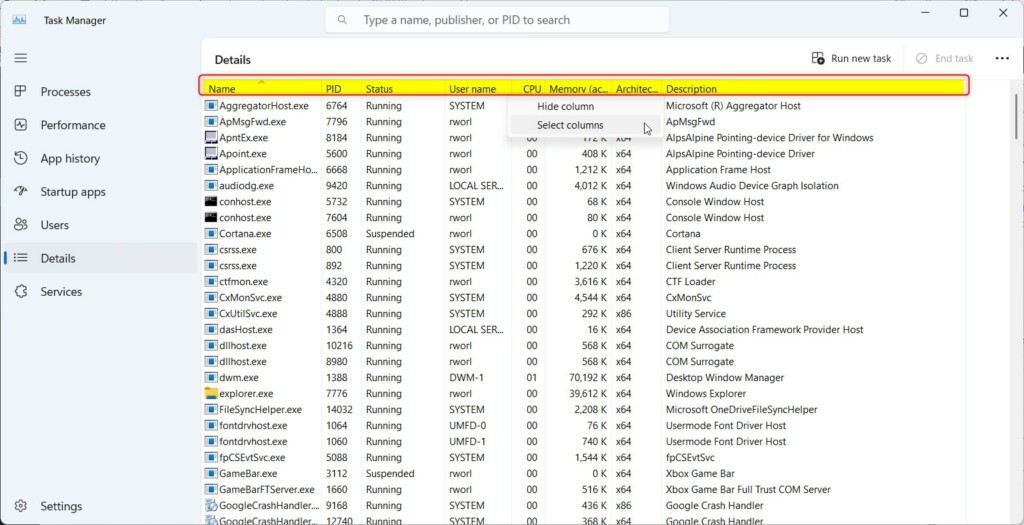
You can add and remove columns on the Details page in Windows 11 Task Manager by right-clicking any column header and choosing Select columns from the menu. This opens a small window where you can check or uncheck specific data points like memory usage, thread count, or user names to customize your view.
To add columns on the Details page:
- Click Details in the left menu. You should see a table of running processes with columns such as Name, PID, Status, and CPU.
- Right-click a column name.
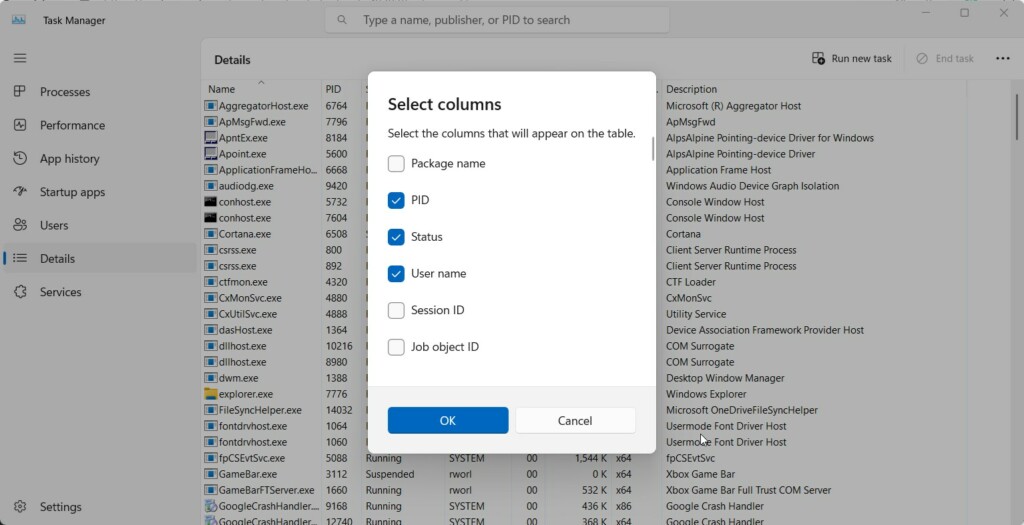
- Click Select columns in the menu. A small pop-up window opens with a list of available columns and a check box beside each one.
Continue in the pop-up window:
- Check the box next to each column you want to add to the Details page.
- Click OK to apply. The new columns appear in the table.
- To rearrange columns, drag a column name left or right and drop it where you want it.
You can remove a column in two ways:
- Right-click the name of the column you want to remove and select Hide column. The column disappears from the table.
- Or, right-click a column name, open the pop-up window again, and uncheck the columns you want to hide. Then click OK.
The Name column is the main identifier for each row, so Task Manager does not let you hide it.
That completes the process.
Conclusion:
- The redesigned Task Manager in Windows 11 matches the new design principles of the operating system, featuring a new navigation bar, settings page, and command bar.
- Users can add or remove columns in the Task Manager app by right-clicking on column titles and selecting the desired actions.
- Different pages within the Task Manager may have specific ways to add or remove columns, with the Details page requiring a specific click action.
- The tutorial provided comprehensive steps for customizing the columns in the Task Manager app, including visual references for clarity.
- With this guide, users can efficiently personalize the Task Manager app to display relevant information based on their preferences.
Have a question about this guide?
Answered by AI from this guide. Good questions may be added to this page — please don't include personal details.
Did this guide fix your problem?

About the Author
Richard
Tech Writer, IT Professional
Richard is a writer at Geek Rewind who turns complex IT tasks into clear, step-by-step guides. He draws on years of hands-on experience in system administration and enterprise IT operations, focusing on Windows, Linux and WordPress: the problems people actually run into, and the fixes that work. His server and WordPress guides come from systems he runs himself. Richard builds and maintains the platform behind Geek Rewind, from its Ubuntu servers and Nginx configuration to its custom WordPress plugins. Many new tutorials start with readers' questions, and he's always glad to answer them in the comments.
No comments yet — be the first to share your thoughts!