How to Enable or Disable Enhanced Security Mode in Edge


Enhanced Security Mode in Microsoft Edge is a built-in safety setting. It applies stricter protections to sites you visit, which makes it harder for malicious code to reach your system. You can turn the mode on or off in Edge itself. You can also control whether people on your computer are allowed to bypass the security rules for unverified sites. This guide covers the bypass control.
Companies often lock this setting down with the EnhanceSecurityModeAllowUserBypass policy so that nobody can change it. If you manage a single PC, you can set the same policy yourself in the Registry Editor. It works on Windows 11 Home, Pro, Enterprise and Education, because it doesn’t need Group Policy.
To control whether users can bypass Enhanced Security Mode in Edge, open Registry Editor (regedit) as an administrator and go to 🗝️HKEY_LOCAL_MACHINE\
Enable or disable Enhanced Security Mode bypass using the Windows Registry editor
The bypass control lives in one value in the Windows Registry, under the Microsoft Edge policy key. You change the EnhanceSecurityModeAllowUserBypass value to turn the bypass off. You delete it to go back to the default. This works well when you want to manage browser security on your computer without using Edge’s own settings page.
Editing the registry can break things if you change the wrong value, so only touch the value named below.
- Press the Windows key, type regedit, and press Enter.
- Click Yes if User Account Control asks whether to allow the app to make changes. Registry Editor opens.
- In the left sidebar, go to the path below. You can also paste it into the address bar at the top of Registry Editor.
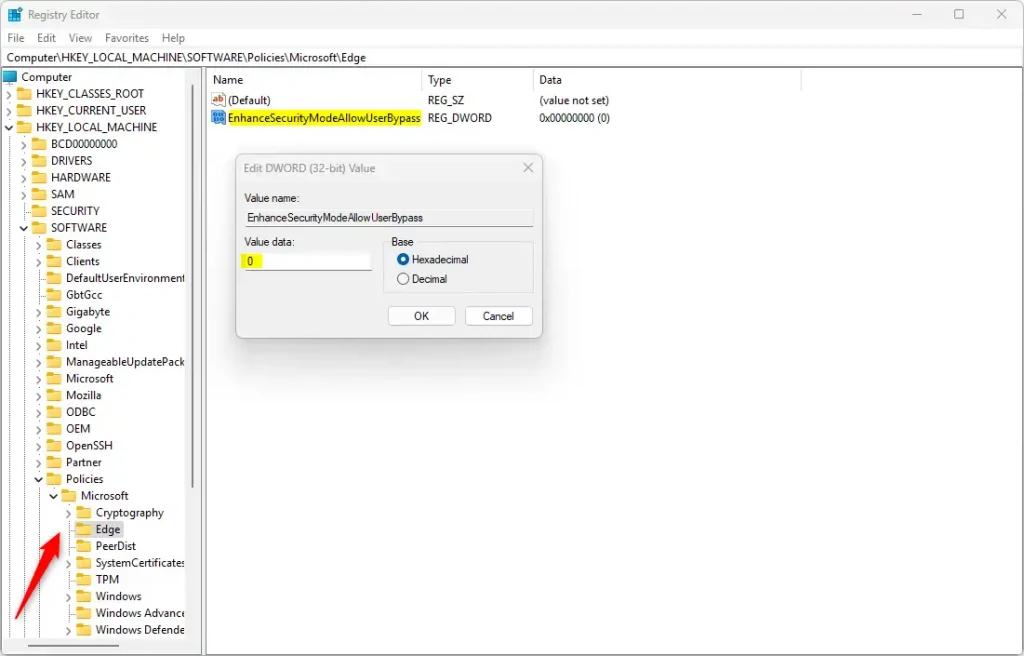
ComputerHKEY_LOCAL_MACHINESOFTWAREPoliciesMicrosoftEdge
If the last key in that path is missing, the policy has never been set on this PC. Right-click the parent key, choose New Key, and give the new key the missing name. Then select it so its contents show in the right pane.
- Look in the right pane for EnhanceSecurityModeAllowUserBypass (type REG_DWORD). Don’t confuse this key with any other Edge key, such as an Explorer key. You only need the key from the path above.
- If the value is there, double-click it. The Edit DWORD (32-bit) Value window opens.
- If the value is missing, right-click a blank area of the right pane and choose New DWORD (32-bit) Value. Type EnhanceSecurityModeAllowUserBypass as the name and press Enter. Then double-click the new value to open it.
- Type 0 in the Value data box. This blocks users from bypassing the security restriction.
- Click OK. The right pane should now show the value with data 0x00000000 (0).
To go back to the default behavior and let users bypass Enhanced Security Mode, delete the value. Right-click EnhanceSecurityModeAllowUserBypass in the right pane, choose Delete, and click Yes to confirm. Deleting the value returns Edge to its default, because with no policy set the choice is left to the user.
After you sign back in, you can open edge://policy in Edge to see which policies it is using. If the setting doesn't seem to apply, check that the value name is spelled exactly as shown and that it is a DWORD, not a string.
Conclusion:
- You turned the bypass for Enhanced Security Mode in Microsoft Edge on or off using the Windows Registry Editor.
- You now know how to create the EnhanceSecurityModeAllowUserBypass value, set it to 0 to block bypassing, and delete it to restore the default.
- Enhanced Security Mode makes browsing safer, but there are times when you may need to bypass it, for example for a trusted internal site that Edge can't verify.
- If you have feedback or tips of your own, share them in the comments.
Have a question about this guide?
Answered by AI from this guide. Good questions may be added to this page — please don't include personal details.
Did this guide fix your problem?

About the Author
Richard
Tech Writer, IT Professional
Richard is a writer at Geek Rewind who turns complex IT tasks into clear, step-by-step guides. He draws on years of hands-on experience in system administration and enterprise IT operations, focusing on Windows, Linux and WordPress: the problems people actually run into, and the fixes that work. His server and WordPress guides come from systems he runs himself. Richard builds and maintains the platform behind Geek Rewind, from its Ubuntu servers and Nginx configuration to its custom WordPress plugins. Many new tutorials start with readers' questions, and he's always glad to answer them in the comments.
No comments yet — be the first to share your thoughts!