How to Install LibreNMS with Apache on Ubuntu 24.04

LibreNMS on Ubuntu 24.04 with Apache builds a free monitoring system to track the status and traffic of routers, switches, and servers on your network.
LibreNMS acts as the central dashboard that checks device health, while Apache serves as the web server that displays this data directly in your browser. Running these tools together gives you one convenient place to spot offline equipment and watch network performance across your setup.
Install Apache2 and MariaDB server using `apt install apache2 mariadb-server`. Create the `librenmsdb` database and `librenmsdbuser` within MariaDB. Then, install necessary PHP and Python modules for LibreNMS.
Install Apache HTTP server on Ubuntu
To install Apache HTTP server on Ubuntu 24.04 for your LibreNMS setup, open your terminal and run the commands sudo apt update followed by sudo apt install apache2. This downloads and sets up the Apache web server package so you can view the LibreNMS interface in your web browser.
To do that, open the Ubuntu terminal and run the commands below to install the Apache web server.
sudo apt update
sudo apt install apache2
Once Apache is installed, the commands below can start, stop, and enable the Apache web server to start automatically when your server boots up.
sudo systemctl stop apache2
sudo systemctl start apache2
sudo systemctl enable apache2
You can test that the Apache web server is running by opening your web browser and browsing to the server’s localhost or IP address.
http://localhost
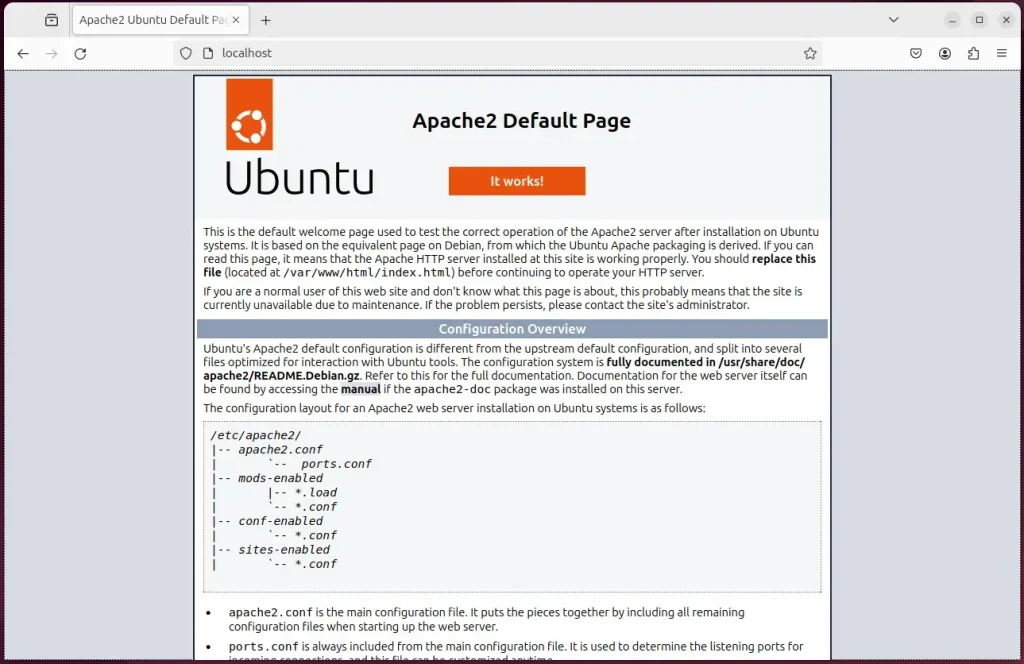
When you see the Apache2 Default Page, it means the Apache HTTP server is successfully installed.
Additional help on installing Apache on Ubuntu is in the link below.
Install the MariaDB database server on Ubuntu
To install the MariaDB database server on Ubuntu 24.04 for your LibreNMS installation, open your terminal and run the command sudo apt install mariadb-server. This installs the database engine required to store all your network monitoring data and device logs securely.
To install and use the MariaDB database server, use the instructions below.
Open the Ubuntu terminal and run the commands below to install the MariaDB database server.
sudo apt update
sudo apt install mariadb-server
Once the MariaDB database server is installed, use the commands below to stop, start, and enable the MariaDB server to start automatically when the server boots.
sudo systemctl stop mariadb
sudo systemctl start mariadb
sudo systemctl enable mariadb
Run the following commands to validate and test if the MariaDB database server is installed successfully.
sudo mariadb
Once you run the commands above, it will log you onto the MariaDB console and display a message similar to the one below.
Welcome to the MariaDB monitor.  Commands end with ; or g.
Your MariaDB connection id is 32
Server version: 10.11.2-MariaDB-1 Ubuntu 23.04

Copyright (c) 2000, 2018, Oracle, MariaDB Corporation Ab and others.

Type 'help;' or 'h' for help. Type 'c' to clear the current input statement.

MariaDB [(none)]>
The message tells you that the server is installed successfully.
Additional help on installing MariaDB.
- How to install MariaDB on Ubuntu Linux
- MariaDB without password prompt
Create a LibreNMS database
To create a LibreNMS database in MariaDB, log into your database shell using sudo mysql and run the SQL commands to create a dedicated database and user. This gives LibreNMS its own protected space to store network information safely away from other applications.
As part of the setup, we will create a librenmsdb database and a user account called librenmsdbuser.
The `librenmsdbuser` gets full access to the `librenmsdb` database for LibreNMS to store and retrieve monitoring data correctly. This step ensures the LibreNMS application can manage its database operations without permission issues.
All the database steps above can be done using the commands below:
But first, log on to the MariaDB database server:
sudo mariadb
Then run the commands below to complete the steps:
CREATE DATABASE librenmsdb CHARACTER SET utf8mb4 COLLATE utf8mb4_unicode_ci;
CREATE USER librenmsdbuser@localhost IDENTIFIED BY 'type_your_password_here';
GRANT ALL ON librenmsdb.* TO librenmsdbuser@localhost WITH GRANT OPTION;
FLUSH PRIVILEGES;
exit
Install PHP and Python modules
To install PHP and Python modules required for an Install LibreNMS Ubuntu setup, run the package manager command to download PHP along with all necessary XML, CLI, and mbstring extensions. These components allow the LibreNMS application code to execute properly on your server.
Then, run the commands below to install the latest PHP version.
sudo apt install php libapache2-mod-php php-intl php-mysql php-curl php-cli php-zip php-xml php-gd php-common php-mbstring php-xmlrpc php-bcmath php-json php-sqlite3 php-soap php-zip php-ldap php-imap php-redis acl curl fping git graphviz imagemagick mtr-tiny nmap php-gmp php-snmp rrdtool snmp snmpd unzip python3-command-runner python3-pymysql python3-dotenv python3-redis python3-setuptools python3-psutil python3-systemd python3-pip whois traceroute
Additional help on installing PHP
Download and install LibreNMS files
To download and install LibreNMS files on your Ubuntu server, create a dedicated system user and use Git to clone the source code into the opt librenms directory. This sets up the core application files in the correct location for your web server to read.
First, create a new account called 'librenms' for LibreNMS to run its services.
sudo useradd librenms -d /opt/librenms -M -r -s "$(which bash)"
Next, navigate to the /opt directory and use the git command to download the content for LibreNMS.
cd /opt
sudo git clone https://github.com/librenms/librenms.git
After creating the LibreNMS account and downloading its content, execute the commands below to set the correct permissions for files and directories.
sudo chown -R librenms:librenms /opt/librenms
sudo chmod 771 /opt/librenms
sudo setfacl -d -m g::rwx /opt/librenms/rrd /opt/librenms/logs /opt/librenms/bootstrap/cache/ /opt/librenms/storage/
sudo setfacl -R -m g::rwx /opt/librenms/rrd /opt/librenms/logs /opt/librenms/bootstrap/cache/ /opt/librenms/storage/
Next, switch to the librenms account and run the command below to download the required dependencies for LibreNMS.
sudo su - librenms
./scripts/composer_wrapper.php install --no-dev
exit
Next, open the PHP configuration file and update the system's timezone. Ensure that PHP has the same timezone as the server.
sudo nano /etc/php/8.3/apache2/php.ini
sudo nano /etc/php/8.3/cli/php.ini
Update the data.timezone line in the file.
[Date]
; Defines the default timezone used by the date functions
; https://php.net/date.timezone
date.timezone = America/Chicago
Remember to set the system timezone as well.
sudo timedatectl set-timezone "America/Chicago"
Once you have completed all the above steps, continue configuring the Apache web server below to serve the LibreNMS content.
Run the commands below to create an Apache virtual host file for LibreNMS.
sudo nano /etc/apache2/sites-available/librenms.conf
Then, copy and paste the content block below into the Apache server block.
<VirtualHost *:80>
  ServerName librenms.example.com
  ServerAdmin admin@example.com
  DocumentRoot /opt/librenms/html

  <Directory /opt/librenms/html/>
       Options FollowSymlinks
       AllowOverride All
       Require all granted
  </Directory>

       ErrorLog ${APACHE_LOG_DIR}/error.log
       CustomLog ${APACHE_LOG_DIR}/access.log combined
</VirtualHost>
Save the file.
Add the `www-data` account to the `librenms` group to give it the necessary permissions for LibreNMS to function. Run the command `sudo usermod -a -G librenms www-data` to complete this step.
sudo usermod -a -G librenms www-data
Then, run the commands below to enable the virtual host and restart the Apache server.
sudo a2ensite librenms.conf
sudo a2enmod rewrite
sudo systemctl restart apache2
Setup Let’s Encrypt SSL/TLS for LibreNMS
To set up Let's Encrypt SSL/TLS for LibreNMS on Apache, install Certbot and run the apache plugin command to generate a free security certificate. This encrypts all traffic between your web browser and the monitoring server to protect sensitive login details.
Please read the post below for additional resources on installing and creating Let’s Encrypt SSL certificates for Apache.
How to set up Let’s Encrypt SSL certificate for Apache on Ubuntu Linux
Once you have restarted the Apache web server, open your browser and browse to the server hostname or IP address defined in the Apache server block.
http://librenms.example.com/install
The LibreNMS installation wizard should appear.
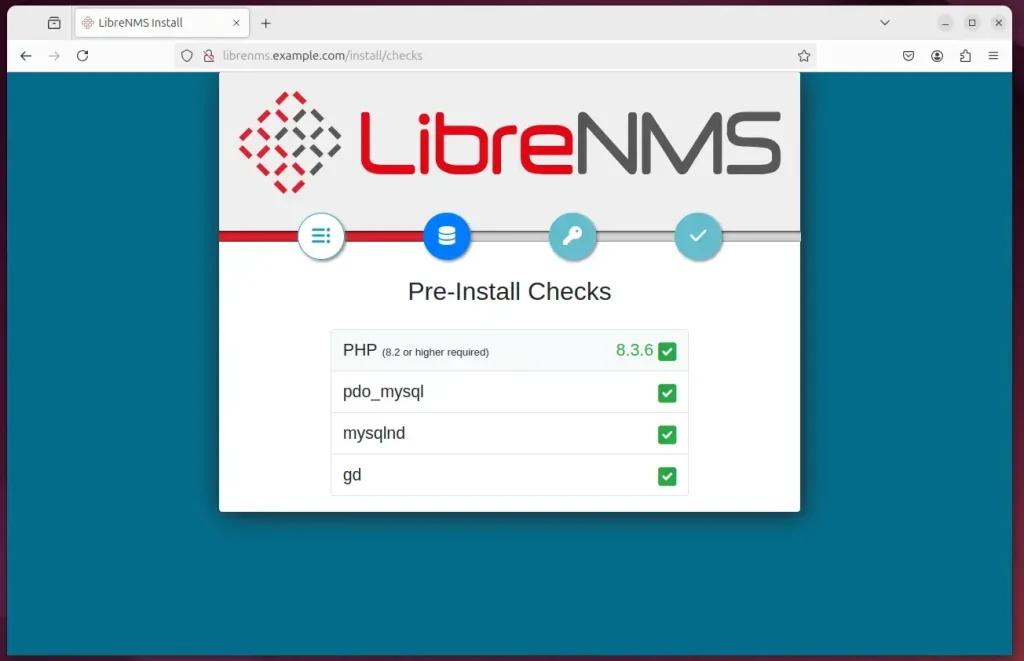
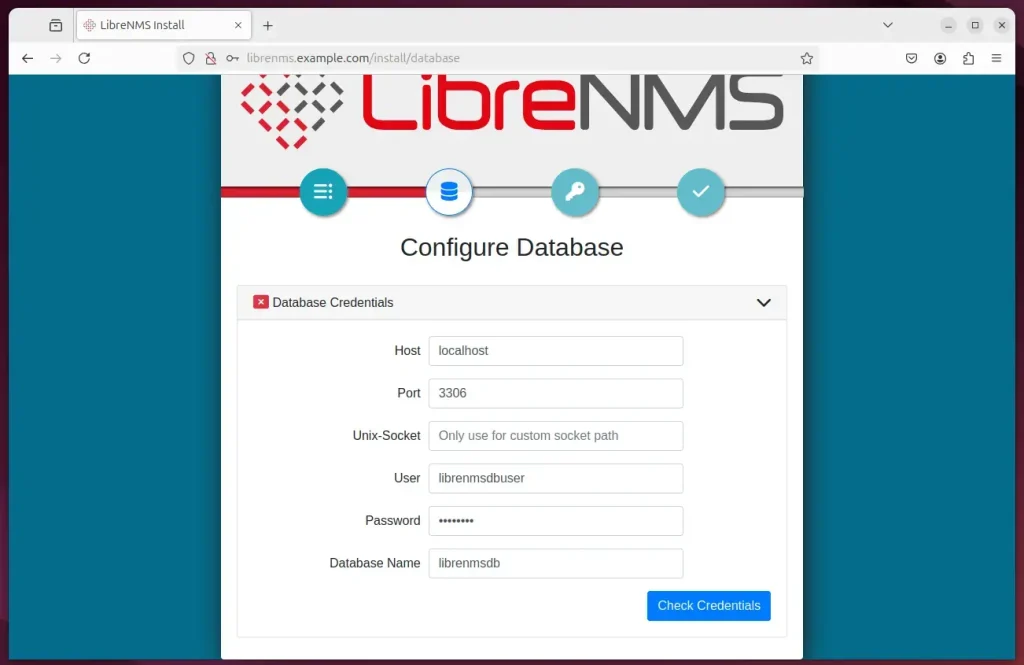
Click on the database icon to continue. Then, type in the database name and password.
Build the database when prompted.
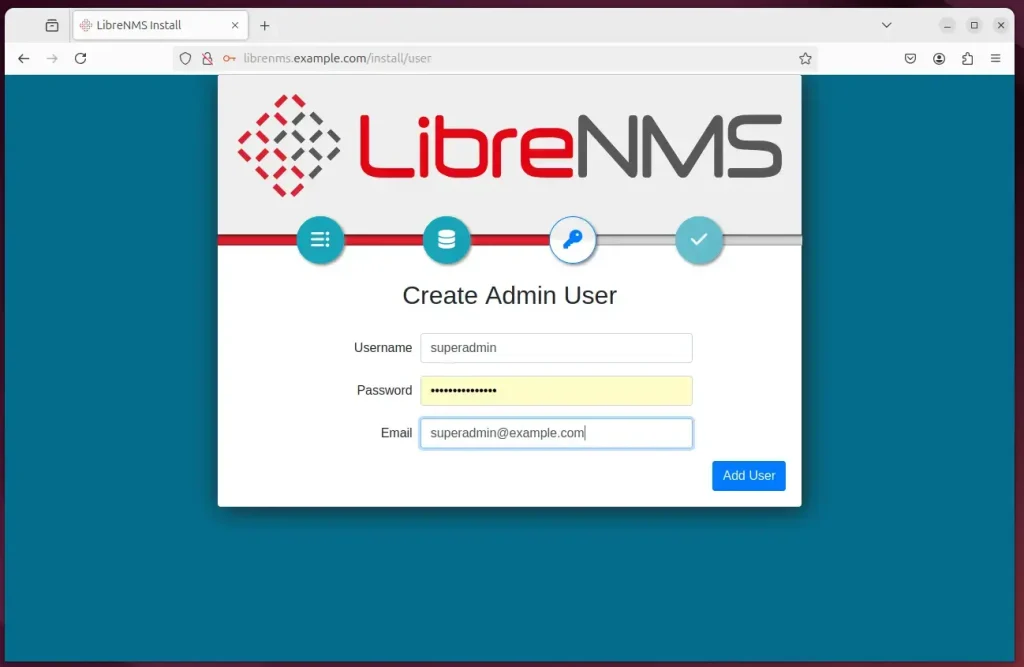
Create an admin account and continue.
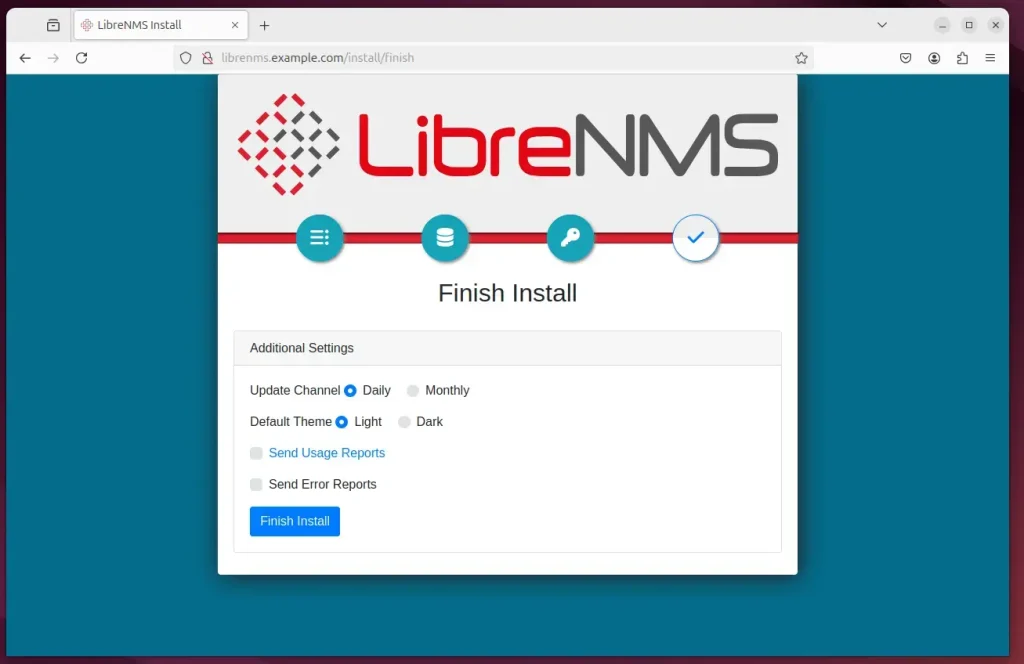
Finish the installation.
LibreNMS should be ready to use.
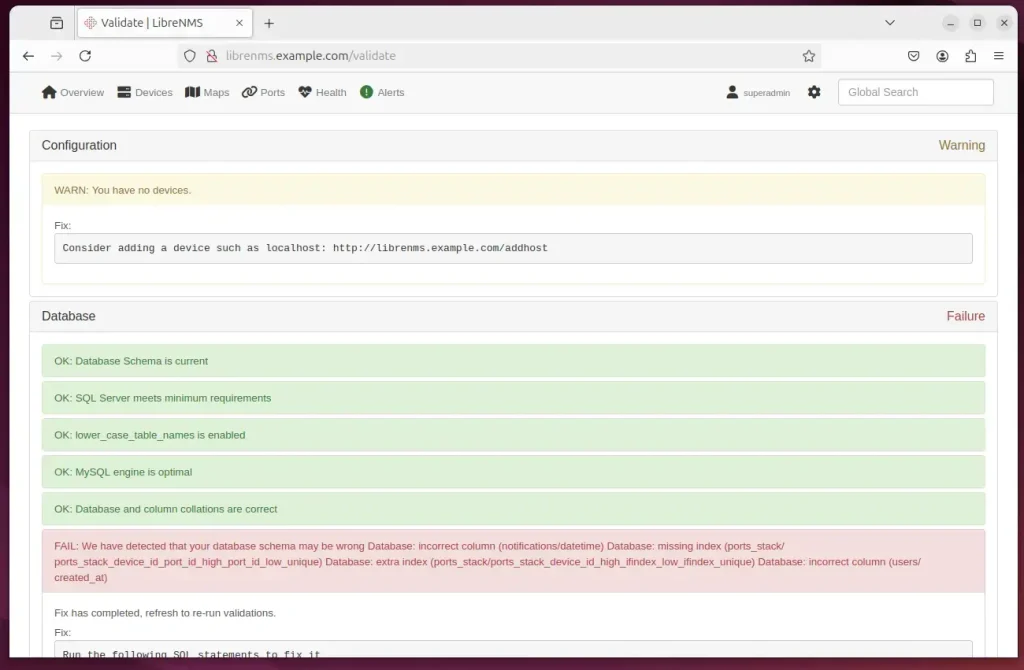
Fix all warnings in the portal.
That should do it!
Conclusion
Installing LibreNMS on Ubuntu with Apache is straightforward, providing a powerful network monitoring tool. Here are the key takeaways:
- Comprehensive Setup: The installation process covers the essential components, including Apache, MariaDB, PHP, and necessary Python modules.
- User-Friendly: Follow the step-by-step instructions to ensure a smooth setup, with detailed commands for each stage.
- Secure Configuration: Implementing Let’s Encrypt SSL/TLS enhances the security of your LibreNMS installation, adding an essential layer of protection.
- Monitor Effectively: Once installed, LibreNMS offers robust features for effectively monitoring network devices, servers, and services.
- Community Support: As an open-source tool, LibreNMS has a strong community that can provide assistance and additional resources for users.
With the preceding configuration steps finished, you possess a fully functional LibreNMS installation. This LibreNMS setup is ready to monitor your network environment, providing real-time data and alerts, making your network management more efficient.
Was this guide helpful?

About the Author
Richard
Tech Writer, IT Professional
Richard, a writer for Geek Rewind, is a tech enthusiast who loves breaking down complex IT topics into simple, easy-to-understand ideas. With years of hands-on experience in system administration and enterprise IT operations, he’s developed a knack for offering practical tips and solutions. Richard aims to make technology more accessible and actionable. He's deeply committed to the Geek Rewind community, always ready to answer questions and engage in discussions.



No comments yet — be the first to share your thoughts!