Disable Website Typo Protection Override in Microsoft Edge


Website Typo Protection in Microsoft Edge warns you when you may have mistyped a web address. That helps you avoid fake phishing sites that sit on domains that look almost like the real ones.
This built-in security filter spots common spelling mistakes in URLs and warns you before you open a risky page. By default, a user can click past that warning. If you manage several computers, you can remove that option so users cannot bypass the warning. The change is a single registry value.
To disable typo protection override in Microsoft Edge, open Registry Editor, navigate to 🗝️HKEY_LOCAL_MACHINE\
Prevent users from overriding “Website Type Protection” in Edge
You can stop users from overriding Website Typo Protection in Edge by adding one value to the Windows Registry. After the change, nobody can click past the warning page on a mistyped address to visit a potentially unsafe site. The setting applies to every user on the computer.
The registry method works on Windows 11 Home and Pro alike, so you do not need the Group Policy editor. Editing the registry by hand carries some risk, so consider exporting the key or creating a restore point first.
- Open the Windows Registry Editor. Approve the User Account Control prompt if one appears.
- Go to the registry key shown below. You can paste the path into the address bar at the top of the Registry Editor, or expand the folders in the left pane one by one.
ComputerHKEY_LOCAL_MACHINESOFTWAREPoliciesMicrosoftEdge
Right-click the parent key, choose New Key, and name it to match the path above. Repeat until the whole path exists.
- In the right pane of the key, look for the PreventTyposquattingPromptOverride (REG_DWORD) name.
- If you see it, double-click it. The Edit DWORD (32-bit) Value window opens.
- If you don’t see it, right-click an empty spot in the right pane and choose New DWORD (32-bit) Value. Name it PreventTyposquattingPromptOverride and press Enter. Then double-click the new item to open it.
- In the Value data box, enter
1to disable users overriding “Website Typo Protection.” - Click OK. The item now shows your value in the Data column.
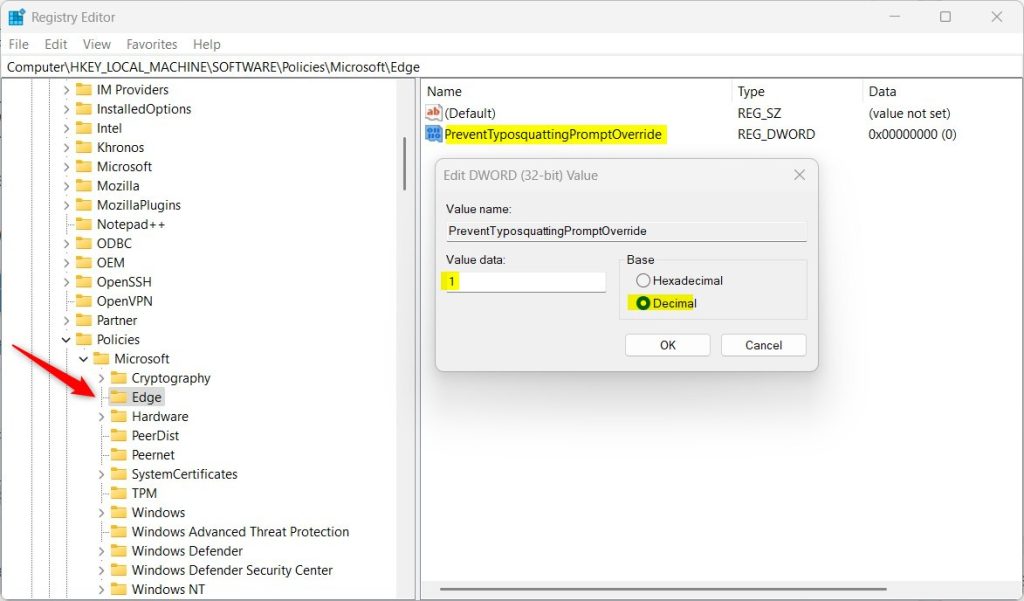
Close the Registry Editor when you are done. Close every open Edge window and start Edge again. Edge reads policies at startup, so this is often enough. If the warning page still shows an option to continue, restart the computer for the changes to take effect. When Edge picks up a policy, its menu usually shows Managed by your organization.
To restore the default behavior and allow users to override "Website Typo Protection," undo the change like this:
- Open the Registry Editor and go back to the same key.
- Right-click the PreventTyposquattingPromptOverride item you created and choose Delete.
- Click Yes to confirm, then restart Edge or the computer.

That should do it!
Conclusion:
- Disabling the "Website Typo Protection" override in Microsoft Edge can significantly enhance online security.
- Users are urged to avoid phishing scams and other fraudulent activities before considering any overrides.
- The provided steps can effectively prevent users from overriding the "Website Typo Protection" feature in Microsoft Edge.
Have a question about this guide?
Answered by AI from this guide. Good questions may be added to this page — please don't include personal details.
Did this guide fix your problem?

About the Author
Richard
Tech Writer, IT Professional
Richard is a writer at Geek Rewind who turns complex IT tasks into clear, step-by-step guides. He draws on years of hands-on experience in system administration and enterprise IT operations, focusing on Windows, Linux and WordPress: the problems people actually run into, and the fixes that work. His server and WordPress guides come from systems he runs himself. Richard builds and maintains the platform behind Geek Rewind, from its Ubuntu servers and Nginx configuration to its custom WordPress plugins. Many new tutorials start with readers' questions, and he's always glad to answer them in the comments.
No comments yet — be the first to share your thoughts!