How to Copy File and Folder Paths in Windows 11

You copy a file and folder path in Windows 11 directly through File Explorer.
A file path is essentially the specific address that tells Windows precisely where a file or folder is located on your PC’s storage. This handy shortcut is vital when you need to share files, troubleshoot problems, or integrate them into command-line tasks.
Windows 11 makes grabbing these paths simple with its integrated “Copy path” feature, readily accessible in the File Explorer ribbon. You no longer need to manually type out those lengthy directory strings.
To copy a file or folder path, select the item in File Explorer and press Ctrl+Shift+C. Alternatively, right-click the item, select “Copy as path.” For paths without quotes, use the address bar and select “Copy address.
Why do this?
Typing long file paths is slow and prone to errors. Copying the path automatically ensures you get the address exactly right. This is helpful when dealing with complex folders like 📁C:\Users\GenericUser\Documents\Reports.
What happens when done?
Once you copy the path, it is saved to your clipboard. You can then paste it anywhere using Ctrl+V. You can paste it into a text document, an email, or the Windows Terminal.
Using the Keyboard Shortcut: Ctrl+Shift+C
You can quickly copy a file or folder path in Windows 11 using the keyboard shortcut Ctrl+Shift+C. Just open File Explorer, select the item you need, and press Ctrl+Shift+C. The full path will then be saved to your clipboard, ready to be pasted wherever you need it.
- Open File Explorer.
- Select the file or folder you want.
- Press Ctrl+Shift+C on your keyboard.
The path is now on your clipboard. Note: Pressing it multiple times won’t overwrite your clipboard history. It just copies the path again. You can view your history by pressing Windows Key + V.
Using the Context Menu
You can also use your mouse to copy a path.
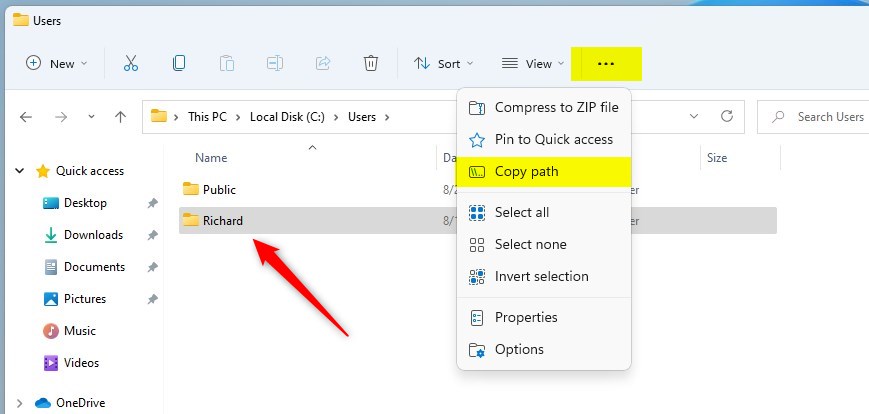
- Right-click the file or folder.
- Select Copy as path from the menu.
You can also find this option in the command bar at the top of the window by clicking the ellipses (…) icon.
How to Remove Quotation Marks
Windows 11 adds quotes around paths to handle folder names with spaces. If you need the path without quotes, paste the path into Notepad. Highlight the quotes and press ⌫ to delete them. Alternatively, use the Address Bar method below.
Copying Multiple File Paths
You can copy the paths of many files at once.
- Highlight all the files you want.
- Press Ctrl+Shift+C.
- When you paste, each file path will appear on a new line.
Using the Address Bar
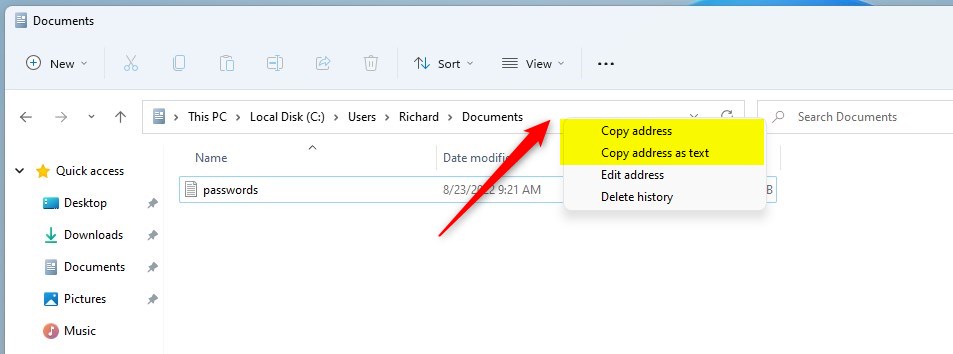
If you need the folder location without those extra quotation marks, use the address bar at the top of the window.
- Navigate to the folder in File Explorer.
- Right-click inside the address bar at the top.
- Choose Copy address or Copy address as text.
Important Note on Privileges
You don’t need special permissions to copy the path of any file or folder in Windows 11, even for protected system locations like 📁C:\Windows\System32. While copying a path is simple, running commands on those files might require administrator privileges, so be mindful of that if you’re working with sensitive system items.
If you are trying to copy the path of a system file in 📁C:\Windows\System32, you do not need special permissions to copy the path. However, if you intend to run commands on that file, you must run your terminal as an administrator. (Requires Admin Privileges): Search for “Command Prompt” or “PowerShell” in the start menu, right-click it, and select Run as administrator.
Summary
You can easily copy file paths using the Ctrl+Shift+C shortcut, the right-click menu, or the address bar. Use these tools to save time and avoid typos when working with file locations in Windows 11.
How do I copy a file path without quotes in 🪟 Windows 11?
To copy a path without quotes, click the address bar at the top of File Explorer. Right-click the highlighted text and select Copy address. This provides the raw path without the quotation marks that the standard Copy as path command automatically adds to your clipboard.
Was this guide helpful?

About the Author
Richard
Tech Writer, IT Professional
Richard, a writer for Geek Rewind, is a tech enthusiast who loves breaking down complex IT topics into simple, easy-to-understand ideas. With years of hands-on experience in system administration and enterprise IT operations, he’s developed a knack for offering practical tips and solutions. Richard aims to make technology more accessible and actionable. He's deeply committed to the Geek Rewind community, always ready to answer questions and engage in discussions.



No comments yet — be the first to share your thoughts!