How to Switch Between HTML &Amp; Plain Text in Outlook

Outlook can send a message as HTML, Plain Text, or Rich Text. HTML supports pictures, colors and layout. Plain Text is basic text with no styling, and every email app can read it. Rich Text is a Microsoft format that Outlook and Exchange understand best.
You can change the format for one message while you write it, or change the default format for every message you send. The steps work in Outlook 2016, 2019, 2021, and Microsoft 365.
In New Outlook, click the Settings gear, go to Mail Compose and reply, and choose your message format. In Classic Outlook, go to File Options Mail, then select your format from the dropdown. You can also change the format for a single email via the Format Text tab.
Applies to
This guide covers Classic Outlook, New Outlook for Windows, and Outlook on the Web (OWA). The menus differ between them, so check which version you are running before you start. Classic Outlook has a File menu in the top left. New Outlook has a Home tab and a gear icon for Settings.
Knowing how to adjust your Outlook message format settings helps your emails appear the way you intend. A professional newsletter benefits from HTML, and a short text-only note may be better as Plain Text.
Why change the email format?
Switching formats either keeps your design elements intact or strips out styling for the widest compatibility. Plain Text removes fonts, colors, pictures and tables. If you convert a message to Plain Text and then back to HTML, the formatting that was removed does not come back. Convert only when you are sure, or keep a copy of the draft.
What happens when you are done?
New messages use your updated default format, but messages you already sent or received stay as they were. Signatures with images or custom styling may need small adjustments after you switch. A Plain Text message cannot show a picture signature, so check how your signature looks in a new draft before you send anything important.
Quick Summary Table
| Format | Best For | Pros | Cons |
|---|---|---|---|
| HTML | Marketing & Business | Visual appeal, branding | Can trigger spam filters |
| Plain Text | Technical & Accessibility | High deliverability, fast | No styling options |
| Rich Text | Internal Exchange | Advanced layout control | Not compatible with all apps |
How to change format in New Outlook for Windows
- Open the New Outlook app.
- Click the gear icon for Settings, usually found in the top right corner. The Settings window opens.

- Go to Mail Compose and reply. The compose options appear in the right-hand pane.

- Scroll to Message format and select your preference. New Outlook offers HTML and Plain text here.
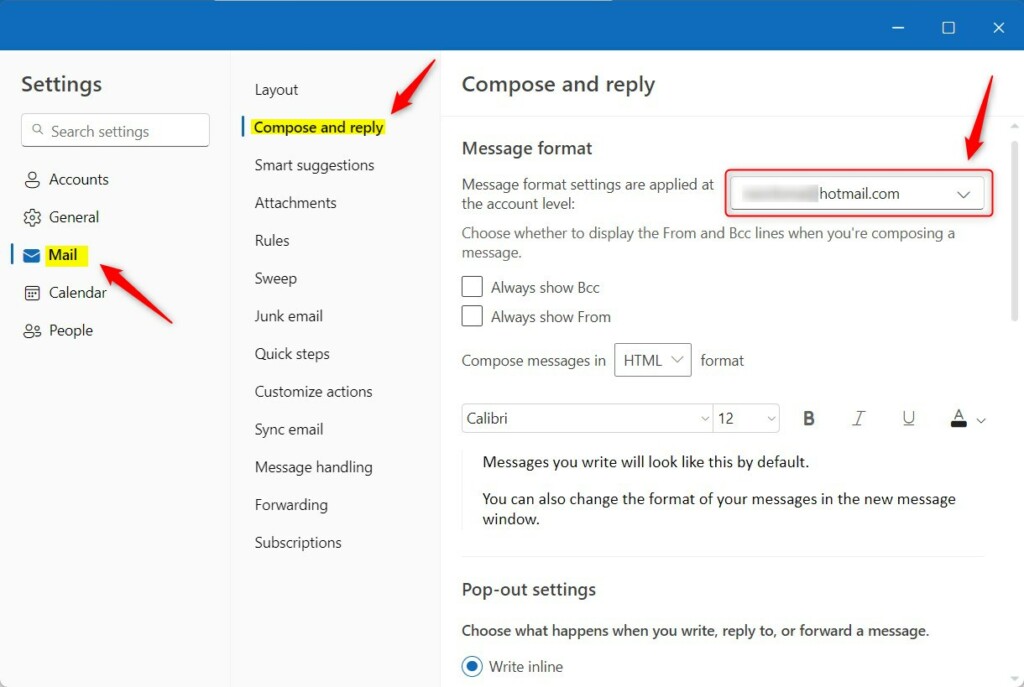
- Click Save. The next message you start will use the format you picked.
To undo the change, return to the same setting, pick the previous format, and click Save again.
How to change format in Classic Outlook
- Open Classic Outlook.
- Go to File Options Mail The Outlook Options window opens on the Mail page.
- Under Compose messages, use the dropdown menu to select HTML, Plain Text, or Rich Text.
- Click OK. The setting applies to new messages from now on, and you do not need to restart Outlook.
If you have more than one email account, the default applies to all of them. To go back, repeat the steps and choose your old format.
How to change format for a single email
Sometimes you want a different format for a single message and leave your default alone. Do this from the message window:
- Start a new message, or open a reply in its own window if you are in the reading pane.
- Click the Format Text tab in the top ribbon.
- In the Format group, select HTML, Plain Text, or Rich Text. The change applies to that draft only.
If you choose Plain Text, Outlook may warn you that formatting will be lost. Read the warning before you confirm. The formatting tools in the ribbon will also look greyed out, because they have no effect in a Plain Text message.
Summary
HTML offers full visual styling, while Plain Text guarantees compatibility with older email clients. Choose the option that fits your message and your recipients. For more help, see our guides covering managing email signatures and troubleshooting email delivery.
Have a question about this guide?
Answered by AI from this guide. Good questions may be added to this page — please don't include personal details.
Did this guide fix your problem?

About the Author
Richard
Tech Writer, IT Professional
Richard is a writer at Geek Rewind who turns complex IT tasks into clear, step-by-step guides. He draws on years of hands-on experience in system administration and enterprise IT operations, focusing on Windows, Linux and WordPress: the problems people actually run into, and the fixes that work. His server and WordPress guides come from systems he runs himself. Richard builds and maintains the platform behind Geek Rewind, from its Ubuntu servers and Nginx configuration to its custom WordPress plugins. Many new tutorials start with readers' questions, and he's always glad to answer them in the comments.
No comments yet — be the first to share your thoughts!