How to Control DLNA Device Access in Windows 11


- 6 steps
- Needs administrator rights
- Includes a restart or sign-out
Controlling DLNA device access in Windows 11 lets you choose which smart TVs, game consoles, and other hardware can stream media from your computer. DLNA (Digital Living Network Alliance) is a network standard that allows devices on your home network to share photos, music, and videos.
Windows 11 includes built-in media streaming options that display a list of every device trying to connect to your PC. You can review this list and block unwanted devices to keep your personal files private and secure.
The steps below work the same on Home and Pro. You turn on network discovery in Settings, turn on media streaming in the Control Panel, and then allow or block each device. Every change can be reversed, and I note how to undo it where it matters.
Open Control Panel, go to Network and Sharing Center, and click Media streaming options. Click Turn on media streaming, then choose Allow or Block for each device in the list. Blocking a device stops it from streaming your media. Network discovery must be on under Settings Network & internet Advanced network settings Advanced sharing settings.
Enabling Network Discovery for DLNA
Enabling Network Discovery for DLNA is required so your computer can see and talk to other gadgets on your home network. If it is off, your TV or console will not find the PC, and the PC will not show them in the device list. Here is where to turn it on:
Open Settings and go to Network & internet, click Advanced network settings, select Advanced sharing settings, and turn on Network discovery for your current profile.
- Open Settings and go to Network & internet. You can press the Win plus I to open Settings quickly.
- Select Advanced network settings. You will see your network adapters and a list of related settings.
- Click Advanced sharing settings. The page now shows profile sections such as Private networks and Public networks.
- Ensure Network discovery is set to On for your current network profile. Expand the profile section that matches your connection, usually Private networks at home, and switch the toggle on.
If Network discovery is greyed out or turns itself off, check which profile your connection uses. Public profiles keep discovery off by default. For your home network, open Settings Network & internet, select your Wi-Fi or Ethernet connection, and set the network profile type to Private network. Do not do this on a public Wi-Fi network.
To undo the change later, return to the same page and switch Network discovery to Off. No restart is needed in either direction.
Configuring Media Streaming Options
Configuring Media Streaming Options lets you share your personal music, pictures, and videos with DLNA devices on your home network. Open the Control Panel app, go to Network and Sharing Center, and click Media streaming options to turn this feature on.
Windows 11 keeps this setting in the classic Control Panel, not in the Settings app. That is why the steps below send you there.
- Open the Control Panel app. If you prefer, click Start, type Control Panel , and select it from the results.
- Navigate to Control Panel Network and Internet Network and Sharing Center Media streaming options. If you cannot find the link, type “media streaming options” into the Control Panel search box or the Start menu search, and open the result.
Turn on media streaming by clicking the button that says “Turn on media streaming” if the feature is not active. Media streaming allows your Windows 11 computer to share media files, like videos and music, with other devices on your network.
After you click the button, the window changes. You should see a box to name your media library and a list of devices found on your network. Click OK when you are done so Windows saves your choices.
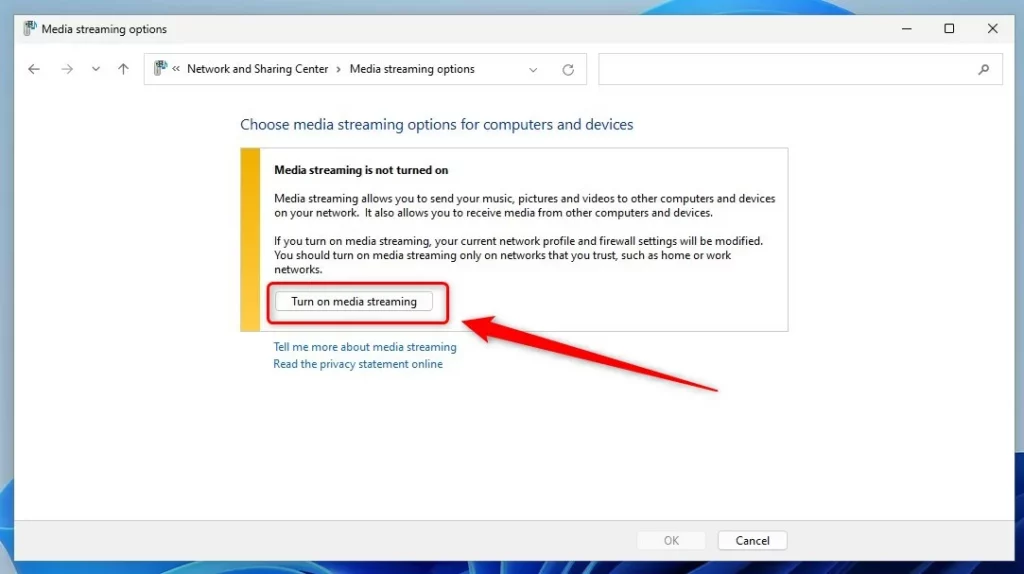
Only do this on a network you trust, like your home Wi-Fi.
If you ever connect the PC to a shared or public network, go back to this window and turn media streaming off, or use Block All as described in the next section.
How to block or allow specific devices
Blocking or allowing specific DLNA devices in Windows 11 gives you full control over which TVs, speakers, and game consoles can reach your personal files. Open the media streaming settings list to choose whether to allow all devices, block all devices, or check individual boxes for specific gadgets.
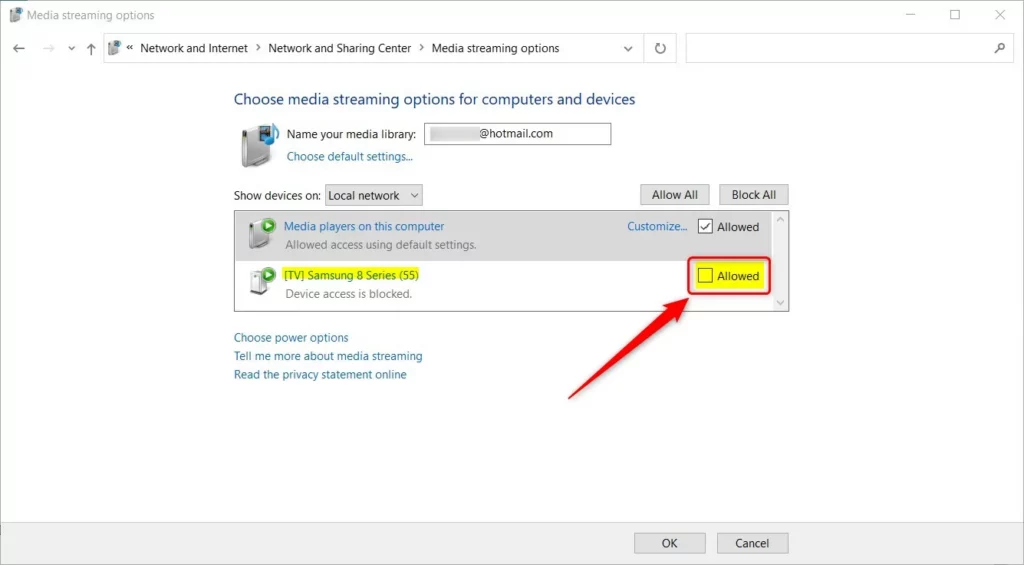
To get to the list, reopen Media streaming options as in the previous section. Each device appears with a check box and a name. Make your choices, then click OK. The three options work like this:
- Allow AllGives every device on your network access to your media. This is quick, but it includes devices you may not recognize, so check the list first.
- Block AllStops all devices from accessing your media. Use this when you want to shut off sharing without turning the feature off. You can allow devices again at any time.
- Individual ControlFind the device in the list. Uncheck the Allowed box to block that specific device. Check the box again to let it back in.
If a device you expect is missing from the list, make sure it is powered on and connected to the same network as the PC. Then confirm that Network discovery is on and reopen the window.
If you do not recognize a device name, it may be a phone, a TV, or another PC on your network. Block it, and unblock it later if something stops working.
Advanced Troubleshooting and Registry Settings
Advanced troubleshooting for DLNA device access in Windows 11 involves checking that background services like SSDP Discovery (a service that finds networked devices) are running properly. To check, open Services from the Start menu search, find SSDP Discovery in the list, and look at the Status column. If it is not running, open its properties and start it. Setting the startup type to Manual or Automatic is the usual fix if it was disabled.
If problems continue, you can check the registry path 🗝️HKEY_LOCAL_MACHINE\
For those comfortable with more advanced settings, the registry path for media sharing is: HKEY_LOCAL_MACHINE\SOFTWARE\Microsoft\Windows\CurrentVersion\Media Center. Be careful: Changing the registry incorrectly can cause problems with your system.
Before you edit anything, back up the key. In Registry Editor, right-click the key, choose Export, and save the file somewhere safe. If a change causes trouble, double-click the saved file to restore the old values. The key may not exist on every PC, so do not create it unless you have a specific reason. Restart the PC after any registry change.
Summary
By using the Media streaming options in the Control Panel, you can keep your media library accessible to your favorite devices while keeping unwanted devices blocked. Enabling Network Discovery and managing your device list ensures a safe and reliable streaming experience on Windows 11.
Review the device list every so often, especially after you add new TVs, consoles, or speakers. If anything looks unfamiliar, uncheck it or use Block All.
Have a question about this guide?
Answered by AI from this guide. Good questions may be added to this page — please don't include personal details.
Did this guide fix your problem?

About the Author
Richard
Tech Writer, IT Professional
Richard is a writer at Geek Rewind who turns complex IT tasks into clear, step-by-step guides. He draws on years of hands-on experience in system administration and enterprise IT operations, focusing on Windows, Linux and WordPress: the problems people actually run into, and the fixes that work. His server and WordPress guides come from systems he runs himself. Richard builds and maintains the platform behind Geek Rewind, from its Ubuntu servers and Nginx configuration to its custom WordPress plugins. Many new tutorials start with readers' questions, and he's always glad to answer them in the comments.
[…] If a device is on the list you don’t want to stream to or allow access to your Windows machine, you can selectively block access to your shared resources. […]