How to Enable or Disable OneDrive Screenshot Saving in Windows 11

OneDrive screenshot saving is a Windows 11 feature that backs up the pictures you capture with the Print Screen key to your cloud storage at Pictures\Screenshots. Your captures then open on any other device signed in to the same account. The cost is space. Screenshots add up fast, and they can quickly fill the free 5 GB that comes with a Microsoft account.
Turn the setting on to send your captures to the cloud. Turn it off to keep them only on your PC. You can switch between the two at any time, and the choice only affects screenshots taken after you change it. Files already uploaded stay in OneDrive until you delete them.
Open the OneDrive cloud icon in your taskbar, click Help & Settings, select Settings, go to the Sync and backup tab, and toggle Save screenshots I capture to OneDrive on or off. The change takes effect immediately without restarting Windows.
OneDrive Folder Backup vs. Screenshot Auto-save
Screenshot auto-save sends your captured images straight to your OneDrive folder. It is not the same as OneDrive Folder Backup, also known as Known Folder Move. That feature syncs your whole Desktop, Documents, and Pictures folders to the cloud.
The two settings are separate, so you can use one without the other. If you only want to stop screenshots from using cloud space, you do not need to turn off folder backup.
Steps to Enable or Disable OneDrive Screenshot Saving
The steps below show how to open that window and find the toggle. You must be signed in to OneDrive with your Microsoft account. If the cloud icon is missing altogether, OneDrive is not running or not signed in. Start it from the Start menu first. The steps are the same on Windows 11 Home and Pro.
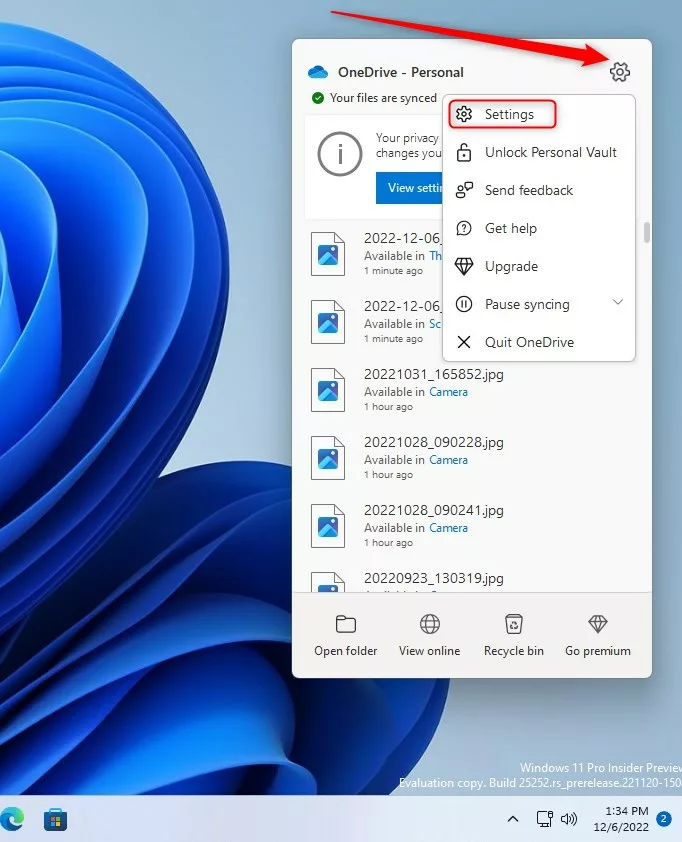
- Click the OneDrive cloud icon in the taskbar notification area . If you don’t see it, click the arrow icon (Show hidden icons) to reveal it. A OneDrive panel opens showing your sync status.

- Click the Help & Settings gear icon in the top-right corner of the panel, then select Settings. The OneDrive settings window opens.
- Select the Sync and backup tab on the left. The backup and sync options for your account appear on the right. On some OneDrive versions the screenshot toggle sits under Advanced settings on this tab, so expand that section if you don’t see it right away.
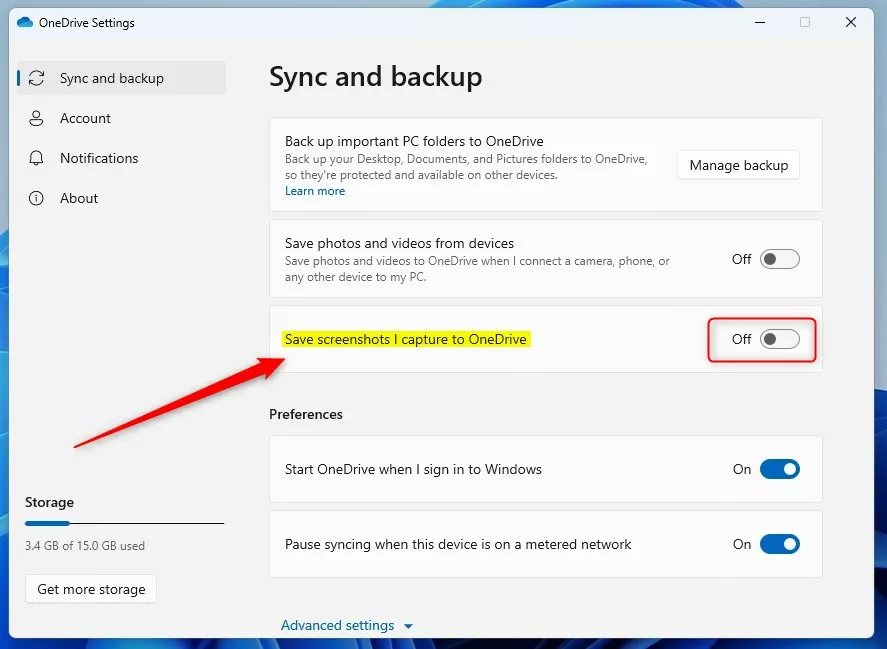
Find the Save screenshots I capture to OneDrive toggle. It decides whether your screenshots upload to OneDrive storage.
- Switch it On to save your screenshots to OneDrive.
- Switch it Off to stop saving them there. New screenshots then stay on your PC only.
The change applies right away. You don’t need to restart Windows. To undo it, return to the same tab and flip the toggle back. If the toggle is missing, update OneDrive and make sure you are signed in with the account you want to use. Some work or school accounts may have this option managed by an administrator.
Troubleshooting OneDrive Sync Issues
Sometimes screenshots keep going to the cloud even after you switch the toggle off. Work through the simple fixes first. Restart the OneDrive app by choosing Help & Settings and then Quit OneDrive, then start it again from the Start menu. Check for pending Windows and OneDrive updates, since a bug in an older build can cause this. Then open the settings again and confirm the toggle really is off.
The Registry Editor is the central database where Windows stores its settings. You can use it to force the change by updating the specific values linked to your account. Editing the registry can break things if you change the wrong entry, so back up the key before you touch it. The items below cover the details.
- Restart OneDriveRight-click the icon, select Quit OneDrive, then open it again from the Start menu.
- Check for UpdatesEnsure your OneDrive sync client is up to date.
- Registry CheckFor advanced users, check the registry. Warning: Modifying the registry incorrectly can cause system issues. Press Win+R, type
regedit, and navigate toHKEY_CURRENT_USER\Software\Microsoft\OneDrive. Ensure theAutoSaveCameraPhotosvalue is set to 0.
Summary
Managing this setting lets you decide where your captured images live. They can stay on your computer or sync to the cloud. This is a different thing from a full folder backup, so check both settings if your OneDrive storage is filling up faster than you expect.
Have a question about this guide?
Answered by AI from this guide. Good questions may be added to this page — please don't include personal details.
Did this guide fix your problem?

About the Author
Richard
Tech Writer, IT Professional
Richard is a writer at Geek Rewind who turns complex IT tasks into clear, step-by-step guides. He draws on years of hands-on experience in system administration and enterprise IT operations, focusing on Windows, Linux and WordPress: the problems people actually run into, and the fixes that work. His server and WordPress guides come from systems he runs himself. Richard builds and maintains the platform behind Geek Rewind, from its Ubuntu servers and Nginx configuration to its custom WordPress plugins. Many new tutorials start with readers' questions, and he's always glad to answer them in the comments.
No comments yet — be the first to share your thoughts!