How to Enable Updates for Edge on Metered Connections


Edge updates itself in the background, and on a metered connection that can use up a limited data allowance. This guide shows two ways to control whether Edge may download updates over a metered connection: the browser’s own settings, and the Windows Registry.
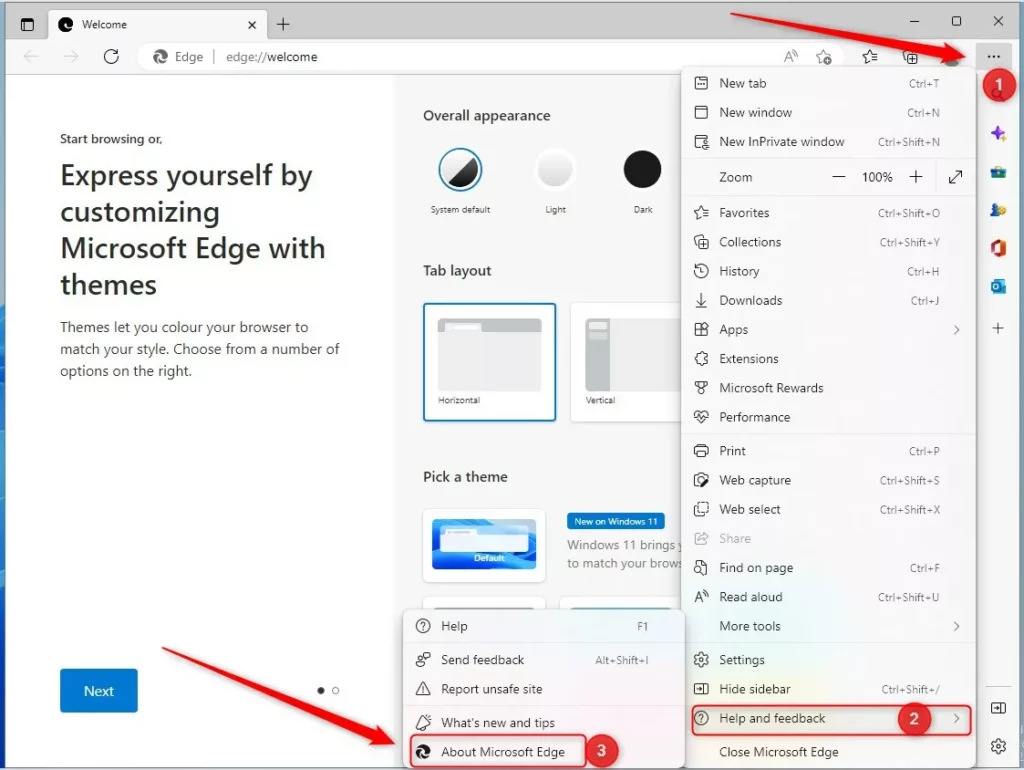
Open Microsoft Edge, click the three-dot menu, select Help and feedback, then About Microsoft Edge. Find the toggle for Download updates over metered connections and switch it On to allow updates on metered networks.
What is Microsoft Edge?
Microsoft Edge is the web browser that comes with Windows 11. It is built on the same engine as Google Chrome, and it also runs on Windows 10, Linux, and macOS.
By default, Edge checks for and installs the latest updates automatically. You can also check for updates by hand whenever you want. The About page described below is where you do that.
Why Control Updates on Metered Connections?
Edge updates download in the background, and they can eat into your allowance and cost extra.
Allowing updates on metered networks keeps the browser patched and current, which is good for security. The trade-off is data use. If your plan is tight, leave the setting off and update Edge when you are on an unmetered network. If you are not sure whether Windows treats your connection as metered, check Settings Network & internet, open your Wi-Fi or Ethernet connection, and look at the Metered connection switch.
Method 1Enable Updates Through Microsoft Edge Settings
Step 1Open Microsoft Edge
- Click the Edge icon on the taskbar . Or open the Start menu and type “Microsoft Edge” in the search box.
- Select Microsoft Edge from the results if you used search.
The browser window should now be open.
Step 2Go to Settings
- Click the three-dot menu button (Settings and more) in the top right corner of the window.
- Select Help and feedback.
- Click About Microsoft Edge.
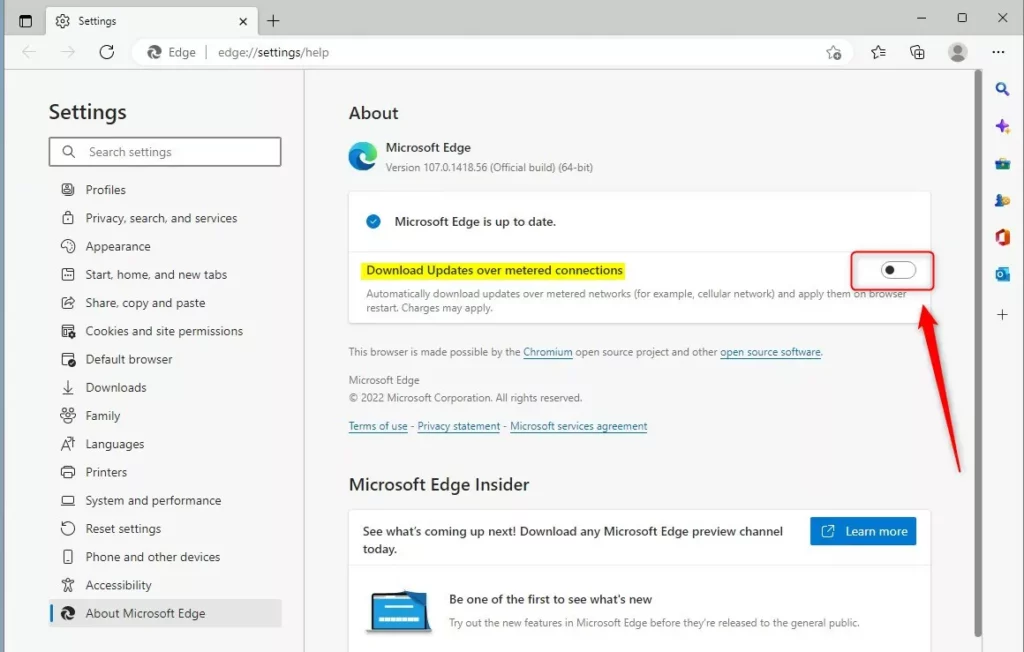
The About page opens. Edge may start checking for updates as soon as the page loads, so you may see a short progress message.
Step 3Turn Updates On or Off
- Find the toggle switch for updates over metered connections on the About Microsoft Edge page. It is labeled Download updates over metered connections.
- Switch the toggle On to allow Edge to download updates whatever the connection type.
- Switch it Off to limit updates to unmetered networks.
The change applies straight away, and there is no Save button. To undo it, flip the toggle back. If the toggle is missing or greyed out, your PC may be managed by an organization that sets Edge policies. In that case you will usually see a "managed by your organization" notice, and you will need to ask your administrator.
Step 4Close Microsoft Edge
- Close the browser window.
Your choice is saved. You do not need to restart Windows for this method.
Method 2Enable Updates Using Windows Registry
You can also change the Edge update setting in the Windows Registry. The Registry is a database that stores low-level settings for Windows and its programs. The setting lives under the HKEY_LOCAL_MACHINE\SOFTWARE\Microsoft\EdgeUpdate path. This method gives you more direct control over update behavior than the browser interface does. It is also the method to use if you manage several PCs or want the setting applied for all users.
Step 1Open Registry Editor
⚠️ Admin Required
You need an administrator account to change this key. To open the tool, search for "Registry Editor" in the Start menu, then choose Run as administrator. Click Yes if User Account Control asks for permission.
It opens to the folder path HKEY_LOCAL_MACHINE\SOFTWARE\Microsoft, and from there you can change system configuration that affects how Windows operates. A wrong change can cause problems, so back up first. Select File Export, choose All as the export range, and save the file somewhere safe. Registry editing works the same on Windows 11 Home and Pro.
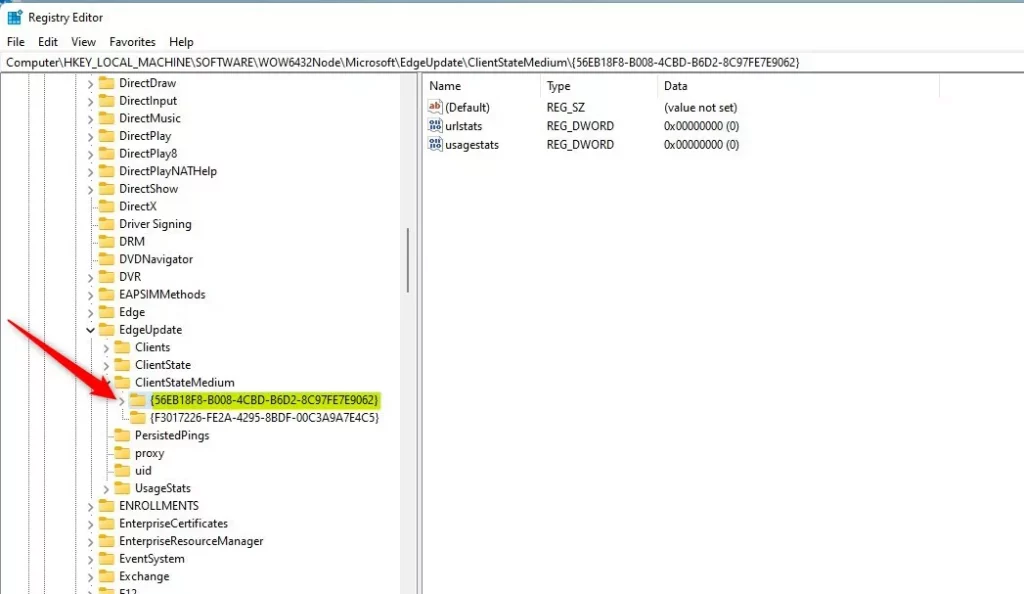
HKEY_LOCAL_MACHINE\SOFTWARE\WOW6432Node\Microsoft\EdgeUpdate\ClientStateMedium\{56EB18F8-B008-4CBD-B6D2-8C97FE7E9062}Step 2Create the Folder (If Needed)
Go to the {56EB18F8-B008-4CBD-B6D2-8C97FE7E9062} folder, which sits under ClientStateMedium inside the EdgeUpdate key.
If the {56EB18F8-B008-4CBD-B6D2-8C97FE7E9062} folder is missing, create it:
- Right-click ClientStateMedium.
- Choose New Key.
- Name the new key {56EB18F8-B008-4CBD-B6D2-8C97FE7E9062}, then press Enter.
A key is the Registry's version of a folder, so the new key should now appear under ClientStateMedium.
Step 3Create a New Value
- Click the {56EB18F8-B008-4CBD-B6D2-8C97FE7E9062} folder so it is selected.
- Right-click an empty space in the right-hand pane.
- Select New DWORD (32-bit) Value.
- Name the new entry MeteredConnectionUpdates.
The new entry appears in the right-hand pane with a default value of 0.
Step 4Set the Value
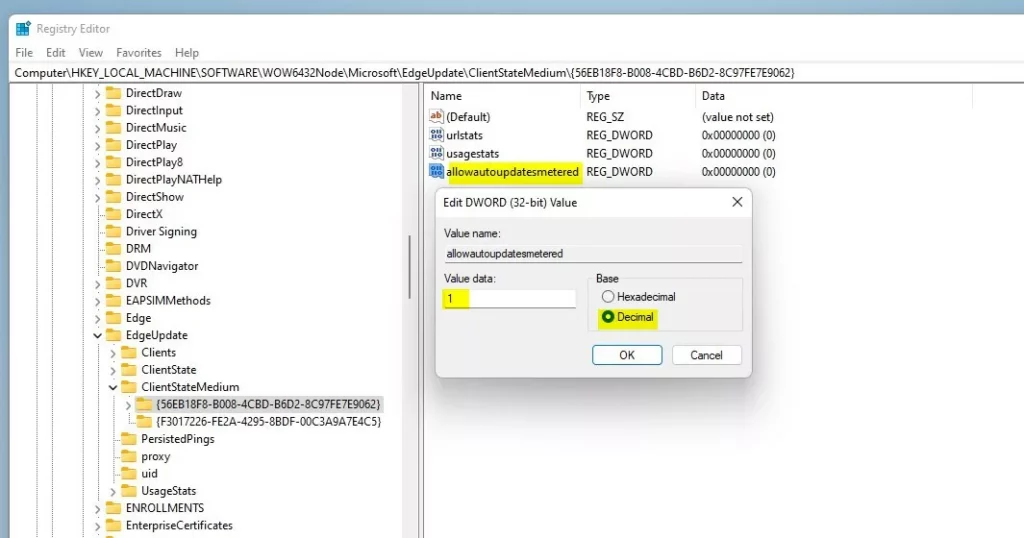
- Double-click the new
allowautoupdatesmeteredentry. - Enter the number you want in the Value data box:
- 1 = Turn on updates over metered connections
- 0 = Turn off updates over metered connections
- Click OK.
The entry now shows your value in the Data column. Close the Registry Editor when you are done. If the change does not seem to take effect, close and reopen Edge, and restart the PC if needed. To undo it, set the value back to 0, or import the backup you exported earlier.
Summary
You can manage Edge updates on metered connections in the browser settings, or in the Windows Registry if you want more control. Turning on metered updates keeps Edge current but uses more data. For a limited data plan, turning the feature off is the better choice. Pick the option that best fits your monthly data limit.
- Use the Edge browser settings for a quick, easy change
- Use the Windows Registry for more advanced control
In short, enabling metered updates keeps Edge up to date but costs extra data. Turn it off if your plan is limited, and update Edge by hand when you are on an unmetered connection.
Have a question about this guide?
Answered by AI from this guide. Good questions may be added to this page — please don't include personal details.
Did this guide fix your problem?

About the Author
Richard
Tech Writer, IT Professional
Richard is a writer at Geek Rewind who turns complex IT tasks into clear, step-by-step guides. He draws on years of hands-on experience in system administration and enterprise IT operations, focusing on Windows, Linux and WordPress: the problems people actually run into, and the fixes that work. His server and WordPress guides come from systems he runs himself. Richard builds and maintains the platform behind Geek Rewind, from its Ubuntu servers and Nginx configuration to its custom WordPress plugins. Many new tutorials start with readers' questions, and he's always glad to answer them in the comments.
No comments yet — be the first to share your thoughts!