How to Back Up Important Folders to OneDrive in Windows 11

Backing up important folders to OneDrive in Windows 11 saves copies of your files to Microsoft’s cloud. Your photos, documents and other key files stay safe and are available from any device where you sign in to the same Microsoft account.
The OneDrive backup feature lets you pick specific folders on your PC, such as Documents, Desktop and Pictures. Once you turn it on, OneDrive moves those folders into your OneDrive and keeps them in sync. Any change you make to a file in them is uploaded as soon as you are online.
This protects you from a failed drive, a lost laptop or an accidental deletion. You can set up basic backup in a few minutes. The steps below cover where to find it, how to check it works, and how to fix it when it doesn’t.
Open OneDrive from the taskbar or Start menu , click the gear icon, select Settings, then Sync and backup, and click Manage backup. Toggle On the folders you want to back up—Documents, Pictures, Desktop—and click Save changes. OneDrive uploads them to your Microsoft account immediately.
OneDrive Backup vs. Windows Backup
OneDrive folder backup and Windows Backup do different jobs, and many people mix them up.
- OneDrive backup covers your everyday files, such as documents, photos and desktop items. It keeps them synced and safe in the cloud.
- Windows Backup saves your system settings and your list of installed apps, so you can restore a whole PC to a new setup.
Windows Backup does not replace your files, and OneDrive does not bring back your settings.
| Feature | OneDrive Backup | Windows Backup Utility |
|---|---|---|
| Purpose | File Syncing | System Recovery |
| Storage | Microsoft 365 Cloud | Microsoft Account Cloud |
| Access | Anywhere | During PC Setup |
Manage OneDrive Backup in 🪟 Windows 11
The OneDrive backup settings control which folders sync automatically to your cloud storage. From the OneDrive app you can turn folder protection on or off, check how much storage you have left, and pick specific folders such as Documents or Pictures.
Before you start, check two things:
- You are signed in to OneDrive with your Microsoft account. The cloud icon in the taskbar should not show an error or a sign-in prompt.
- You have enough space. A free Microsoft account includes 5 GB, which fills up quickly if you back up Pictures and Videos. A Microsoft 365 subscription includes 1 TB.
Folder backup works the same on Windows 11 Home and Pro. On a work or school PC, your organization may control this setting, and the options can be missing or greyed out. In that case, ask your IT administrator.
OneDrive is built into Windows 11, so you usually don't need to install anything. Use any one of these ways to open it:
- Click Start, type OneDrive, and select the app from the results.
- Or click the cloud icon in the Taskbar. If you don't see it, click the arrow to open the Taskbar overflow, where it is often hidden.
- Or launch the program directly from C:\Program Files\Microsoft OneDrive\OneDrive.exe.
You should see the OneDrive window, or a small panel above the taskbar showing your sync status. If OneDrive asks you to sign in, do that first. If the path above doesn't exist on your PC, OneDrive may be installed for your user account only, so use the Start menu method instead.

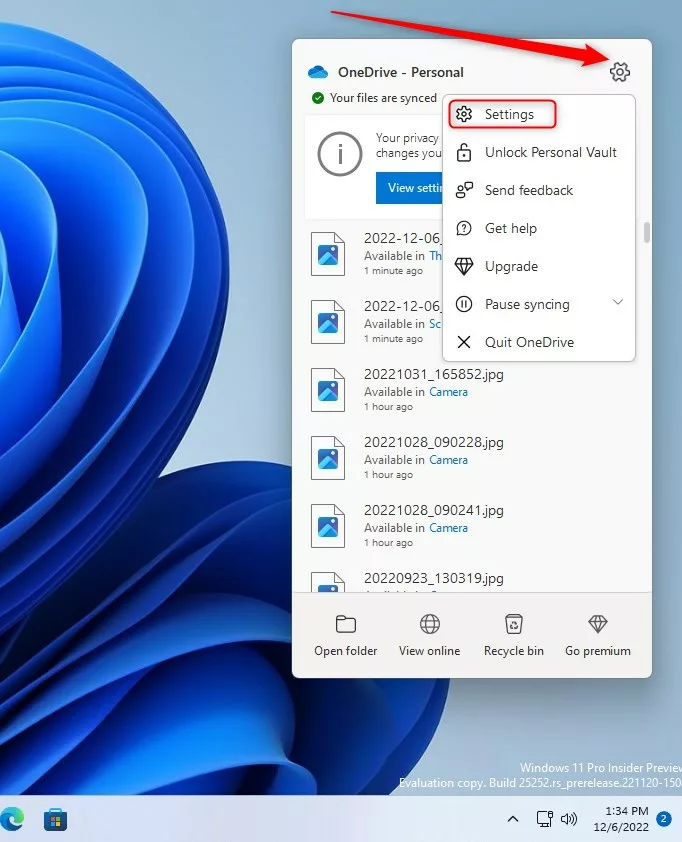
- When the OneDrive window opens, click the Help & Settings (gear) icon in the top-right corner.
- Select Settings from the menu.
A separate Settings window should open with a list of sections down the left side.
- In the Settings window, open the Sync and backup section.
- Click the Manage backup button.
A window opens with the folders you can back up. If you can't find the button, update OneDrive and make sure you are signed in. Older versions of OneDrive show this under a Backup tab instead.

You will see a list of folders such as Documents, Pictures, Desktop, Music and Videos. Depending on your OneDrive version, you may also see others, such as Screenshots or Camera Roll.
- Find each folder you want to protect.
- Use the toggle to turn backup On for it, or Off for folders you want to leave out.
- Click Save changes if the window asks for it. OneDrive then starts uploading.
You can keep working while it runs. If a folder is bigger than your free space, OneDrive warns you. Turn that folder off or buy more storage.
To undo this later, open the same window and turn the folder to Off. Windows shows a prompt asking you to confirm. Files already uploaded stay in OneDrive, and the folder on your PC may look empty. Open your OneDrive folder and move them back if you need them locally.

Verifying Your Sync
To check that your files are syncing, open File Explorer and look at the small status icon next to each file or folder.
- A solid green circle with a white checkmark means the file is saved on your device and in the cloud.
- A blue icon means the file is syncing right now. Wait for it to finish before you shut down.
- A cloud outline means the file is online-only and doesn't take up space on your PC.
You can also click the OneDrive icon in the Taskbar. It shows whether syncing is up to date or paused, and how many files are left. If it says Sync paused, it may be because of battery saver or a metered connection. Resume it from the same panel.
Restoration Process
If you lose or overwrite a file, you can often get it back.
- Right-click the file in your OneDrive folder. On Windows 11 you may need to choose Show more options first.
- Select Version history.
- Pick the older version you want and restore it.
This lets you restore earlier versions of your work. For deleted files, sign in to the OneDrive website and open the Recycle Bin there to recover them. Deleted items stay in the Recycle Bin for a limited time, so check soon after you notice the loss.
Troubleshooting Common Errors
Most OneDrive backup errors in Windows 11 have simple causes. Work through these checks in order:
- Check file permissions. Make sure your account can read and change the files and folders that fail.
- Close any programs that are using those files. An open file can block a sync until it is closed.
- Confirm you are signed in to your Microsoft account in OneDrive.
- Check that you have free storage left in your OneDrive.
- If syncing is still stuck, reset the OneDrive app. This can clear stuck sync problems and get your files uploading again.
A reset does not delete your files. OneDrive may take a while to recheck everything afterward, so give it time before you judge whether it worked.
OneDrive uses special file links called reparse points and junction points to connect your local folders with the cloud. If these become corrupted, reset the app, as described above.
Also keep in mind that there is a limit to how long a file's path (its address) can be. If a file's path goes over 260 characters, it won't sync. To fix this, shorten the file name or move the file to a folder nearer the top of the folder tree. You can also shorten the names of the folders it sits in.
Summary
In summary, OneDrive backup in Windows 11 protects your important data by syncing files to the cloud automatically. Once it is on, there is little to maintain. Remember to check the sync status now and then, and watch your storage limit, especially on a free account. Backing up Pictures and Videos is the usual way people run out of space.
Have a question about this guide?
Answered by AI from this guide. Good questions may be added to this page — please don't include personal details.
Did this guide fix your problem?

About the Author
Richard
Tech Writer, IT Professional
Richard is a writer at Geek Rewind who turns complex IT tasks into clear, step-by-step guides. He draws on years of hands-on experience in system administration and enterprise IT operations, focusing on Windows, Linux and WordPress: the problems people actually run into, and the fixes that work. His server and WordPress guides come from systems he runs himself. Richard builds and maintains the platform behind Geek Rewind, from its Ubuntu servers and Nginx configuration to its custom WordPress plugins. Many new tutorials start with readers' questions, and he's always glad to answer them in the comments.
[…] can automatically back up your essential folders (your Desktop, Documents, and Pictures folders) on your device with […]
[…] can automatically back up your essential folders (your Desktop, Documents, and Pictures folders) on your device with the OneDrive […]
[…] can automatically back up your essential folders (your Desktop, Documents, and Pictures folders) on your device with the OneDrive […]
[…] can automatically back up your essential folders (your Desktop, Documents, and Pictures folders) on your device with the OneDrive […]
[…] can automatically back up your essential folders (your Desktop, Documents, and Pictures folders) on your device with the OneDrive […]
[…] By default, your device’s essential folders (your Desktop, Documents, and Pictures folders) will automatically be backed up to Microsoft cloud online. […]
[…] can automatically back up your essential folders (your Desktop, Documents, and Pictures folders) on your device with the OneDrive […]
[…] can automatically back up your essential folders (your Desktop, Documents, and Pictures folders) on your device with […]
[…] By default, your device’s essential folders (your Desktop, Documents, and Pictures) will automatically be backed up to Microsoft cloud online. […]
[…] By default, your device’s essential folders (your Desktop, Documents, and Pictures folders) will automatically be backed up to Microsoft cloud online. […]
[…] can even automatically back up important folders like Desktop, Documents, and Pictures to OneDrive. This keeps your files safe and synced on all […]
[…] files and folders to the cloud. This lets you reach your documents from any device. You can also automatically back up your essential folders your important folders like Desktop and […]
[…] also backs up preferences, such as your language and accessibility choices. If OneDrive is turned on is enabled, your chosen folders will automatically upload to the cloud. What happens when done? […]