How to Enable or Disable Sync In Windows 11


Sync in Windows 11 copies your personal data, including browser passwords, custom desktop themes, and saved Wi-Fi profiles, to the cloud so you can share those preferences across multiple PCs. When sync is on, your saved customizations are applied automatically the first time you sign in to a new computer with the same Microsoft account.
Sync only works with a Microsoft account. If you sign in with a local account, the sync options will be missing or won’t do anything. Sign in with a Microsoft account first.
Disabling sync stops your PC from uploading these preferences to Microsoft servers, so your settings stay on that one device. Data you already uploaded may stay in your Microsoft account until you clear it from the privacy settings of that account. You can turn sync on or off in the Windows 11 Settings app under Accounts and Windows backup.
Press Win+I to open Settings , go to Accounts, select Windows backup, and turn on the switches for Remember my apps and Remember my preferences. Sync activates immediately for your Microsoft account across all your devices.
How to Enable Sync via Windows Settings
The Settings app is the easiest way to enable sync, and it works on both Home and Pro editions. It backs up your apps, passwords, and preferences so they follow you to your other devices. Press Win+I to open Settings , go to Accounts, select Windows backup, and turn on the switches for the items you want to keep synced. The same switches turn sync off.
- Open Settings by pressing Win+I. The Settings window opens with the list of categories on the left.
- Go to Accounts, then select Windows backup. The backup options for your Microsoft account appear on the right. If you don’t see the sync switches, check that you are signed in with a Microsoft account and not a local account.
- Set the switches for Remember my apps and Remember my preferences to On or Off. Use On to sync that category and Off to stop it. Each switch is independent, so you can sync your preferences but not your app list, for example. On current builds, expand Remember my preferences to see and choose individual items such as passwords and language settings. A restart is not normally needed, but the change can take a few minutes to reach your other devices. To undo it, come back here and flip the switch the other way.
Advanced Sync Management for IT Professionals
In managed environments you often need to control sync on many machines at once, or lock it so users can’t change it. Two tools do this: the Local Group Policy Editor (a console for managing Windows policies on a PC) and the Registry. Both need administrator rights. A policy set this way usually makes the matching option in Settings greyed out, which is why you may see a message that some settings are managed by your organization.
Using Local Group Policy Editor (gpedit.msc)
You can manage sync for the whole computer with the Local Group Policy Editor if you have administrator rights. Press Win+R, type gpedit.msc, press Enter, and go to Computer Configuration\Administrative Templates\Windows Components\Sync your settings. The policies in that folder control how Windows handles your personal data.
On Windows 11 Home, gpedit.msc will not open, so use the Registry method further down instead.
- Press Windows + R, type
gpedit.msc, and hit Enter. The Local Group Policy Editor opens. If Windows says it can't find the file, you are on Home edition. - Navigate to
Computer Configuration\Administrative Templates\Windows Components\Sync your settings. Expand each folder in the left pane. The policies in that folder are listed on the right. - Double-click Turn off syncing of settings. A window opens with the policy options. Policy names can differ slightly between Windows builds, so pick the entry that turns off syncing if the wording is not identical.
- Select Enabled to stop sync or Disabled to allow it, then click Apply and OK. The wording is easy to misread: this policy turns syncing off, so Enabled means sync is blocked. Sign out and back in, or restart, so the change applies. To return to the default behavior, set the policy to Not Configured.
Using the Registry Editor (regedit)
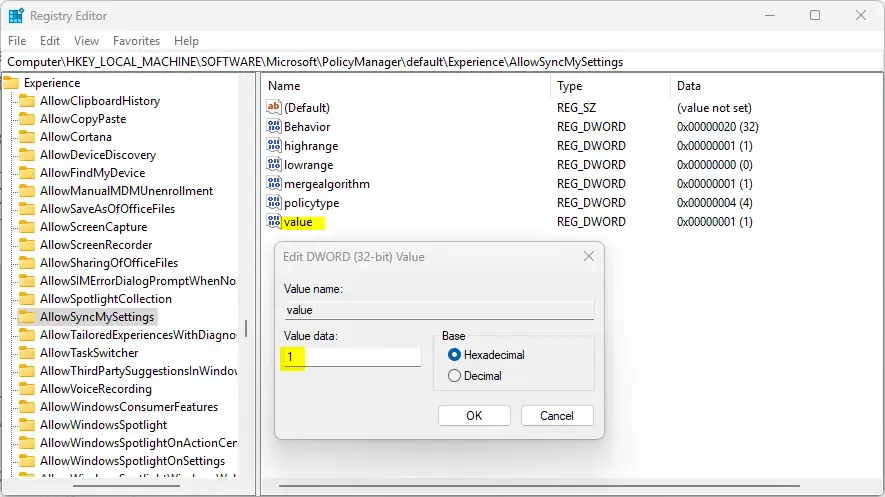
You can force sync on or off by editing the Registry directly. This is the option for Windows 11 Home, which has no Group Policy Editor. Press Windows + R, type regedit, press Enter, and go to HKEY_LOCAL_MACHINE\SOFTWARE\Microsoft\PolicyManager\default\Experience\AllowSyncMySettings. The values there control your sync preferences at the system level.
In Registry Editor, click File and then Export to save a copy of the key you are about to change. Double-clicking the saved file restores it later.
- Press Windows + R, type
regedit, and hit Enter. Click Yes if User Account Control asks for permission. Registry Editor opens. - Navigate to
HKEY_LOCAL_MACHINE\SOFTWARE\Microsoft\PolicyManager\default\Experience\AllowSyncMySettings. You can expand the keys in the left pane or paste the path into the address bar at the top of the window. The values for that key appear on the right. - Double-click the value (REG_DWORD). An edit window opens showing the current Value data.
- Set Value data to
1to enable sync or0to disable it, then click OK. Restart the PC so Windows reads the new value. To undo the change, set the value back or import the .reg file you exported earlier.
Syncing Ecosystems: OneDrive and Edge
Windows 11 sync is separate from services that back up your files or browser data. OneDrive saves your documents and folders, and Microsoft Edge syncs your browser info. Turning off Windows sync does not stop either of them, so manage each one on its own if you want to stop all syncing.
- OneDrive: Click the OneDrive cloud icon in the taskbar notification area, then open its settings from there. You may need to click the up arrow first if the icon is hidden. From the settings you can pause syncing or choose which folders are backed up.
- Edge: In the browser, go to Settings Profiles Sync to switch individual data types on or off, such as favorites, passwords, history, and open tabs. You can also turn off sync entirely for that profile.
Summary
Sync in Windows 11 keeps your settings consistent across your devices. For most people, the Settings app under Accounts and Windows backup is all you need. If you manage several PCs, or run Home edition and need a firmer switch, use the Local Group Policy Editor on Pro or the Registry Editor on any edition. Remember that OneDrive and Edge have their own sync controls.
Was this guide helpful?

About the Author
Richard
Tech Writer, IT Professional
Richard is a writer at Geek Rewind who turns complex IT tasks into clear, step-by-step guides. He draws on years of hands-on experience in system administration and enterprise IT operations, focusing on Windows, Linux and WordPress: the problems people actually run into, and the fixes that work. His server and WordPress guides come from systems he runs himself. Richard builds and maintains the platform behind Geek Rewind, from its Ubuntu servers and Nginx configuration to its custom WordPress plugins. Many new tutorials start with readers' questions, and he's always glad to answer them in the comments.

No comments yet — be the first to share your thoughts!