How to Open Resource Monitor in Windows 11


Resource Monitor is a built-in Windows 11 tool that tracks live performance data for 4 main computer parts: CPU, memory, disk, and network. It shows hardware usage down to the individual process, so you can see which apps are slowing down your PC.
Sluggish performance often comes from a background program using too much memory or processor time. Once you know which task is the heavy one, you can close or restart that app instead of guessing. The tool is included with every edition of Windows 11, Home and Pro alike, so there is nothing to download or install.
Open Resource Monitor by typing “resmon” into the Windows search bar and clicking the result. Alternatively, press Win+R, type “resmon,” and press Enter. You can also access it from the Performance tab in Task Manager .
Open via Start Menu
The fastest way to open this tool is through search. It works the same on Home and Pro, and you never have to remember where the tool is stored.
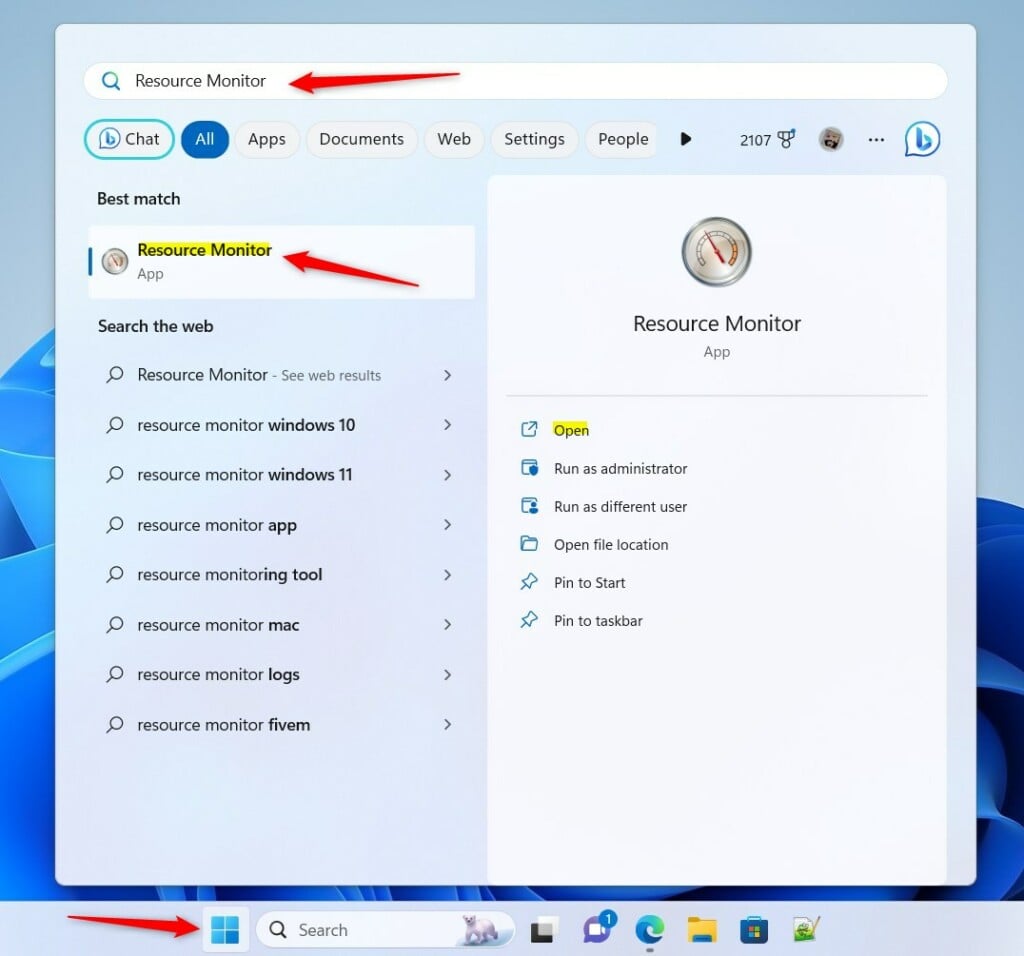
- Click the Start button on the taskbar . The Start menu opens with the search box at the top.
- Type
resmoninto the search box. Results appear as you type, and the app should be listed as the top match. - Click the app in the results to open it. The Resource Monitor window appears with tabs for Overview, CPU, Memory, Disk, and Network.
If the app does not show up, check your spelling and try again. You can also pin it to Start or the taskbar by right-clicking the result and choosing the pin option, which saves you the search next time.
Open via Run Box
Another quick method uses a keyboard shortcut. It is handy when the Start menu is slow to respond because the PC is already under heavy load.
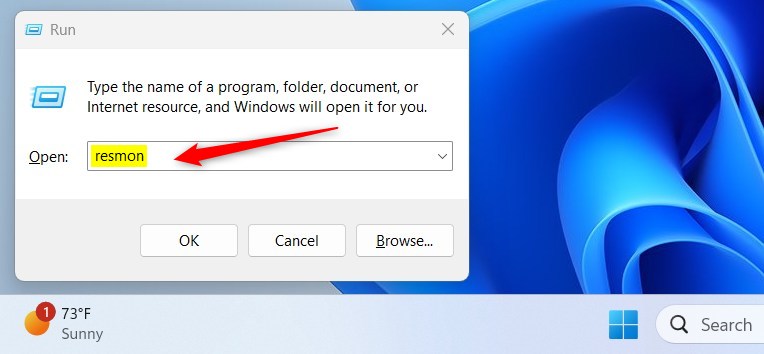
- Press Win+R on your keyboard. The Run dialog opens in the lower-left corner of the screen.
- Type
resmoninto the box. - Press Enter. The Resource Monitor window opens and the Run dialog closes.
If nothing happens, make sure you typed the command with no extra spaces. The same Run box can be used for many other built-in tools.
Open via Task Manager
Task Manager offers a direct launch route for anyone who already has it open. This is useful when you are already looking at a slow app in Task Manager and want more detail. First, open the Task Manager .
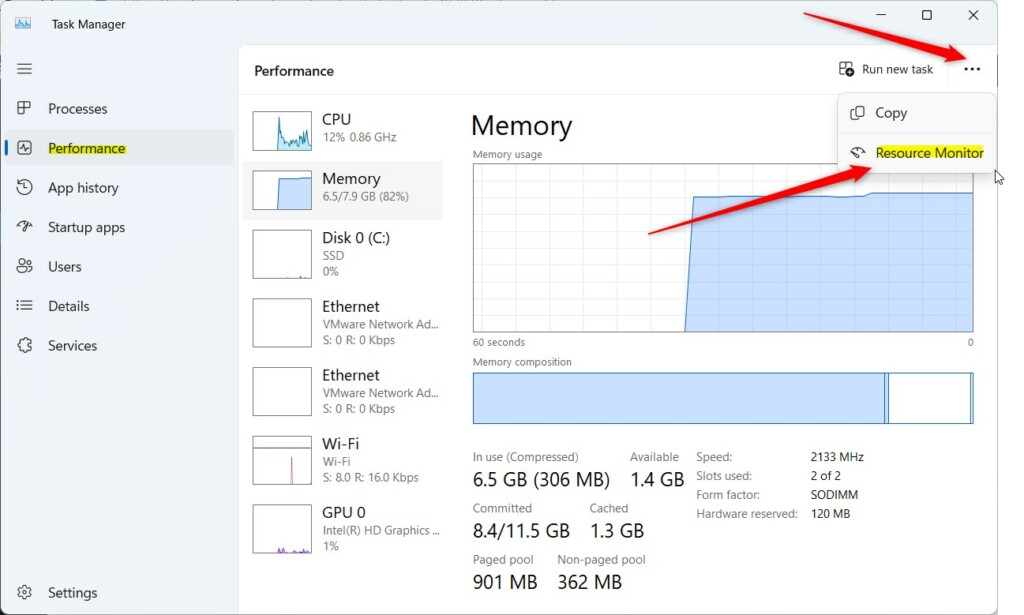
- Click the Performance tab on the left. Live graphs for CPU, memory, disk, and network appear.
- Click the three dots at the top right. A short menu drops down.
- Select Resource Monitor from the list. The Resource Monitor window opens on top of Task Manager .
The layout of Task Manager changed in newer builds of Windows 11. If you cannot find the three dots on your PC, use the Start menu or Run method instead.
Open via Command Line
You can also launch the tool from a command line. Interfaces like Windows Terminal, Command Prompt, or Windows PowerShell work well for this purpose. This is useful for scripts, or when you are already working in a terminal on a remote session.
Open the command-line app of your choice, then type the following command and press Enter. Resource Monitor opens in its own window, and you can keep using the terminal afterward.
resmon.exe
Open via Windows Tools
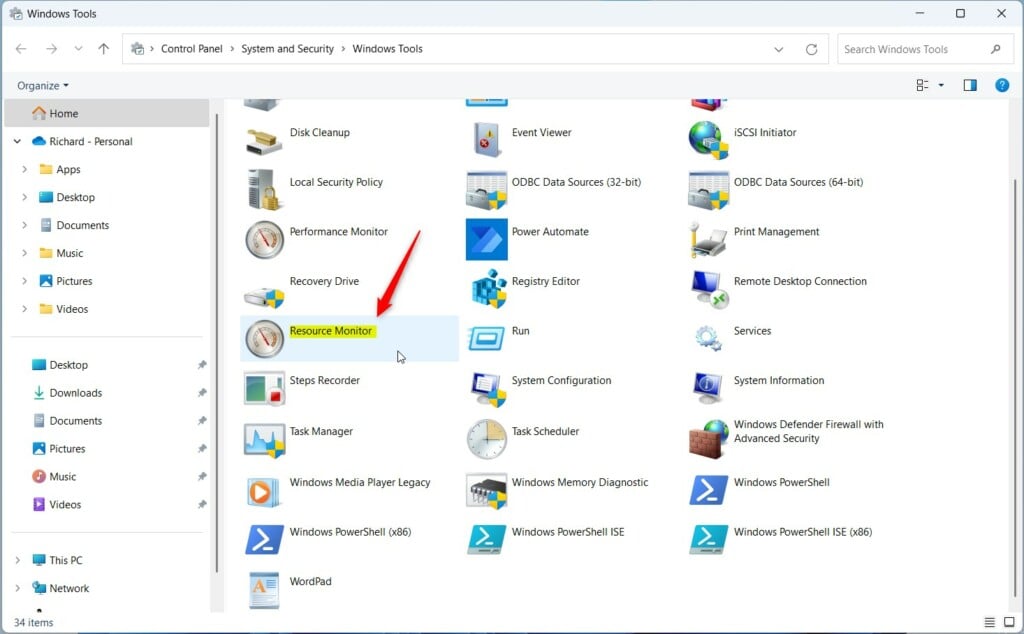
The Windows Tools folder also contains a shortcut to the utility. Open the folder, find the Resource Monitor shortcut in the list, and double-click it to launch the tool. This route is useful if you like browsing a list of admin tools rather than typing.
Task Manager vs. Resource Monitor
| Feature | Task Manager | Resource Monitor |
|---|---|---|
| Usage | Quick overview | Deep analysis |
| Detail Level | Basic | Advanced |
| Real-time | Yes | Yes (More granular) |
Interpreting the Data
Resource Monitor tracks key computer components: the CPU (your PC's processing unit), Memory (its temporary workspace), Disk (where files are stored long-term), and Network (its connection to the internet). Each has its own tab, and the Overview tab shows all four together so you can compare them at a glance.
On any tab, click a column heading such as CPU or Disk to sort the process list. The busiest process rises to the top, which is usually the one to look at first.
Summary
Resource Monitor remains a robust utility for hardware tracking in Windows 11. Whether you launch it from the Start menu, resmon.exe, or Task Manager, the real-time data helps you troubleshoot performance problems. Spotting high disk activity or slow network behavior is the first step toward fixing it, whether that means closing an app, restarting a service, or looking deeper into the cause.
Have a question about this guide?
Answered by AI from this guide. Good questions may be added to this page — please don't include personal details.
Did this guide fix your problem?

About the Author
Richard
Tech Writer, IT Professional
Richard is a writer at Geek Rewind who turns complex IT tasks into clear, step-by-step guides. He draws on years of hands-on experience in system administration and enterprise IT operations, focusing on Windows, Linux and WordPress: the problems people actually run into, and the fixes that work. His server and WordPress guides come from systems he runs himself. Richard builds and maintains the platform behind Geek Rewind, from its Ubuntu servers and Nginx configuration to its custom WordPress plugins. Many new tutorials start with readers' questions, and he's always glad to answer them in the comments.
No comments yet — be the first to share your thoughts!