How to Check RAM on Ubuntu Linux: Step-by-Step Guide

This guide explains how to check your system RAM on Ubuntu Linux in 2026. Knowing your memory specs helps you understand if your computer can handle modern software.
Open Settings, navigate to System, then About, and look for the Memory line to see your total RAM. Alternatively, use the terminal with commands like `free -h` for a human-readable overview or `inxi -m` for detailed specs.
Why check your RAM?
You need to know your RAM size and speed to see if your computer meets the requirements for new apps or games. Understanding your hardware helps you decide if you need an upgrade or if your system is running as well as it should.
What happens when you check your RAM?
You will see exactly how much total memory is installed, how much is currently being used, and details like your RAM speed and manufacturer. This gives you a clear picture of your computer’s performance health.
Check RAM size and speed on Ubuntu Linux
Ubuntu makes it easy to see your basic memory info through the settings menu. In 2026, the layout is streamlined for better access.
To find your RAM size:
- Open the Activities overview and type Settings.
- Alternatively, click the System menu at the top-right corner of your screen and select Settings.
- In the Settings sidebar, click on System.
- Click on the About section.
- Look for the Memory line to see the total RAM installed on your system.
Check system memory using the command line
The terminal offers more detailed information. Modern tools make this process much easier to read than older methods.
Using the ‘free’ command
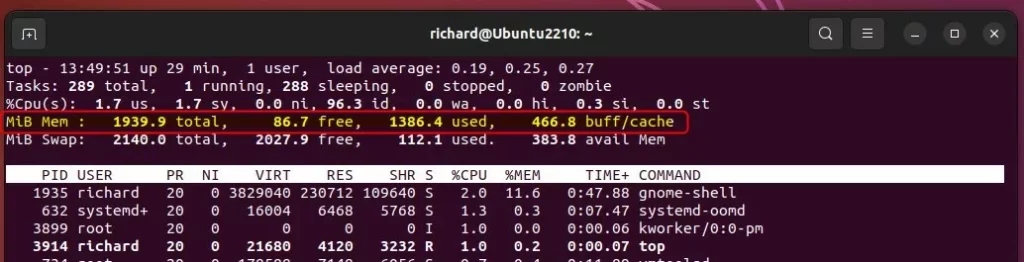
Type free -h in your terminal. This shows your memory in a human-readable format (like GB). You will see a column labeled available. This represents the memory that can be used by apps immediately without causing the system to swap to the hard drive. It includes memory currently used for page caching, which the system can quickly clear if an app needs more space.
Using ‘btop’ or ‘htop’
For a visual look at your RAM, use btop or htop. These tools provide a live, color-coded dashboard.
Install them by typing: sudo apt install btop or sudo apt install htop.
Once installed, just type btop or htop in your terminal to see your memory usage in real-time.
Using ‘inxi’ for hardware details
To see specific details like your RAM speed, type, and manufacturer, use the inxi command. It is much cleaner than older tools.
Install it with sudo apt install inxi, then run:
inxi -m
This command %📂%LNK0%% provides a readable summary of your memory slots and performance. You can also use sudo lshw -short -C memory %📂%LNK1%% if you prefer a standard system utility to verify hardware configuration.
Conclusion
Checking your RAM is a simple way to stay informed about your computer. Whether you use the System settings for a quick look or the terminal for detailed hardware specs, you now have the tools to monitor your system memory effectively in 2026.
Was this guide helpful?

About the Author
Richard
Tech Writer, IT Professional
Richard, a writer for Geek Rewind, is a tech enthusiast who loves breaking down complex IT topics into simple, easy-to-understand ideas. With years of hands-on experience in system administration and enterprise IT operations, he’s developed a knack for offering practical tips and solutions. Richard aims to make technology more accessible and actionable. He's deeply committed to the Geek Rewind community, always ready to answer questions and engage in discussions.

No comments yet — be the first to share your thoughts!